TL;DR:
- Organizations need to redesign their operating models around AI to achieve significant cost and cycle time reductions.
- Agentic AI systems own entire processes, enabling faster decision cycles and shifting human roles to governance and outcomes.
Organizational agility is defined as an enterprise’s ability to sense change and respond faster than competitors. The role of AI in organizational agility is to act as the engine behind that speed, giving teams the ability to process real-time data, automate complex decisions, and restructure workflows without waiting for top-down approval. Platforms like Hymalaia deploy autonomous AI agents that connect over 50 enterprise tools, including Salesforce, Slack, and SharePoint, to make that responsiveness operational rather than theoretical. Research from BCG in 2026 confirms that organizations redesigning their operating models around AI achieve up to 60% cost reduction and 80% cycle time reduction. That gap between incremental adoption and full redesign is where most enterprises lose ground.

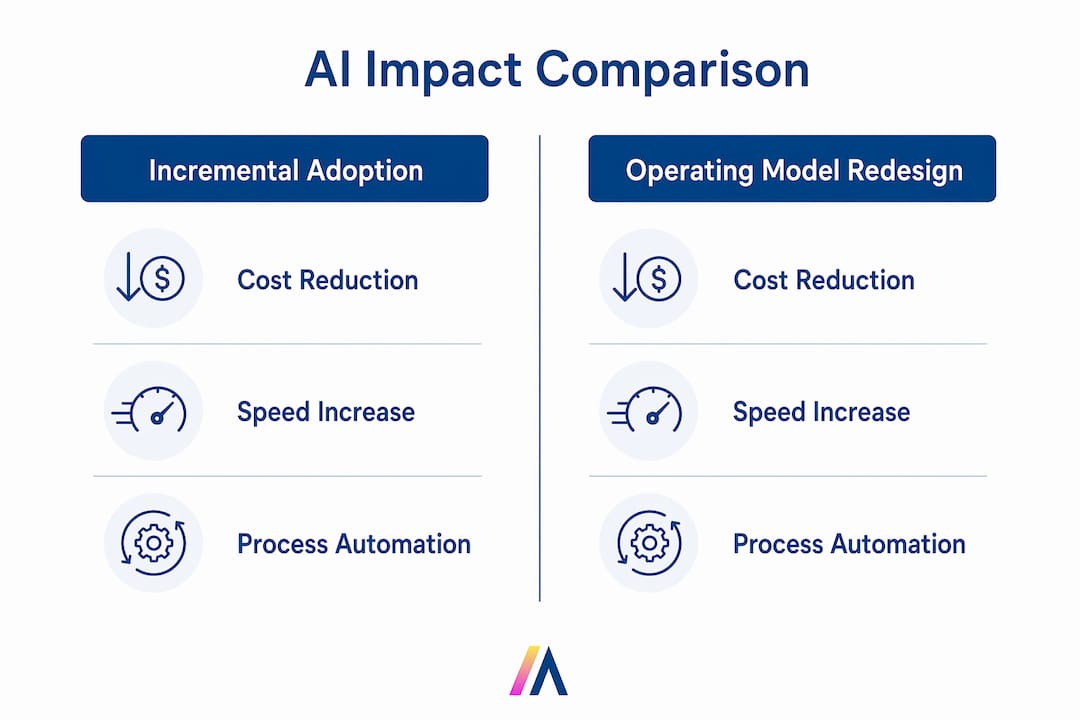
The standard approach to AI adoption fails most organizations. Layering AI tools on top of fragmented systems does not create agility. It amplifies existing inefficiencies. BCG’s 2026 research is direct on this point: superficial AI adoption delivers only 10–20% improvement, while organizations that redesign processes end-to-end achieve results that are three to four times greater.
The alternative is outcome-based redesign. Instead of asking “how can AI help this task,” leaders ask “what outcome do we need, and how do we build backward from it?” This shift produces what BCG calls agentic AI systems: AI agents that own entire process flows, not just individual steps. First-generation agentic AI adopters are already seeing threefold productivity increases, with automation covering 30%–50% of workflows and freeing millions of human hours annually.
Agentic AI is not a chatbot. It is an autonomous system that executes multi-step workflows, monitors outcomes, and adjusts behavior under governance rules. Think of it as a process owner that never sleeps. For business leaders, this means the operating model itself becomes the product of AI design, not just the processes within it.
Pro Tip: Before deploying any AI agent, map your current process from outcome backward. Identify where human judgment is genuinely required versus where it is simply a habit. That distinction determines where agentic AI creates the most value.
The practical implication for enterprise teams is significant. Sales pipelines, support escalations, and operational approvals can all run through AI-human agent networks that own outcomes end-to-end. The human role shifts from executing tasks to governing results.
Traditional org charts are built for control. AI-first organizations need accountability charts built for speed. The difference is not cosmetic. In a command-and-control hierarchy, decisions travel up and down layers before reaching execution. In an accountability chart model, AI agents handle routine execution while humans own outcomes and exceptions.
Microsoft tracks 500,000 AI agents operating across diverse business functions. That number illustrates how quickly the structural shift is happening at scale. The org chart is not disappearing. It is being redrawn around who governs outcomes rather than who manages handoffs.
The impact on decision speed is measurable. Tech companies that replace rigid hierarchies with cross-functional, AI-enabled teams reduce decision cycles by up to 70%. One documented example: new content time-to-market dropped from 20 weeks to 5 weeks after restructuring with AI-augmented teams. That is not an efficiency gain. That is a competitive category change.
| Dimension | Traditional team structure | AI-first team structure |
|---|---|---|
| Decision flow | Top-down through layers | Distributed, outcome-governed |
| Team composition | Function-specific silos | Cross-functional, AI-human networks |
| Execution speed | Weeks to months | Days to hours |
| Human role | Task execution and approval | Judgment, governance, exception handling |
| AI role | Tool support | Autonomous process ownership |
The table above shows why the shift matters for leaders. The question is not whether to restructure. The question is how fast you can do it without losing institutional knowledge in the process.
AI technology alone does not produce agility. Three factors determine whether AI investments translate into real organizational flexibility: technology-management fit, workforce resilience, and data governance.
A study of 300 SMEs found that tech-management fit increases AI effectiveness by 123%. That structural model explains 64% of the variance in organizational agility outcomes. The implication is clear: how well your leadership model aligns with your AI infrastructure matters more than the sophistication of the AI itself.
Workforce resilience is the second factor. The Center for Management Science Research emphasizes that resilient employees better leverage AI to respond rapidly to change. Psychological adaptability, not just technical training, determines how effectively teams use AI tools under pressure. Leaders who invest in AI workforce transformation alongside technology deployment see faster and more durable agility gains.
Data governance is the third factor. In high-functioning AI environments, agility derives from system-level routines and data governance more than top-down control. Without clean, interoperable data infrastructure, AI agents produce unreliable outputs. Without ethical governance frameworks, those outputs create compliance and reputational risk. Solid enterprise AI governance is not a constraint on agility. It is a prerequisite for it.
Pro Tip: Run a workforce readiness audit before your next AI deployment. Measure psychological adaptability alongside technical skills. Teams that score low on adaptability will underperform even with the best AI tools in place.
The 2026 data on AI-driven agility is specific enough to set real expectations. Organizations that move beyond task automation to outcome-based governance with agentic AI report the most significant results across cost, speed, and performance dimensions.
A study of 381 managers found that perceived AI benefits increase agility with a coefficient of 0.4 and organizational performance with a coefficient of 0.3. Agility partially mediates the relationship between AI adoption and performance. That means AI does not improve performance directly in isolation. It does so by first making the organization more agile, and agility then drives performance.
| Impact area | Incremental AI adoption | Operating model redesign |
|---|---|---|
| Cost reduction | 10%–20% | Up to 60% |
| Cycle time reduction | Marginal | Up to 80% |
| Decision cycle speed | Slight improvement | Up to 70% faster |
| Workflow automation coverage | Under 15% | 30%–50% |
| Productivity multiplier | 1.1x–1.3x | Up to 3x |
The numbers in the table above come from BCG’s 2026 research across enterprise organizations. The gap between the two columns is not a matter of degree. It is a matter of approach. Incremental adoption produces incremental results. Structural redesign produces structural advantages.
For leaders assessing where to start, AI-enabled process optimization in high-volume, repeatable workflows delivers the fastest measurable returns. Supply chain coordination, customer support triage, and sales pipeline management are the three areas where agentic AI consistently produces the largest cycle time reductions in the shortest timeframe.
SAP’s 2026 analysis reinforces this: AI creates durable agile value only when deeply embedded into business context, not bolted onto existing systems. The organizations seeing 60% cost reductions did not buy better software. They rebuilt how work flows through their organizations.
AI-driven organizational agility requires structural redesign, not incremental tool adoption, to deliver measurable and lasting competitive advantage.
| Point | Details |
|---|---|
| Redesign over layering | Organizations that redesign operating models around AI achieve up to 60% cost reduction versus 10–20% from superficial adoption. |
| Accountability charts replace org charts | AI agents own routine execution while humans govern outcomes, reducing decision cycles by up to 70%. |
| Tech-management fit is decisive | Aligning leadership models with AI infrastructure increases AI effectiveness by 123% in studied organizations. |
| Workforce resilience amplifies AI gains | Psychologically adaptable employees extract more value from AI tools, especially under conditions of rapid change. |
| Governance enables, not limits, agility | Clean data infrastructure and ethical AI governance are prerequisites for reliable agentic AI performance. |
I have watched organizations spend significant budgets on AI tools and walk away with marginally faster spreadsheets. The pattern is consistent: leadership frames AI as a technology purchase rather than an organizational redesign. The tools get deployed. The processes stay the same. The results disappoint.
The research from BCG, Bain, and SAP in 2026 confirms what I have observed directly. The organizations achieving 60% cost reductions and 70% faster decisions did not find better AI. They rebuilt how decisions get made, who owns outcomes, and where human judgment actually adds value versus where it is just friction in the system.
The hardest part of that redesign is not technical. It is cultural. Leaders have to be willing to eliminate management layers that exist for control rather than value creation. They have to trust AI agents with process ownership in areas where humans have always held authority. That requires a level of organizational confidence that most enterprises have not yet developed.
The change management dimension is where most AI transformations stall. Not because the technology fails, but because the organization was never restructured to use it. My strong view: if your AI deployment does not change your org chart, your governance model, or your workforce development strategy, it will not change your agility either.
Start with one business journey, own it end-to-end with an AI-human team, measure the outcome, and let the results make the case for the next redesign. That is how durable agility gets built.
— Matthieu
Hymalaia is built for exactly the kind of operating model redesign this article describes.
The Hymalaia enterprise platform deploys autonomous AI agents that connect to over 50 enterprise tools, including Salesforce, Slack, Google Workspace, and SharePoint, to unify search, analyze real-time data, and automate complex workflows across sales, support, operations, and product teams. Its retrieval-augmented generation (RAG) engine delivers accurate, context-aware responses grounded in your organization’s actual data. Role-based access controls and GDPR-compliant governance make it deployable in cloud, on-premise, or hybrid environments. For leaders ready to move from incremental AI adoption to full operating model redesign, Hymalaia’s platform features provide the infrastructure to do it at enterprise scale.
AI enables organizational agility by automating routine workflows, accelerating decision cycles, and allowing teams to respond to change faster. Organizations that embed AI into their operating models achieve up to 80% cycle time reduction compared to those using AI as a surface-level tool.
AI-enabled cross-functional teams reduce decision cycles by up to 70% by eliminating approval layers and giving autonomous agents ownership of routine execution. Human leaders focus on governing outcomes and handling exceptions rather than managing handoffs.
Agentic AI refers to autonomous AI systems that own and execute multi-step processes end-to-end under governance rules, rather than simply assisting with individual tasks. This model enables scalable, autonomous execution that drives structural agility rather than incremental efficiency.
Workforce resilience is a critical amplifier of AI’s agility benefits. Research shows that psychologically adaptable employees leverage AI more effectively, and pairing AI deployment with explicit workforce development strategies produces faster and more durable agility gains.
Effective AI governance includes clean data infrastructure, role-based access controls, ethical AI guidelines, and outcome-based accountability models. These practices ensure AI agents produce reliable outputs and that agility gains do not come at the cost of compliance or organizational trust.
