TL;DR:
- AI workforce transformation involves redesigning work through automation, analytics, and continuous learning to enable higher-value tasks for humans. It shifts roles by automating routine tasks, expands roles requiring judgment, and emphasizes organizational change, governance, and employee training. Leaders should prioritize workflow redesign, clear decision rights, ongoing governance, and employee engagement to succeed in AI-driven transformation.
AI-driven workforce transformation is defined as the systematic redesign of how work gets done through automation, intelligent decision support, and continuous learning systems. The role of AI in workforce transformation goes far beyond replacing tasks. It restructures entire workflows, shifts job roles toward higher-complexity work, and creates new demands for human judgment. Enterprise leaders at companies like Salesforce, Google, and IBM are already deploying multi-agent AI systems to automate training, surface real-time insights, and redefine what their people actually do each day. This guide explains what that shift looks like in practice and how to lead it well.
AI automation does not simply eliminate jobs. It redistributes work. Routine, rules-based tasks move to machines, and the remaining human work becomes more complex, more judgment-intensive, and more strategically valuable.

The numbers confirm this shift. Routine clerical job share is expected to drop by 2.19% by 2028 due to AI automation. That decline frees up significant labor capacity, but only organizations that actively redesign roles will capture the productivity gain.
Here is what that role shift looks like across common enterprise functions:
The impact of AI on jobs is not uniform. High-repetition, low-judgment roles face the most disruption. Roles requiring contextual reasoning, stakeholder management, and creative problem-solving are expanding. Understanding enterprise AI automation types helps leaders map which functions are most exposed and which are most ready for augmentation.
Pro Tip: Build a role-by-role task inventory before deploying AI. Identify which tasks are automatable, which require human oversight, and which create new hybrid responsibilities. This exercise prevents reactive restructuring later.
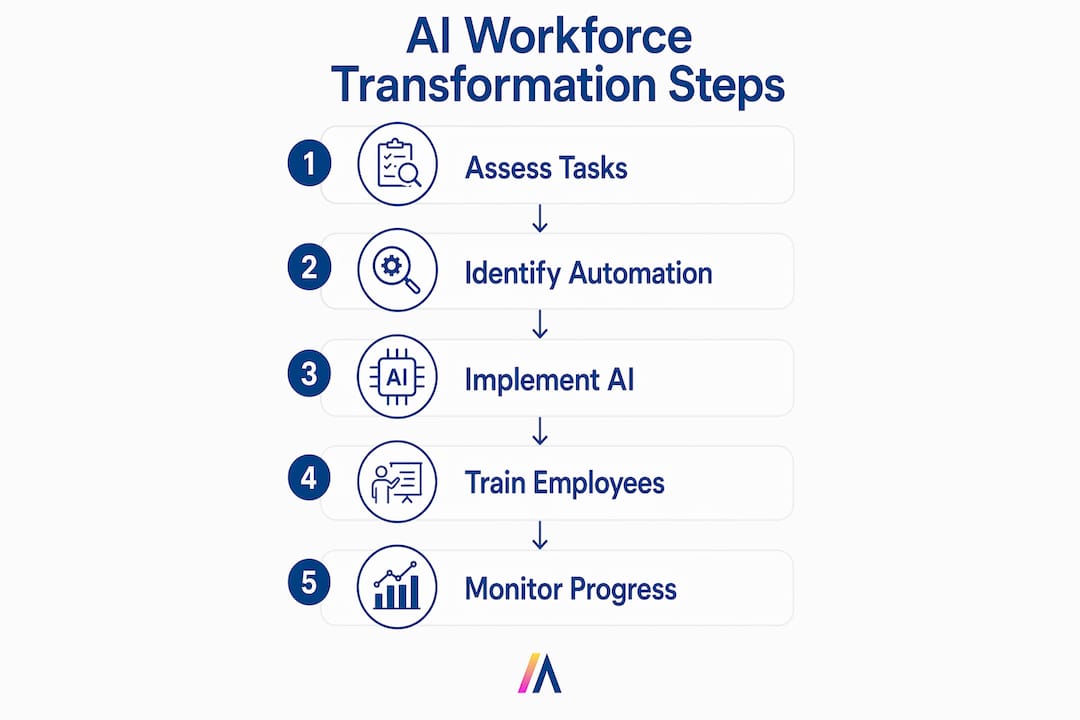
AI in employee training is the fastest-maturing application of AI workforce automation, and the performance gap between AI-driven and traditional approaches is already measurable. AI-personalized learning paths achieve 2x higher course completion rates compared to traditional training methods. That gap exists because AI adapts content to individual skill levels, learning pace, and role context in real time.
The contrast between traditional and AI-driven training is stark:
| Dimension | Traditional Training | AI-Driven Training |
|---|---|---|
| Content delivery | Fixed curriculum, scheduled sessions | Adaptive paths based on role and skill gaps |
| Course creation | Weeks of instructional design effort | 16 minutes per SCORM course with multi-agent RAG |
| Completion rates | Industry average below 30% | Up to 2x higher with personalization |
| Learning continuity | Episodic, event-based programs | Continuous, embedded in daily workflows |
| Feedback loops | Post-course surveys | Real-time performance data and adaptive adjustment |
The 16-minute course generation figure deserves attention. Multi-agent retrieval-augmented generation (RAG) systems can produce SCORM-compliant instructional modules directly from enterprise documents. That means a new product launch, compliance update, or process change can become a deployable training course within the same business day it is approved.
Continuous learning matters more than episodic training. A two-day annual workshop does not build AI fluency. Embedding short, role-specific learning moments into daily workflows through tools like Microsoft Viva, Workday Learning, or a custom RAG-powered knowledge agent does.
Pro Tip: HR leaders should prioritize AI fluency as a core competency, not a technical elective. Build it into onboarding, performance frameworks, and promotion criteria. Employees who understand how AI tools work make better decisions about when to trust AI outputs and when to override them.
Successful AI adoption requires structural changes, not just technology deployment. The role of AI in change management is to surface information faster and reduce decision latency. But the decisions themselves still require human accountability, and that accountability must be explicitly designed into the organization.
CHROs must act as design architects for AI-enabled workflows, clarifying which decisions belong to AI systems and which belong to humans. Without that clarity, accountability gaps form. Teams defer to AI outputs without scrutiny, or they ignore AI recommendations entirely because no one defined when the tool’s judgment should be trusted.
Four structural changes enterprise leaders must make:
“AI transformation is not a technology program. It is a people program with technology as the enabling layer. The organizations that win are the ones that redesign work first and deploy tools second.”
How AI changes work culture depends almost entirely on leadership behavior. If executives use AI tools visibly and talk openly about what those tools do well and where they fall short, adoption accelerates across the organization.
The most common failure mode in AI workforce automation is treating AI as a productivity add-on rather than a reason to redesign workflows from scratch. Deploying AI without workflow redesign stalls productivity gains and creates tool fatigue among employees who see AI as extra work rather than reduced work.
Three pitfalls that consistently derail enterprise AI programs:
Managing employee expectations is equally critical. Workers who fear job loss disengage from AI adoption programs. Leaders who communicate clearly about role evolution, not elimination, see faster and deeper adoption. The role of AI in change management also depends heavily on data maturity. Organizations without organization-specific change data get generic AI outputs that do not reflect their actual workforce dynamics.
Pro Tip: Before scaling any AI tool, run a 90-day pilot with a defined workflow, a specific team, and measurable output metrics. Pilots surface data quality issues, accountability gaps, and adoption friction before they become enterprise-wide problems.
Transformation through AI technology requires a deliberate execution framework, not a series of disconnected tool deployments. The following strategies give enterprise leaders a repeatable approach to building AI-ready organizations.
| Strategy | Primary Metric | Expected Outcome |
|---|---|---|
| AI fluency programs | Completion rate, skill assessment scores | Faster, more confident AI adoption |
| Bottom-up catalysts | Internal champion activity, peer adoption spread | Higher voluntary tool usage |
| Modular governance | Policy compliance rate, incident frequency | Reduced risk, sustained trust |
| Data-driven impact tracking | Adoption rate, decision latency, error rate | Continuous improvement and ROI visibility |
The AI and future of work conversation often focuses on what AI will do to organizations. The more useful question is what organizations will do with AI. That shift in framing, from passive recipient to active architect, is what separates leaders who capture transformation value from those who accumulate technical debt.
AI workforce transformation succeeds when organizations redesign work around AI capabilities, invest in people-side change, and build governance as a continuous function rather than a one-time program.
| Point | Details |
|---|---|
| Workflow redesign is non-negotiable | Deploying AI without redesigning workflows stalls productivity and creates adoption fatigue. |
| People-side change drives most value | 70% of AI transformation value comes from redesigning work and managing trust, not technology alone. |
| Data quality determines AI reliability | Ground AI tools in proprietary organizational data to prevent hallucinations and maintain compliance. |
| CHROs must lead as design architects | HR leaders must define decision rights and embed continuous learning to sustain AI adoption. |
| Governance must be continuous | Treating AI governance as an ongoing process, not a one-time program, sustains long-term transformation. |
The organizations I’ve watched succeed with AI transformation share one counterintuitive trait: they slow down before they speed up. They spend more time mapping workflows and clarifying accountability than they do evaluating tools. The ones that rush to deploy end up managing a portfolio of underused software and frustrated employees.
The cultural shift is harder than any technical integration. Employees do not resist AI because they fear technology. They resist it because no one explained how their role would change or what success looks like in an AI-augmented environment. That communication gap is a leadership failure, not a technology failure.
I’ve also seen organizations underestimate the data problem. An AI agent is only as good as the information it can access. Connecting tools to live, proprietary data sources, rather than generic models, is what separates useful AI from impressive demos. The enterprise AI change management work is unglamorous. It involves governance documents, role redesign workshops, and a lot of difficult conversations about accountability. But that work is exactly what makes the technology pay off.
The future of work is not AI versus humans. It is humans who understand AI versus humans who do not. That gap will define competitive advantage for the next decade.
— Matthieu
Enterprise leaders need more than a point solution. They need a platform that connects AI agents to real organizational data, automates complex workflows, and maintains the governance controls that large organizations require.
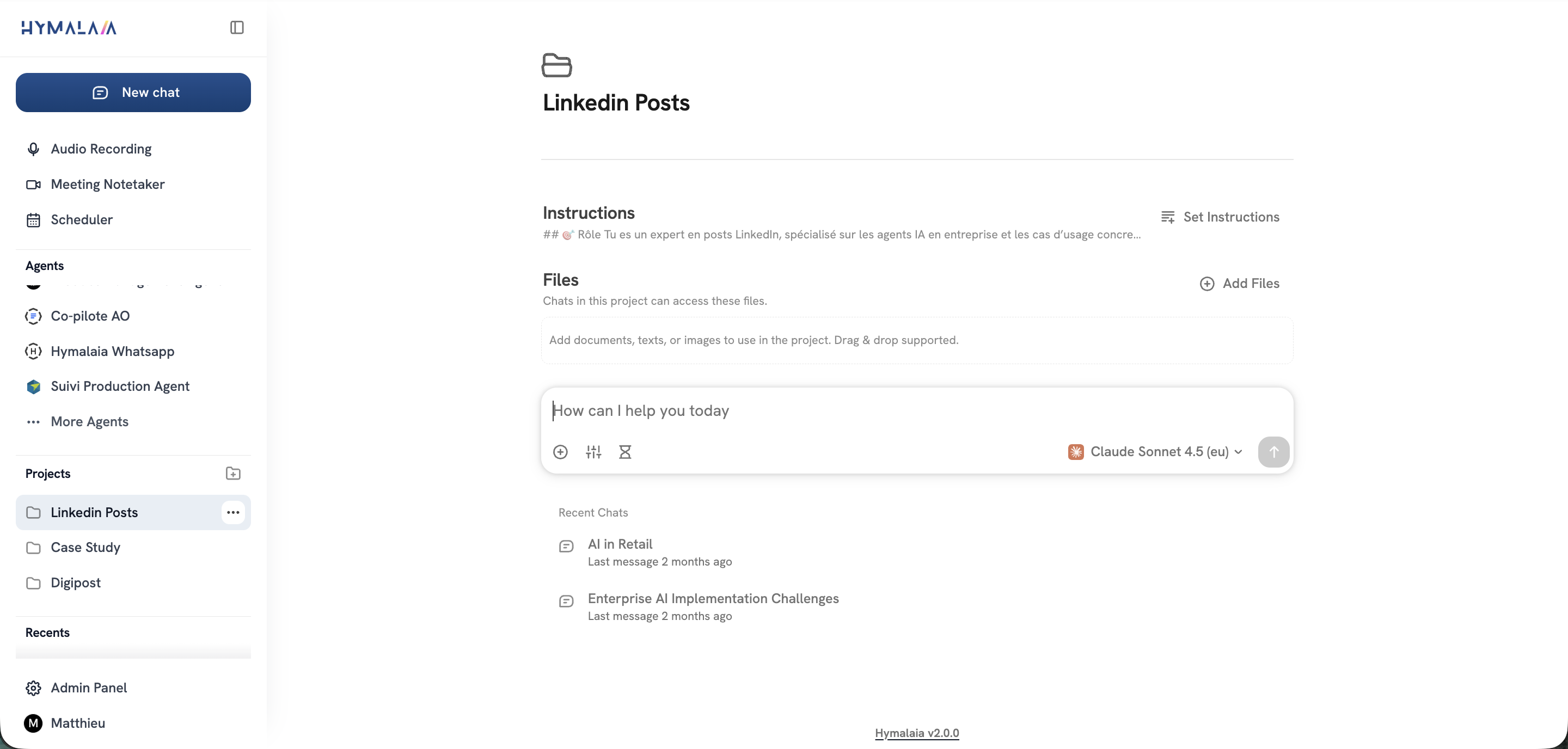
Hymalaia deploys autonomous AI agents that unify enterprise search across Salesforce, Slack, Google Workspace, SharePoint, and 50+ other tools. Its RAG architecture grounds every AI response in your proprietary data, eliminating hallucinations and keeping outputs accurate. From training automation to real-time decision support, Hymalaia gives your teams the AI infrastructure to execute transformation at scale. GDPR-compliant, role-based access controls, and flexible deployment options mean your governance requirements are met from day one. Explore what Hymalaia can do for your organization at hymalaia.com.
AI workforce transformation is the process of redesigning jobs, workflows, and organizational structures using AI automation, intelligent analytics, and adaptive learning systems. The goal is to shift human effort toward higher-value, judgment-intensive work while AI handles routine tasks.
Routine clerical roles are projected to decline by 2.19% by 2028, while roles requiring contextual reasoning and decision-making are expanding. The net effect is a shift in skill requirements, not a simple reduction in headcount.
AI accelerates change management by surfacing workforce capacity risks, adoption patterns, and initiative saturation at the portfolio level faster than traditional methods. Effective use requires organization-specific data; generic AI models produce generic, often unhelpful outputs.
CHROs must act as workforce design architects, clarifying which decisions belong to AI and which belong to humans, embedding continuous learning programs, and building AI governance as an ongoing organizational function rather than a compliance checkbox.
Most programs underperform because they treat AI as a standalone tool rather than a reason to redesign workflows. BCG research shows 70% of transformation value comes from people-side actions, including work redesign and trust management, not technology deployment alone.
