TL;DR:
- Most enterprise AI projects fail due to organizational barriers rather than technology failures. Successful scaling requires deliberate change management focusing on leadership, clear communication, and ongoing reinforcement. Embedding strategic AI adoption practices ensures measurable outcomes and sustainable organizational value.
Most enterprise AI projects don’t fail because the technology stops working. They fail because the organization never truly started. Closing the gap between a successful AI pilot and real operational value requires deliberate, structured enterprise AI change management steps that treat adoption as a discipline, not an afterthought. This guide gives you a practical, sequenced framework built specifically for enterprise leaders and IT managers responsible for turning AI investments into measurable outcomes across the organization.
| Point | Details |
|---|---|
| People challenges dominate AI adoption | Most AI initiative stalls result from leadership and user proficiency issues, not technology failures. |
| Preparation is critical | Starting with operational pain points and a clear AI strategy aligns technology with business value and governance. |
| Leadership drives adoption | Visible, consistent executive involvement and communication significantly increase AI adoption success. |
| Measure and reinforce continuously | Tracking meaningful KPIs combined with feedback loops sustains AI benefits beyond deployment. |
| Change management creates value | Treating AI change efforts as a strategic, measurable capability improves shareholder returns and transformation outcomes. |
The first thing most enterprise leaders discover after a promising AI pilot is that scaling it is a completely different problem. The model performs. The integration works. And yet, adoption stalls. Teams revert to old workflows. Managers don’t reinforce usage. The initiative quietly loses momentum.
Here’s what the data says: 56 to 64% of AI adoption challenges are people-centered, and executive behavior is one of the strongest predictors of whether an AI initiative scales or stalls. That’s not a technology problem. That’s an organizational one.
The most common people-centered obstacles enterprise leaders encounter include:
“The four key executive role in AI adoption levers are visibility, vision, voice, and value. Leaders who activate all four consistently see significantly higher adoption rates than those who treat AI as a technology deployment project.”
Understanding these dynamics is not about assigning blame. It’s about designing your change management approach around the actual barriers that derail AI initiatives. It also points to the importance of embedding responsible AI practices in enterprises from the start, so that trust concerns don’t become blockers later.
Preparation is where most organizations skip steps and pay for it later. A rushed preparation phase produces AI deployments that solve the wrong problems, confuse the wrong people, or violate governance requirements that were an afterthought.
Here’s how to build the preparation phase correctly:
A practical approach to aligning AI with business goals ensures your preparation phase produces decisions that the whole organization can execute against, not just the AI team.
| Preparation activity | Key output | Common failure mode |
|---|---|---|
| Pain point inventory | Prioritized use case list | Selecting use cases based on technology excitement, not operational need |
| Use case alignment | Business outcome metrics | Vague success criteria that can’t be measured |
| Capability assessment | Skill gap analysis | Overestimating readiness and underinvesting in training |
| Governance setup | Data policy documentation | Retroactive compliance scrambles post-deployment |
| Strategy documentation | Shared AI roadmap | Siloed plans that different departments interpret differently |
Pro Tip: Don’t start with the most ambitious use case. Start with the one most likely to produce visible, positive results for a skeptical audience. An early win that frontline employees can see and feel is more valuable than a sophisticated deployment that only the IT team understands.
Incorporating establishing responsible AI governance into this phase protects you from regulatory surprises and builds employee confidence that leadership is managing AI thoughtfully.
Execution is where the change management framework meets real organizational behavior. Plans succeed or fail based on what leaders actually do during this phase, not what they intend to do.
Follow these execution steps deliberately:
“People-centered change management integral to transformations leads to better financial outcomes and faster scaling compared to technology-first approaches.”
The most underutilized resource in any enterprise AI transition is the informal influence network. Building internal AI advocates through deliberate champion programs accelerates grassroots adoption far faster than top-down mandates. These advocates know where the real friction lives, and they have the credibility to address it.
Pro Tip: Executive sponsorship is critical. Assign a named executive sponsor to every major AI initiative. That sponsor should speak at kick-offs, appear in communications, and be reachable when escalations arise. Sponsorship without visibility is just a title on a slide.

Execution isn’t a one-time event. It’s an ongoing AI change process that requires consistent reinforcement, frequent feedback loops, and the organizational courage to adjust course when something isn’t working.
Most enterprises declare victory too early. They see strong adoption numbers in month two and reduce change management investment. Then, six months later, usage drops, old behaviors return, and the initiative needs resuscitation. Sustainment is not optional. It’s where your AI investment actually pays off.
Here’s what a strong verification and sustainment approach looks like:
| Sustainment activity | Frequency | What it tells you |
|---|---|---|
| Operational outcome tracking | Weekly/monthly | Whether AI is actually changing workflow performance |
| Pulse sentiment surveys | Bi-weekly | Employee friction, trust levels, and skill confidence |
| Change agent feedback reviews | Monthly | Ground-level issues not visible in dashboards |
| Workflow improvement sprints | Quarterly | Where to refine AI processes for better adoption |
| Executive sponsorship reviews | Monthly | Whether leadership signals remain consistent |
Pro Tip: Connect measuring AI-driven process improvements to your existing performance review cycles. When AI adoption metrics appear alongside traditional KPIs, managers take them seriously. When they live in a separate AI dashboard nobody opens, they don’t.
Sustainable adoption is not a destination. It’s an operating posture. Plan for 12 to 18 months before calling an AI initiative truly embedded in your organizational culture.
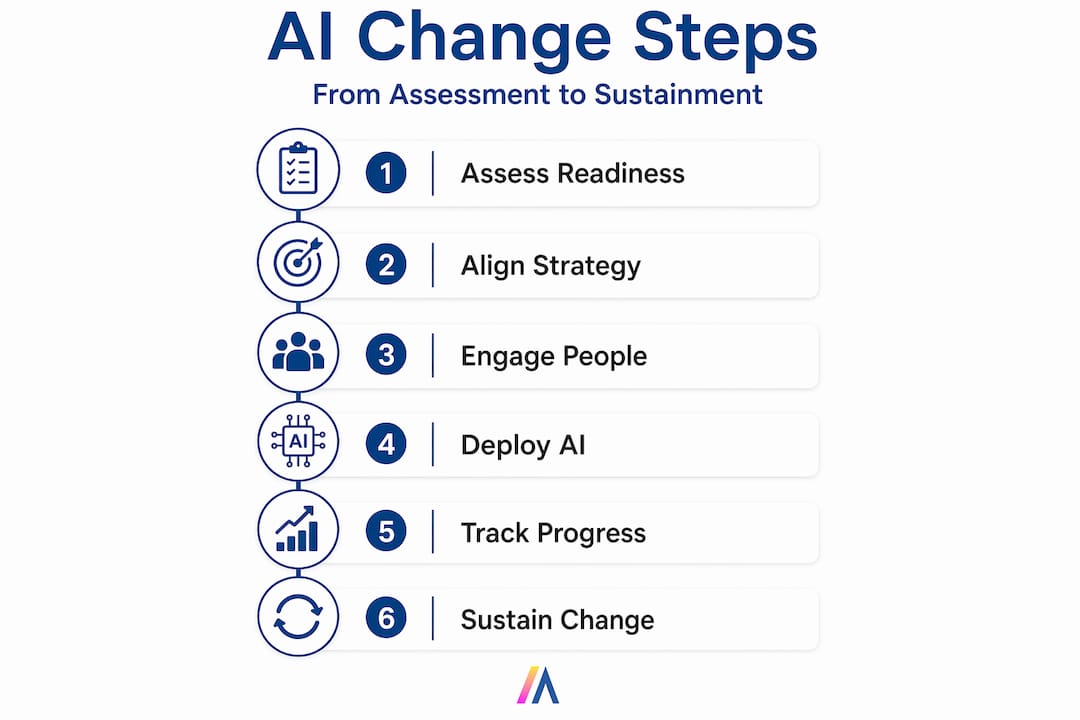
Here’s an opinion you won’t hear often enough: most enterprises still treat AI change management as a support function, something the HR or communications team handles while the “real” AI work happens in IT and data science. That framing is exactly why so many AI initiatives produce capability without value.
Companies that make people-centered change management integral to transformation outperform peers by 15% in total shareholder return. That’s not a soft finding. That’s a financial outcome. When you treat change management as a strategic discipline with its own budget, its own metrics, and its own executive accountability, you’re not adding overhead. You’re protecting the return on your AI investment.
The enterprises that pull ahead don’t have better AI models. They have leaders who understand that adoption is the product. They build strategic AI alignment into every deployment decision, not as an afterthought, but as the primary design constraint. They measure behavioral outcomes, not just technical ones. They sustain investment in change management long after go-live because they know that’s where the compound returns accumulate.
The practical implication: your change management team needs a seat at the AI strategy table from day one. Not a briefing after the architecture is decided. Not a communication plan handed to them at launch. A seat at the table where use cases, governance, and deployment timelines are determined. That shift alone separates high-performing AI enterprises from organizations that perpetually run pilots.
Executing the steps above requires more than a framework. It requires a platform designed to support AI at enterprise scale, with built-in governance, auditability, and the operational visibility leaders need to monitor adoption and adjust in real time.
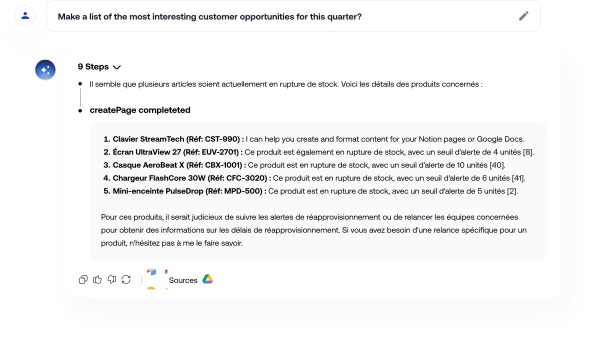
The Hymalaia enterprise AI platform is built precisely for this challenge. Autonomous AI agents connect to over 50 enterprise tools, including Salesforce, Slack, Google Workspace, and SharePoint, giving your teams AI-powered workflows that fit how they already work. Role-based access controls, GDPR-compliant data handling, and audit-ready logging satisfy the governance requirements your change management framework demands from day one. Explore the full Hymalaia AI platform features to see how real-time analytics and conversational AI can help you turn your change management plan into a sustained operational reality. Book a demo and take your AI change management from concept to measurable impact. 🏔️
Leaders should actively sponsor AI adoption by being visibly involved, communicating a clear vision, and removing barriers to employee trust and skill development. Executive behavior is a strong predictor of AI adoption success, with visibility, vision, voice, and value identified as the four critical levers.
Success is best measured using adoption metrics tied to operational outcomes, like training completion, actual usage patterns, and workflow performance improvements, combined with real-time employee feedback. Defining adoption measures paired with real-time feedback mechanisms protects your investment well beyond the go-live date.
Designing AI deployments to be reversible, with human approval gates built in, reduces employee resistance by demonstrating that leadership is committed to careful, trust-building adoption rather than pushing irreversible automation. Early AI deployments should have narrow scope with human approval steps to build organizational confidence.
Sustainable AI adoption often requires 12 to 18 months, covering initial deployment, building operational proof, developing internal advocates, and expanding use cases as organizational trust grows. Effective AI change management timelines reflect the reality that behavioral change at scale takes sustained effort, not a single launch event.
