TL;DR:
- Predictive AI transforms enterprise operations by anticipating problems and automating responses before issues occur. Successful implementation depends on unifying and governing enterprise data, starting with targeted pilots, and gradually scaling to agentic systems. Investing in data management is the critical foundation for reliable, scalable AI-driven operational excellence.
One fleet operator achieved 89% failure prediction accuracy, cut breakdowns by 62%, and saved $1.4M in avoided downtime. That’s not a future scenario. It’s a production result from AI-driven predictive operations deployed today. Yet many enterprise IT leaders still treat predictive AI as a research project or a long-term ambition rather than an operational priority. This guide cuts through the confusion, defines what predictive operations with AI actually means for large organizations, and gives you a practical path from pilot to production.
| Point | Details |
|---|---|
| Measurable ROI | AI-driven predictive operations deliver millions in savings and major efficiency gains. |
| AI outperforms rules | AI handles complex, nonlinear data more effectively than traditional analytics, especially for real-time decision-making. |
| Start with pilots | Launching with focused, high-impact pilots maximizes learning and reduces risk. |
| Prioritize data unification | Robust predictive operations require consolidated, governed, and accessible enterprise data. |
| Gradual automation path | Progress from predictive alerts to autonomous agentic AI as confidence and ROI grow. |
Predictive operations with AI is the practice of using machine learning models, real-time data streams, and historical enterprise data to anticipate problems, optimize processes, and automate responses before issues escalate. It’s not just dashboards or alerts. It’s operationalized intelligence.
The scope is broad. Explore the full range of predictive operations overview and you’ll find use cases spanning every major enterprise function:
The key difference between traditional analytics and AI-driven predictive operations lies in how each handles complexity. Traditional approaches use rules and statistical models built on historical patterns. They’re interpretable and reliable within narrow parameters. AI, by contrast, adapts to nonlinear, high-dimensional data relationships in real time. As Forrester’s 2026 predictions note, AI handles nonlinear and large-scale data better than traditional statistics, but the tradeoff is reduced interpretability. Your team gains predictive power while accepting some “black box” risk.
“The real shift isn’t from manual to automated. It’s from reactive to anticipatory. Enterprises that master predictive operations don’t just respond faster. They stop problems from becoming problems.”
Pro Tip: Don’t try to replace all your rules-based processes immediately. A hybrid approach, where AI handles exceptions and edge cases while proven rules govern core operations, gives you the safety net to build confidence in AI outputs before expanding autonomy.
The business case for predictive operations isn’t speculative. The financial evidence is substantial across industries, and the numbers are worth understanding in detail.
Consider enterprise AI in action at a global chemical manufacturer. Deploying AI-driven predictive maintenance on industrial furnaces delivered a 50% reduction in downtime and a $45M measurable impact through extended furnace run lengths. That figure represents more than cost savings. It reflects recaptured production capacity, reduced emergency labor, and fewer supply disruptions cascading through the value chain.

The fleet operations case study mentioned above adds another data point. An 89% failure prediction accuracy rate, combined with a 62% reduction in breakdowns and $1.4M saved in downtime, demonstrates that even asset-heavy, logistics-intensive operations can achieve rapid, measurable returns. Retail also benefits: AI-driven models deliver up to 21% better demand forecasting accuracy compared to traditional approaches, reducing overstock costs and stockout losses simultaneously.
Here’s a summary of benchmark results across key industry verticals:
| Industry | AI capability deployed | Measured outcome |
|---|---|---|
| Fleet operations | Equipment failure prediction | 89% accuracy, $1.4M saved |
| Chemical manufacturing | Predictive maintenance | 50% less downtime, $45M impact |
| Retail | Demand forecasting | 21% accuracy improvement |
| IT operations | Anomaly detection | Reduced outage frequency |
The underlying value drivers are consistent across these examples:
The ROI case is strongest when organizations identify a high-frequency, data-rich process with clear cost consequences. That’s your starting point.
The concrete value cases make a compelling case, but how does predictive AI differ from traditional business analytics strategies? The distinction matters because it shapes which tools you choose, how you govern them, and what risks you accept.
Traditional analytics approaches use structured data, defined rules, and statistical models like regression or time-series analysis. They’re fast to explain, easy to audit, and reliable in stable environments. An experienced analyst can trace every output back to a formula. That interpretability is genuinely valuable in regulated industries.

AI-driven predictive operations work differently. Machine learning models, including gradient-boosted trees, neural networks, and deep learning architectures, identify patterns across thousands of variables simultaneously. Forrester’s research confirms that AI handles nonlinear, high-volume data better than classical statistics, but at the cost of interpretability. A model might accurately predict a compressor failure without being able to explain exactly which combination of signals triggered the alert.
| Dimension | Traditional analytics | AI predictive operations |
|---|---|---|
| Data handling | Structured, tabular, limited volume | High-volume, multimodal, real-time |
| Adaptability | Static models, manual updates | Continuous learning from new data |
| Interpretability | High, auditable | Lower, requires explainability tools |
| Setup complexity | Low to medium | Medium to high |
| Best for | Stable, well-defined processes | Complex, dynamic, exception-heavy processes |
| Risk profile | Predictable, low surprise | Powerful but requires governance |
For risk-sensitive enterprises in finance, healthcare, or critical infrastructure, a hybrid approach is often the right call. Use AI to surface anomalies and edge cases that rules-based systems miss. Use proven rules for core, high-frequency transactions where auditability is non-negotiable. This secure AI deployment model lets you expand AI’s role incrementally as trust builds.
Here’s a practical migration path:
Pro Tip: Invest in model explainability tools like SHAP (SHapley Additive exPlanations) from the start. Being able to show a compliance officer or plant manager why an AI flagged a specific alert accelerates adoption significantly and reduces resistance from frontline teams.
Understanding the comparison, enterprise leaders now need a roadmap for moving from basic pilots to advanced, agentic predictive operations. The jump from proof-of-concept to production is where most initiatives stall. Here’s how to avoid that.
Forrester recommends that enterprise leaders start with narrow use cases like predictive maintenance before scaling to agentic systems, with data unification and governance as foundational priorities. That advice is grounded in observing dozens of enterprise deployments. The organizations that succeed don’t start with the most ambitious AI vision. They start with the most tractable problem.
Phase 1: Targeted pilot
Phase 2: Data unification and governance
This is the step most teams underestimate. AI models are only as accurate as the data they train on. Disconnected data silos, inconsistent field naming conventions, and missing historical records will degrade model performance regardless of algorithm sophistication.
Phase 3: Measure, validate, and scale
Phase 4: Agentic operations
Agentic AI goes beyond prediction. It acts. An agentic system might detect an anomalous vibration signature in a turbine, automatically schedule a maintenance work order in your CMMS, notify the relevant technician via Slack, and update the asset’s service record, all without human intervention. That’s the operational ceiling you’re building toward.
Pro Tip: Don’t rush to agentic automation. Human-in-the-loop oversight at the alert and recommendation stage builds the organizational trust and model accuracy track record that justifies removing human review later. Skipping that step is one of the most common reasons agentic pilots get shut down after a single high-profile error.
Key factors for successful scaling:
Before you launch an AI initiative, it’s worth pausing to consider why so many projects unexpectedly stall. Most post-mortems don’t point to faulty algorithms. They point to data problems that were invisible until the model tried to learn from them.
Here’s an uncomfortable pattern: a team selects a strong machine learning model, secures budget, and runs an impressive demo. Then they hit production data. Field names differ between the ERP and the IoT platform. Three years of sensor readings are missing because a system migration was poorly documented. The “historical maintenance records” turn out to be a mix of structured database entries and scanned PDFs sitting in SharePoint with no extraction pipeline. The AI initiative doesn’t fail because of AI. It fails because no one owned the data foundation.
Forrester is direct on this point: prioritizing data unification and governance before scaling to agentic systems is the structural prerequisite, not an optional step. Enterprises that treat data as a strategic asset, investing in integration, lineage, quality controls, and access governance, consistently outperform those that invest in model sophistication first.
The shift in mindset required is significant. Data is not the byproduct of operations. It is the operations asset that AI converts into value. When you invest in a sound AI data management foundation, every subsequent AI capability you add becomes faster to deploy, more accurate out of the gate, and easier to govern. When you skip that step, every new model becomes an isolated pilot that never scales.
The practical implication: before your next AI budget conversation, ask your data engineering team how long it would take to produce a single, clean, unified dataset combining sensor readings, work orders, and operational KPIs for your top three assets. If the answer is “months,” that’s where your investment priority should be.
If you’re ready to go from pilot to full-scale predictive operations, here’s how Hymalaia supports every step.
🏔️ Hymalaia is built specifically for enterprises that need to turn fragmented data into operational intelligence at scale. The enterprise AI agent platform unifies data from over 50 enterprise tools, including Salesforce, Slack, Google Workspace, SharePoint, and IoT data sources, so your AI models train on clean, consolidated, governed data from day one.
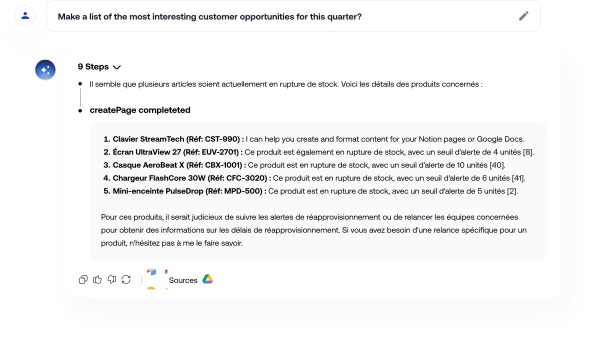
With Hymalaia’s AI platform features, you get retrieval-augmented generation (RAG) for accurate, source-grounded AI responses, role-based access controls, GDPR-compliant data handling, and flexible deployment across cloud, on-premise, or hybrid environments. Our AI consulting services help IT leaders customize the platform for their specific operational context, accelerating the path from pilot to production while managing risk at every stage. Whether you’re targeting predictive maintenance, demand forecasting, or full agentic workflow automation, Hymalaia provides the secure, scalable foundation to execute.
Book a Demo or Start Trial today and see predictive operations in action.
Maintenance, supply chain, and demand forecasting processes see the greatest gains due to high operational and cost impact, as demonstrated by the 50% downtime reduction and $45M savings achieved at a global chemical manufacturer.
AI-driven operations use dynamic, data-driven models to anticipate and adapt in real time, while traditional automation runs on fixed rules. Forrester confirms that AI handles nonlinear and large-scale data far better than classical statistics, though with reduced interpretability.
Agentic AI automates actions based on predictions with minimal human intervention, and adoption is accelerating. However, Forrester notes that enterprises are still cautious, with a meaningful share of AI budgets held back pending clearer ROI validation and governance frameworks.
Begin with a narrowly defined pilot in an area with abundant data and clear metrics, such as equipment maintenance. Forrester recommends starting with targeted use cases before scaling to agentic systems to manage risk and build organizational confidence.
