TL;DR:
- Most enterprise leaders wrongly believe AI can automatically fix workflow issues, but it amplifies existing strengths and flaws.
- Effective AI deployment requires thorough process mapping, clarity, and governance to ensure measurable outcomes and scalability.
Most enterprise leaders assume that deploying AI will automatically fix slow, costly, or broken workflows. That assumption is one of the most expensive mistakes in enterprise technology. The reality, backed by years of real-world deployment data, is that AI amplifies what already exists in your processes, both the strengths and the flaws. This guide cuts through the hype to show you exactly how to structure your workflow design before introducing AI, which automation approaches produce measurable outcomes, and how to build an end-to-end AI program that delivers genuine business impact rather than an isolated proof-of-concept that never scales.
| Point | Details |
|---|---|
| Process clarity first | Mapping and simplifying workflows is a critical step before introducing AI for optimization. |
| Outcome-driven AI | AI delivers the best results when deployed for measurable business outcomes, not as isolated copilots. |
| Real-world impact | Enterprise-wide AI adoption can dramatically boost throughput, productivity, and compliance. |
| Smart workflow design | Align AI strengths to high-volume processes and keep humans in charge of complex exceptions. |
| Full-scale beats pilots | Wide, end-to-end AI programs drive greater ROI than small pilots focused on a single task. |
Before you write a single line of automation logic or onboard an AI agent, you need to answer a fundamental question: do you actually understand how your current processes work? Not the documented version. The real one, with every workaround, exception path, and informal approval loop your teams have built over the years.
“AI does not inherently fix process problems; if workflows are fragmented, unclear, or over-layered, AI can increase confusion and complexity rather than simplify execution.” — Forrester
This is not a warning to avoid AI. It is a call to respect the sequence. Enterprises that deploy AI on top of chaotic workflows tend to move faster in the wrong direction. An AI agent processing invoices incorrectly at 10x human speed is not a productivity gain. It is a liability.
Before any AI integration, evaluate your workflows across three dimensions:
If your answers reveal ambiguity, overlapping ownership, or poorly documented exceptions, those are signals to redesign first and automate second. Exploring the AI platform features available today makes it clear that even the most capable AI tools depend on clean input data and defined decision logic to deliver value.
Pro Tip: Before you begin any automation initiative, map your five most critical workflows end-to-end, including every exception path and every informal workaround. This single exercise will reveal more about your AI readiness than any vendor assessment.
The payoff for this upfront work is significant. Enterprises that invest in process clarity before AI deployment consistently report faster implementation timelines, lower error rates, and higher adoption among frontline teams. The discipline of mapping your workflows is not overhead. It is the foundation your AI program is built on.
With your workflows mapped and rationalized, you are ready to think seriously about what AI-enabled optimization actually looks like at the enterprise scale. And the industry is moving fast.
Gartner expects most enterprises to abandon assistive AI tools in favor of outcome-focused, delegated execution models by 2028. That is a profound shift. Copilot-style AI, where a human reviews every suggestion and clicks to approve each step, is giving way to agentic AI that owns a workflow segment, executes decisions within defined policy guardrails, and escalates only when confidence thresholds are breached.
Here is how those two models compare in practice:
| Dimension | Copilot AI | Agentic AI |
|---|---|---|
| Execution model | Human-in-the-loop for every step | Autonomous within guardrails |
| Speed | Limited by human review cycles | Near-real-time execution |
| Auditability | Manual logging | Built-in policy and audit trails |
| Exception handling | Human decides all exceptions | AI escalates based on confidence score |
| Best suited for | Complex, judgment-heavy tasks | High-volume, rule-governed workflows |
| Risk profile | Lower autonomy risk | Requires strong governance framework |
The implications for your teams are real. Accounts payable, procurement approvals, IT ticket routing, HR onboarding, and customer support escalation are all candidate workflows for agentic AI. In each case, the AI agent processes the standard path, applies confidence thresholds to decide whether to execute or escalate, and creates a full audit trail that satisfies compliance requirements.

Forrester notes that agentic AI shifts AP operations from transaction processing toward supervisory control, emphasizing confidence thresholds, auditability, exception quality, and escalation discipline. Your finance and operations teams are not being replaced. They are being elevated to supervisory roles where they review exceptions, refine AI policies, and focus on higher-value analysis.
The AI agent platform overview at Hymalaia reflects exactly this model: autonomous agents that execute within defined boundaries, connect across your enterprise tool stack, and surface only the decisions that genuinely require human judgment.
Key capabilities that define outcome-focused AI workflow platforms include:
These capabilities are not optional extras. They are the minimum requirements for enterprise-grade AI workflow automation. Without them, you expose your organization to regulatory risk, operational errors, and governance failures that can erase any efficiency gains.
Understanding what AI-enabled optimization can achieve is valuable. Seeing what it actually delivers in production is more convincing.
Emirates Global Aluminium demonstrates what is possible when AI is deployed as part of a structured, end-to-end program rather than a collection of disconnected pilots. Their program produced measurable impact exceeding $100 million, with improvements across throughput, labor productivity, safety alert response time, SOP compliance, and logistics delay reduction.
| Metric category | Outcome type | What this signals for your enterprise |
|---|---|---|
| Throughput improvement | Volume and speed | AI executing standard workflow steps faster than manual processing |
| Labor productivity | Output per employee | Teams redirected from routine tasks to judgment-intensive work |
| Safety alert response | Response latency | Real-time monitoring reducing incident risk |
| SOP compliance | Error and deviation rate | AI enforcing standard paths consistently |
| Logistics delay reduction | Process efficiency | Predictive routing and proactive exception handling |
These results did not emerge from a three-month pilot. They came from committing to AI ROI analysis at the program level, with executive sponsorship, cross-functional alignment, and a governance model that could scale.
The numbered steps below outline how leading enterprises build toward these outcomes:
Pro Tip: If your AI initiative is still in pilot mode after six months, the problem is almost certainly organizational, not technical. Small pilots rarely generate the cross-functional data and stakeholder alignment needed to demonstrate enterprise-level ROI. Push for end-to-end deployment in at least one complete process domain.
Knowing that AI can transform workflows is one thing. Designing those workflows correctly is another. The single most common mistake in enterprise AI deployment is attempting to automate everything, including the cases where human judgment is irreplaceable and where forcing automation creates more problems than it solves.
AI ROI depends directly on matching AI capabilities to workflow characteristics, specifically the volume of transactions, the value at stake in each decision, and the nature of exception paths. High-volume, low-ambiguity tasks are ideal candidates for autonomous AI execution. Low-volume, high-stakes decisions with significant contextual nuance are better served by AI-assisted human judgment.
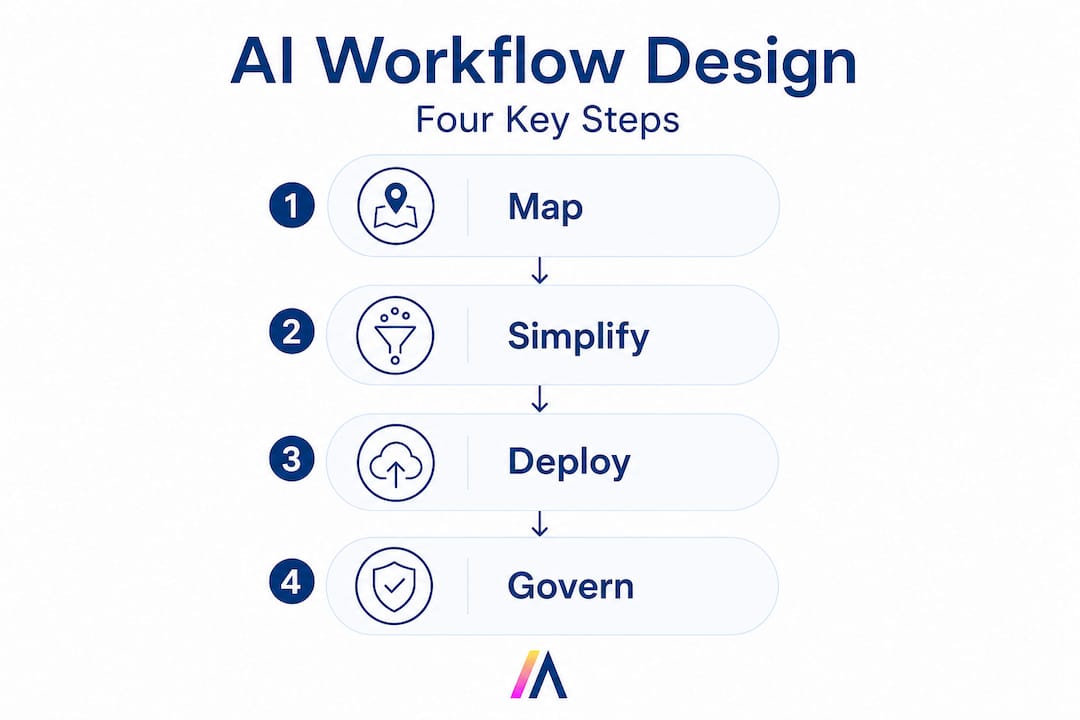
The design principle here is deliberate delegation. You are not choosing between human work and AI work. You are designing a system where each type of decision is handled by the right resource.
Consider these workflow segments and how to categorize them:
When you design workflows this way, your AI agents operate in their zone of strength, and your people operate in theirs. The result is a system that is both faster and more accurate than either humans or AI working independently.
The phased approach to building this system follows a clear sequence:
Connecting this to enterprise process optimization means choosing a platform that supports all four phases natively, with the integrations, governance features, and real-time data connectivity to make each phase operationally sound.
Pro Tip: Design your escalation protocols before you go live. The quality of your exception handling will define whether your AI program builds or erodes trust with your frontline teams. Fast, well-contextualized escalations tell your people that the AI knows its limits.
Here is what most enterprise AI initiatives get wrong from the very start: they treat process improvement as a byproduct of deploying AI, when it should be the prerequisite.
We have observed this pattern repeatedly. An organization invests in a capable AI platform, integrates it with core systems, and launches with genuine organizational energy. Six months later, the results are underwhelming. Exception rates are high. Agents are escalating constantly. Adoption is low. The diagnosis is almost always the same: the underlying workflows were never designed for automation. The AI found every fragmented handoff, every undocumented exception, every informal workaround, and faithfully amplified each one.
As Forrester puts it directly, fragmented workflows worsen with automation. This is not a flaw in the AI. It is a flaw in the implementation strategy.
The leaders who get this right think differently. They see AI not as a technology project but as a process discipline backed by technology. They invest time in the unglamorous work of workflow mapping, exception documentation, and decision ownership clarification before they ever configure an agent. They recognize that the advanced AI workflow tools available today are genuinely powerful, and that power is precisely why process clarity matters so much.
Our perspective is straightforward: the ROI of AI is not primarily determined by the sophistication of the AI. It is determined by the quality of the processes you bring to it. The organizations achieving $100M+ outcomes from AI transformation are not doing so because they found a better algorithm. They are doing so because they did the hard work of understanding their operations at a granular level before asking AI to execute within them.
If you are an enterprise leader evaluating your next AI initiative, start with your processes. Simplify before you automate. Document before you delegate. The technology is ready. The question is whether your workflows are.
You now have a clear framework: map your processes, match AI capabilities to workflow characteristics, deploy with governance, and measure outcomes at the program level. The next step is finding a platform that makes all of this operationally achievable rather than theoretically elegant.
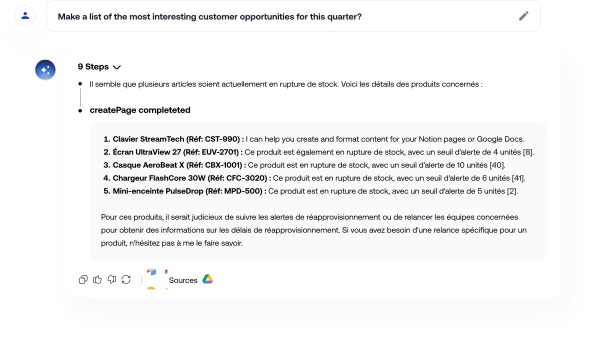
Hymalaia’s enterprise AI platform is built specifically for this challenge. Autonomous agents connect to over 50 enterprise tools, execute within policy-defined guardrails, and surface real-time insights across sales, operations, support, and finance. Whether you are starting with workflow mapping or scaling an existing AI program, Hymalaia’s AI platform features give you the infrastructure to deploy with confidence. Need help designing your workflows before automation? Our AI consulting services support enterprise teams in clarifying process design, governance models, and deployment strategy from day one. 🏔️
Start by mapping core processes, identifying pain points, and clarifying exception paths to ensure that AI enhances rather than complicates your workflows. Fragmented workflows worsen with automation, so documentation and simplification must come first.
Track metrics like throughput, productivity, exception resolution times, and compliance rates post-AI adoption. The EGA case study demonstrates that throughput, SOP compliance, and logistics delay reduction are among the most meaningful indicators of real AI impact.
Yes, end-to-end AI programs produce far greater impact than isolated pilots, as demonstrated by accelerated throughput, improved productivity, and compounding efficiency gains across interconnected workflow stages.
No, high-volume and repeatable steps suit AI best, while complex exceptions are better left for human judgment. AI ROI depends on matching AI capabilities to workflow design and deliberately delegating ambiguous judgment calls to human reviewers.
