TL;DR:
- Most enterprise AI initiatives fail due to misalignment with business strategy rather than technological issues.
- Creating measurable KPIs linked to P&L and managing AI as a continuous portfolio ensures strategic coherence and value capture.
Most large organizations have already funded AI pilots. Many have launched dozens. Yet a striking number of those initiatives quietly stall, get defunded, or deliver results that no one can connect to the income statement. That is not a technology failure. It is an alignment failure. Enterprise AI strategy must be bidirectionally linked to business strategy, with portfolios and operating models adjusted as business priorities shift. When that link is missing, even technically impressive AI projects become expensive distractions. This article gives you a structured, evidence-backed framework for closing that gap.
| Point | Details |
|---|---|
| Start with measurable goals | Always tie AI initiatives to explicit KPIs and business outcomes for accountability. |
| Manage an evolving AI portfolio | Treat alignment as bidirectional—let business and AI strategies influence each other and adjust your portfolio regularly. |
| Prioritize with frameworks | Use standardized value and feasibility models to pick high-impact, scalable AI initiatives. |
| Govern to prevent chaos | Strong governance is key to avoiding AI sprawl and keeping projects aligned to business intent. |
| Focus on value streams | Integrate AI into end-to-end workflows—just automating a few tasks is not enough. |
Misaligned projects often begin with unclear goals. Teams get excited about a model’s capabilities, spin up a proof of concept, and only later ask what business problem it actually solves. By then, momentum has replaced strategy.
The antidote is deceptively simple: define your success criteria before you define your solution. That means specifying KPIs (key performance indicators) that connect directly to P&L impact, not to technical benchmarks. A reduction in customer support ticket volume is a business KPI. An improvement in model accuracy scores is not, unless you can trace it to revenue retention or labor cost savings.
Front-loading measurable outcomes and connecting pilots to P&L impact is a core alignment mechanic that separates high-value AI programs from vanity projects. Boards and executive sponsors increasingly demand this. If your AI initiative cannot answer “what moves on the income statement?”, it will struggle to survive the next budget cycle.
Common pitfalls to avoid at this stage:
Pro Tip: Build a one-page initiative charter for every AI use case that includes a target KPI, a baseline measurement, an expected P&L line item, and a named business owner. Without a named business owner, accountability evaporates. This single document forces the right conversations before a single line of code is written.
Understanding AI use cases and ROI at the enterprise level also means recognizing that value often compounds across functions. A customer service AI agent that reduces handle time also generates structured data that improves product decisions. Capturing that secondary value in your KPI framework from day one is what separates good measurement from great measurement. For more on structuring your analysis, ROI analysis best practices provide a practical starting point for finance and AI teams to work from the same playbook.
Once your objectives are clear, the next step is creating an AI portfolio that stays synced with business goals over time.
Most organizations are not short on AI ideas. They are short on discipline about which ideas belong in the portfolio right now, which ones to defer, and how to retire initiatives that no longer serve the strategy. Managing AI as a portfolio rather than as a collection of independent pilots changes the decision-making dynamic entirely.
Here is a practical five-step process for building and maintaining your AI portfolio:
The comparison below illustrates the structural difference between an isolated pilot approach and a managed portfolio approach:
| Dimension | Isolated pilots | Explicit AI portfolio |
|---|---|---|
| Strategic linkage | Ad hoc, often retroactive | Defined and reviewed quarterly |
| Resource allocation | Based on team enthusiasm | Based on value and feasibility scoring |
| Risk management | Each pilot carries its own risk | Balanced across initiative categories |
| Executive visibility | Low, fragmented reporting | Centralized portfolio dashboard |
| Feedback to strategy | Rarely captured | Bidirectional: AI insights inform strategy |
The last row in that table deserves extra emphasis. Bidirectional alignment means that AI capabilities should also inform and reshape business strategy, not just execute it. When your AI agents surface a pattern in customer behavior that your strategy team had not anticipated, that is a signal to revisit business priorities. Organizations that only allow alignment to flow one way (from business to AI) will consistently miss these opportunities.
Pro Tip: Assign a standing agenda item in your quarterly business review to surface AI-driven insights that challenge or refine current strategic assumptions. This builds the bidirectional feedback loop into your operating rhythm rather than leaving it to chance.
Reviewing responsible AI frameworks early in the portfolio mapping phase also ensures you are not building a portfolio of initiatives that will later be blocked by ethics, compliance, or regulatory concerns. The steps for selecting AI solutions for enterprise deployment add further structure to vendor and build decisions within each portfolio category.
With a portfolio framework in place, you need to focus on picking the right use cases and establishing robust governance.

Choosing a use case based on executive enthusiasm or vendor marketing is one of the fastest ways to waste an AI budget. Prioritization must be systematic. It must account for both the potential business value and the realistic cost and complexity of execution. Use cases that look exciting in a demo often collapse under the weight of messy enterprise data or fragmented process ownership.
A repeatable prioritization process looks like this:
Aligning AI teams and governance across the enterprise is critical to avoiding “agent chaos,” where autonomous AI agents proliferate without accountability structures and begin producing inconsistent or conflicting outputs. The following framework gives governance a practical structure:
| Governance layer | What it covers | Who owns it |
|---|---|---|
| Strategic oversight | Portfolio alignment to business goals | C-suite, AI steering committee |
| Initiative governance | Stage gate approvals, KPI tracking | Program management office |
| Operational controls | RBAC, audit logs, data access policies | IT, security, compliance teams |
| Agent-level governance | Output monitoring, escalation rules | AI operations team |
| Ethical review | Bias checks, fairness assessments | Cross-functional ethics board |
Pro Tip: Treat governance as a value enabler, not a bottleneck. When governance processes are well-designed, they accelerate decisions by providing clear criteria and accountable owners. When they are bureaucratic and vague, teams route around them and governance fails anyway.
Pairing strong governance with AI system security practices, including zero-trust architectures and role-based access controls, ensures that your AI agents operate within defined boundaries even as they scale. Further AI governance tips for enterprise deployment and insights on AI agents for automation at scale can strengthen your governance foundation substantially.
Once initiatives are prioritized and governed, it is time to operationalize alignment and ensure execution achieves measurable value.
The most common execution mistake is treating AI as a point solution. A conversational AI agent deployed in the customer service function that cannot access real-time order data, does not connect to the CRM, and operates outside the main workflow is a point solution. It delivers limited value and creates integration debt.
The alternative is an end-to-end value stream approach. Operational efficiency alignment is most durable when pursued through value streams (complete, end-to-end workflows) rather than isolated deployments. A value stream perspective forces you to map the entire customer journey or business process and identify where AI creates the most leverage across the whole chain, not just at one touch point.
What effective operationalization requires:
“Scaling AI readiness and human readiness are joint levers for realizing AI value at enterprise scale. You cannot scale one without the other.”
Change management is often where well-designed AI programs stumble. Technology deployment outpaces human readiness. Employees do not understand how the AI agent makes decisions. Managers do not trust outputs enough to act on them. Skills gaps leave teams unable to interpret AI-generated insights.
Closing this gap requires treating human readiness as a parallel workstream, not an afterthought. Training, communication, and process redesign must keep pace with technical deployment. For teams working through AI workflow design, building change management into the workflow design phase rather than bolting it on at the end consistently produces better adoption outcomes.

Most articles on this topic tell you to align your AI strategy to your business goals. That advice is correct but incomplete. It implies that alignment is a one-time exercise and that it flows in only one direction, from business strategy down to AI initiative design. Both assumptions are wrong.
Treating alignment as one-way means you will consistently miss the moments when your AI capabilities reveal new strategic opportunities. When a demand forecasting AI uncovers a customer segment your sales strategy had deprioritized, that is not just a cool data point. It is a strategic signal that should trigger a portfolio reprioritization conversation. Organizations that lack the feedback loop to surface and act on that signal leave strategic value on the table.
The second underappreciated reality is culture. Most alignment frameworks focus on structure: committees, scoring models, stage gates. But the organizations that consistently realize AI value are the ones where executives genuinely trust AI-generated insights and where frontline teams are empowered to escalate when AI outputs seem wrong. Building that culture requires intentional investment in AI literacy across leadership levels, not just in the data science function.
The third pitfall is treating each AI initiative as a project with a start and an end date. Real AI alignment is ongoing. Portfolios must evolve as markets shift. Operating models must adapt as AI capabilities expand. Governance must tighten as agents become more autonomous. The organizations that build repeatable systems for managing AI alignment, rather than episodic projects, are the ones that sustain competitive advantage over time.
We also see organizations underinvest in enterprise AI risks assessment during the portfolio design phase. By the time risks materialize in production, they are far more expensive to address. Front-loading risk reviews into the prioritization process is one of the highest-leverage moves available to enterprise AI leaders.
You now have the frameworks. The next question is execution speed. Translating portfolio plans, governance models, and value stream designs into production-grade AI deployments requires infrastructure that most enterprises are not positioned to build from scratch.
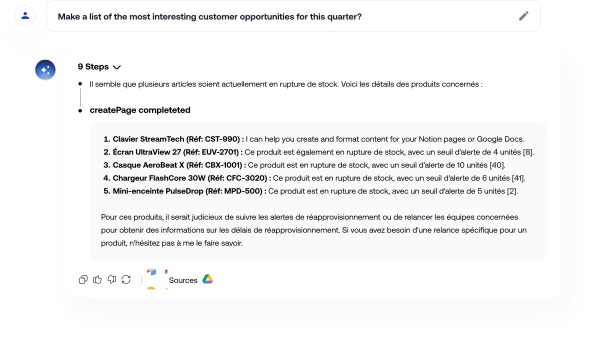
The Hymalaia AI platform 🏔️ is purpose-built for enterprise alignment challenges. It connects to over 50 enterprise tools, including Salesforce, Slack, Google Workspace, and SharePoint, so your AI agents operate on live, integrated data rather than isolated snapshots. Its RAG-based architecture ensures that AI responses are grounded in your actual business knowledge, not generic model outputs. With role-based access controls, GDPR compliance, and flexible deployment options (cloud, on-premise, or hybrid), Hymalaia fits into your governance model rather than requiring you to rebuild it. Explore the full range of platform features and accelerate your alignment journey with AI consulting services tailored for enterprise scale. Book a demo and see alignment in action.
Success is measured by tracking explicit, business-linked KPIs and quantifiable P&L impact rather than technical progress metrics. Front-loading measurable outcomes before deployment ensures your measurement framework is ready before results start arriving.
You risk wasted investments, duplicated efforts, and a portfolio of technically functional AI tools that deliver no meaningful business impact. Bidirectional alignment between AI and business strategy prevents this by keeping both in continuous sync.
Use a standardized framework that scores each candidate on business value and technical feasibility to make portfolio decisions transparent and defensible. Use-case prioritization frameworks help you maintain an explicit portfolio rather than a collection of disconnected pilots.
Strong governance prevents agent chaos by establishing clear accountability, repeatable approval processes, and consistent standards for how AI agents operate. Aligning governance across the enterprise is what separates organizations that scale AI reliably from those that scale it dangerously.
