TL;DR:
- Most enterprise AI failures occur due to organizational unpreparedness rather than technological flaws.
- A comprehensive readiness checklist helps organizations address strategic, data, governance, and infrastructure gaps before scaling AI initiatives.
Most enterprise AI initiatives fail not because the technology is wrong, but because the organization is not ready for it. AI project failures stem from organizational readiness gaps far more often than from technical limitations. This enterprise AI adoption checklist gives you a structured way to close those gaps before they cost you. What follows is not a high-level overview. It covers every dimension that matters: strategic alignment, data readiness, organizational culture, governance, and infrastructure. Work through it systematically and your AI initiatives have a genuine path to production.
| Point | Details |
|---|---|
| Strategy before technology | Define measurable business outcomes and secure executive sponsorship before evaluating any AI solution. |
| Data readiness is non-negotiable | Establish data quality baselines and governance policies before AI deployment, not after problems emerge. |
| Governance requires an inventory | Discover and catalog all AI systems in use, including unsanctioned tools, to maintain compliance and reduce risk. |
| Checklists need execution plans | Translate each checklist item into a prioritized workstream with milestones and KPIs to avoid stalling after diagnosis. |
| Gated decisions prevent waste | Use documented decision gates to prevent premature production transitions and protect both budget and business outcomes. |
Before you evaluate a single vendor or spin up a proof of concept, you need a clear answer to one question: which specific business problem does this AI initiative solve? Organizations that skip this step accumulate pilots that never graduate to production.
Start by mapping candidate AI use cases directly to business objectives. That means pairing each use case with a measurable outcome: reduced case resolution time, lower manual review costs, faster sales cycle. Linking AI use cases to measurable outcomes is what separates a funded program from a science project.
Your AI implementation guide at the strategic level should include:
Microsoft’s Cloud Adoption Framework structures enterprise AI adoption into distinct phases starting with Strategy and Plan precisely because downstream planning, budgeting, and governance decisions all flow from those early choices.
Pro Tip: Assign a single named executive owner per AI initiative, not a committee. Shared ownership is functionally no ownership when decisions under uncertainty need to be made fast.
An AI readiness assessment evaluates your organization across five dimensions: data, people, process, infrastructure, and governance. Readiness is non-binary, which means you do not need a perfect score in every dimension before moving forward. You need an honest picture of where the gaps are.

Most organizations overestimate their data readiness and underestimate their governance gaps. The assessment output should be a scored baseline, not a pass/fail verdict. Use it to sequence your preparation work and allocate resources to the areas with the highest risk exposure.
Data readiness is the primary constraint in enterprise AI adoption. Attempting to evaluate or deploy AI solutions on top of fragmented, inconsistent data sets the initiative up for silent failures that are hard to diagnose after go-live.
A systematic data audit for your artificial intelligence checklist should work through these steps:
Poor data governance leads to rapid data quality degradation once AI systems start acting on that data, creating a compounding problem. Fix the foundation first.
Pro Tip: Do not wait for perfect data to start. Identify the single data set most critical to your first AI use case and invest in cleaning that one thoroughly. Trying to fix everything at once stalls progress indefinitely.
Technology readiness gets most of the attention in an enterprise AI roadmap. People readiness is where most initiatives actually break down.
Assess skills gaps honestly across three categories:
End-user engagement is not optional. When AI outputs are embedded into existing workflows without involving the people who use those workflows, adoption fails. Pull process owners into design sessions early. Let them define what “good” looks like for AI-assisted decisions in their domain.
Building a culture that supports experimentation also means accepting that some pilots will fail. Organizations that punish early failures produce AI teams that avoid risk, which produces AI programs that never move beyond low-stakes automation. Structured experimentation with documented learning, not judgment, is what scales. The change management steps required for AI adoption deserve the same rigor as the technical implementation.
Governance is not a compliance checkbox. It is the operating system that allows your AI program to scale without creating compounding legal, ethical, and operational liability.
Your governance framework needs to cover four areas:
| Governance Area | What to Define |
|---|---|
| AI usage policies | Permitted use cases, prohibited applications, ethical constraints, and escalation procedures |
| AI system inventory | A complete catalog of all AI systems in production, including sanctioned and unsanctioned tools |
| Risk ownership | Named executive accountable for each AI system’s risk profile and performance thresholds |
| Incident response | Defined protocols for model failures, hallucinations, data breaches, and compliance violations |
Shadow AI discovery is a step most organizations skip. Employees are already using AI tools in ways IT leaders have not approved or inventoried. Those unsanctioned deployments carry the same compliance and security risk as sanctioned ones, without the controls.
The NIST AI Risk Management Framework provides a practical structure for operationalizing governance through four functions: GOVERN, MAP, MEASURE, and MANAGE. Each maps directly to a stage in your AI program lifecycle. For organizations in regulated industries, aligning with ISO/IEC 42001 adds a layer of audit credibility. The Statement of Applicability required under that standard acts as an evidence map that auditors scrutinize heavily, so building it with traceability from the start pays dividends later.
For a deeper look at responsible AI practices and how governance structures translate into operational controls, the frameworks section is worth reviewing before you finalize your policy documents.
Your infrastructure needs to support AI workloads specifically, not just enterprise software in general. AI workloads have distinct compute, storage, latency, and security requirements that a standard IT architecture review may not surface.
Work through these infrastructure readiness checks as part of your enterprise AI onboarding checklist:
Operationalizing AI requires monitoring across three layers simultaneously: technical health (latency, error rates), model quality (hallucination frequency, output accuracy), and business value (time saved, adoption rates, decision quality). Most teams monitor the first layer and ignore the other two.
Pro Tip: Set up your monitoring dashboards before you go live, not after the first incident. Defining what “normal” looks like for model performance is much easier when you have a clean baseline from day one.
The most expensive mistake in enterprise AI adoption is moving a pilot to production before it is ready. Gated decision points require documented governance artifacts and monitoring controls before any AI system advances to the next stage. They are what separate scalable AI programs from organizations stuck in perpetual pilot mode.
Define at minimum two gates: one before scaling a pilot to broader user testing, and one before full production deployment. Each gate should require sign-off from your named AI risk owner, evidence that baseline performance metrics are met, and confirmation that incident response protocols are in place.
Structured AI governance documentation at each gate gives you two things: protection against premature scaling decisions and a clear audit trail if something goes wrong later. These artifacts also give your board and executive team the visibility they need to provide meaningful oversight.
In my experience working with enterprise AI programs, the checklist is rarely the problem. Most IT leaders already know, at some level, what dimensions matter. What consistently fails is the translation step. Organizations complete a readiness assessment, identify the gaps, and then the work stalls because nobody has converted those findings into a prioritized engineering roadmap with owners, deadlines, and measurable gates.
I’ve seen organizations spend six months on an AI readiness report and zero months on fixing what the report identified. That is not a readiness problem. It is a planning discipline problem.
The checklist-to-roadmap conversion requires you to treat each gap as a workstream with a specific output, an owner, and a completion criterion. Not a vague goal like “improve data quality,” but a specific deliverable like “reduce duplicate customer records in CRM to below 3% by Q3.”
Governance artifacts get treated as bureaucratic overhead until something goes wrong. I’ve learned to see them differently. NIST AI RMF governance outputs like policy documents, risk ownership assignments, and board-level reports are not red tape. They are the mechanism by which AI programs earn the institutional trust needed to scale. Without them, every new use case requires rebuilding trust from scratch.
The organizations that scale AI effectively are not the ones with the most sophisticated models. They are the ones with the most disciplined execution frameworks.
— Matthieu
Completing your enterprise AI adoption checklist identifies what needs to be in place. Hymalaia gives you the platform to execute it.
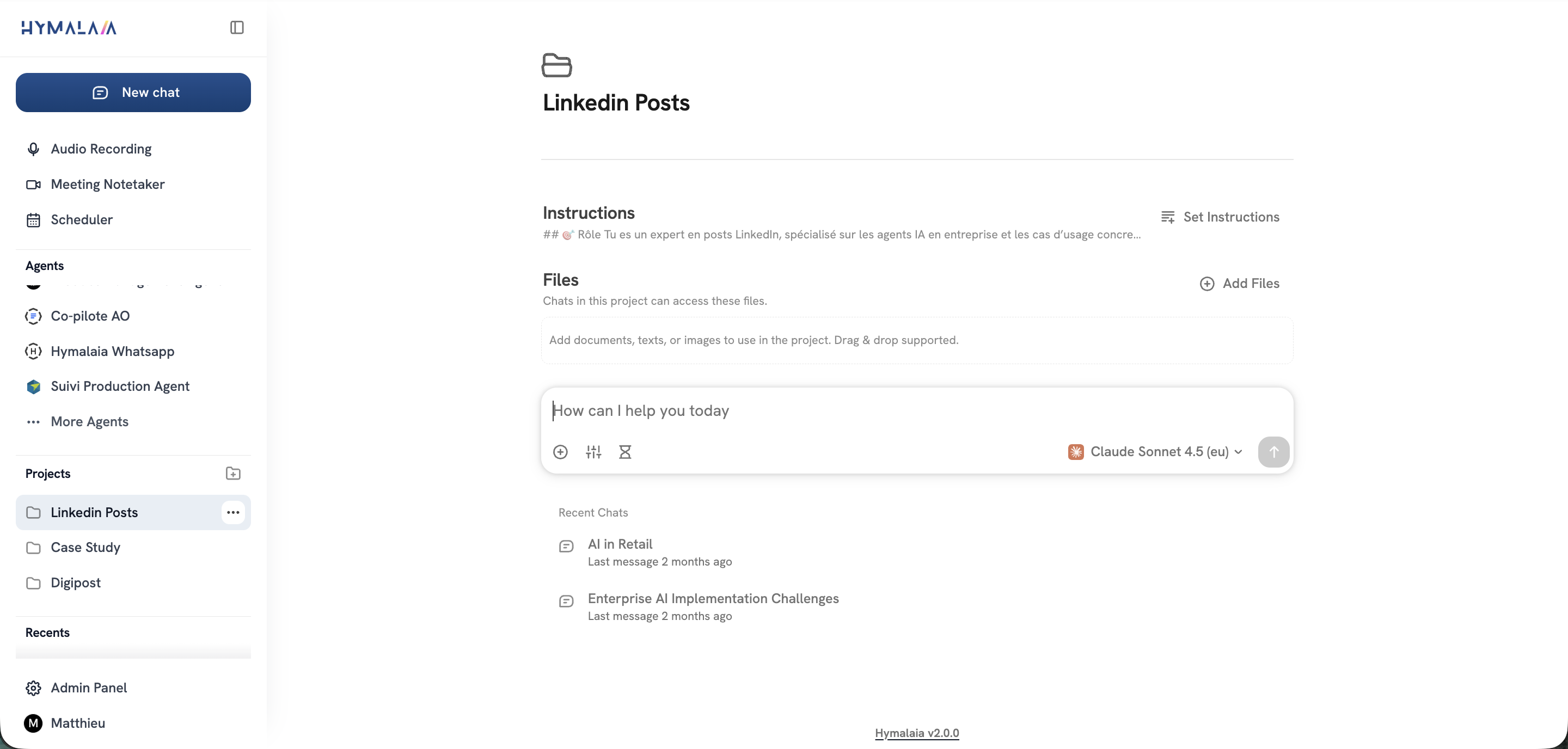
Hymalaia’s enterprise AI agent platform connects with over 50 data sources including Salesforce, Slack, Google Workspace, and SharePoint, unifying the fragmented data environment that stalls most AI programs. Its built-in governance controls, RBAC, GDPR compliance, and audit logging address the infrastructure and governance checklist items directly. The platform’s retrieval-augmented generation (RAG) architecture means AI responses stay grounded in your actual enterprise data, not generic model outputs. Whether you deploy in cloud, on-premise, or hybrid, Hymalaia gives your team the monitoring, automation, and security controls needed to move from pilot to production with confidence. Explore Hymalaia’s full capabilities or review the platform features to see how it maps to your adoption roadmap.
AI initiative failures most often trace back to organizational readiness gaps rather than technology limitations, specifically weak data governance, unclear executive ownership, and insufficient change management.
Score your organization across five dimensions: data quality, people skills, process integration readiness, infrastructure capacity, and governance maturity. Use the results to prioritize preparation work rather than block deployment entirely.
Shadow AI refers to unsanctioned AI tools employees use outside approved IT systems. It matters because those deployments carry compliance, security, and data exposure risks without any of the controls applied to sanctioned tools.
The NIST AI Risk Management Framework structures governance through four functions (GOVERN, MAP, MEASURE, MANAGE), giving enterprises a practical model for assigning risk ownership, inventorying AI systems, validating performance, and managing incidents at scale.
A pilot should advance only after passing a documented decision gate that confirms baseline performance metrics are met, governance artifacts are complete, and incident response protocols are tested. Gated transitions prevent the premature scaling that produces the most costly AI program failures.
