TL;DR:
- AI acts as a support layer for business continuity professionals by filtering alerts, enhancing scenario testing, and improving documentation quality. It supports, but does not replace, human judgment and decision-making, emphasizing the importance of proper governance and validation. Real-world success depends on disciplined implementation, ongoing validation, and leveraging AI as an analytical assistant rather than a decision-maker.
The role of AI in business continuity has become one of the most discussed yet most misunderstood topics in enterprise risk management. Most of the conversation gets stuck in one of two camps: either AI is going to write your business continuity plans and manage your crises autonomously, or it’s just a glorified search function that adds compliance risk. Neither is accurate. What’s actually happening is more useful and more nuanced. AI is becoming a high-value support layer for BC professionals who understand where it genuinely accelerates outcomes and where human judgment remains non-negotiable.
| Point | Details |
|---|---|
| AI reduces alert noise | AI filters multiple data streams to surface critical incidents faster, cutting cognitive overload during crises. |
| Scenario testing at scale | AI can generate and simulate thousands of scenario permutations, improving coverage and reducing human bias in resilience testing. |
| Governance comes first | Never deploy AI on high-stakes BC tasks until a mature, human-validated Business Impact Analysis (BIA) foundation is in place. |
| Human accountability stays | AI can draft, restructure, and flag, but it cannot verify strategy viability or take accountability for continuity decisions. |
| Test your AI fail-safes | Tabletop exercises must include scenarios where AI systems fail or are disabled, not just scenarios where they succeed. |
Most BC teams don’t fail during incidents because they lack data. They fail because they have too much of it, arriving too fast, from too many sources at once. That’s precisely where AI earns its place.
AI functions best in this context as a collector and filter. It ingests alerts from IT monitoring tools, physical security feeds, weather APIs, supply chain sensors, and internal communication platforms simultaneously, then prioritizes what matters. AI reduces alert noise by analyzing multiple data sources to highlight critical trends and suppress low-priority events, which directly improves situational awareness when you can least afford distraction.
Consider what this looks like in practice during a regional infrastructure event. Without AI, your operations team is fielding dozens of status pings across Slack, email, and monitoring dashboards while trying to assess impact scope. With an AI layer integrated across those same tools, correlated signals surface a prioritized picture automatically. AI-powered cameras and platform integrations enhance real-time threat detection by connecting physical and digital signals that human operators would take hours to cross-reference manually.
A few specific capabilities BC teams are using right now:
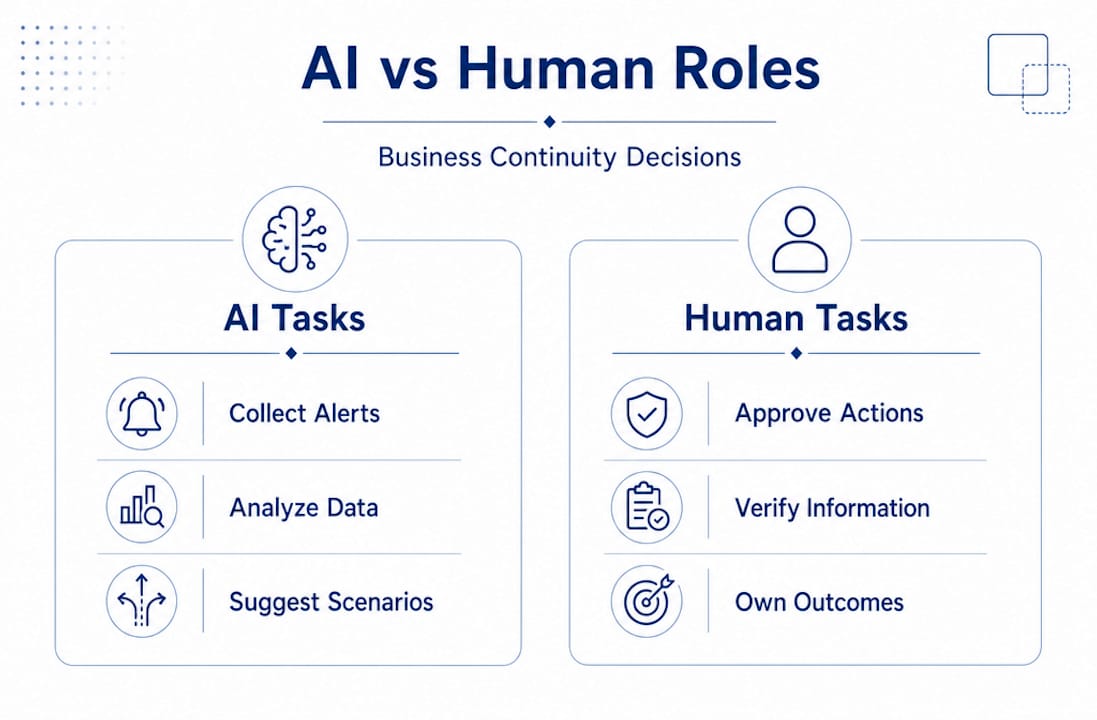
The critical boundary here is clear. AI supports, not replaces, human decision-making during incidents. The technology surfaces what you need to see. Your team decides what to do about it.
“AI’s prime value lies in reducing cognitive overload during crises by filtering noise and highlighting urgent anomalies, complementing but not replacing human judgment.” — Disaster Recovery Journal
This is the section where most BC professionals find the most immediate, practical value. Two distinct use cases stand out: accelerating scenario simulations and improving documentation quality.
Traditional scenario testing is constrained by time, team capacity, and cognitive bias. Facilitators tend to revisit familiar threats and miss emerging compound risks. AI changes that calculus substantially. AI accelerates scenario testing by automating generation and simulating thousands of permutations for extensive coverage, enabling faster and less biased resilience testing than traditional methods allow.

This matters most when you’re designing “severe but plausible” scenarios for executive tabletop exercises. AI can cross-reference historical incident data, industry threat intelligence, and your organization’s specific dependency map to generate scenarios your team would likely never prioritize manually. The result is a more honest stress test.
After an incident begins, AI can also suggest recovery paths tailored to multiple scenarios, giving decision-makers a structured set of options rather than a blank page under pressure.
Here’s where practitioners need to be especially clear-eyed. AI can improve BC plan clarity by restructuring content, removing duplication, and spotting inconsistencies. But this only holds value when the underlying data inputs come from a validated BIA. Feed AI a poorly structured BIA with unverified assumptions, and it will produce a clean-looking document built on flawed foundations.
| What AI does well | What humans must own |
|---|---|
| Restructuring and deduplicating plan content | Verifying strategy viability against operational realities |
| Flagging inconsistencies across plan sections | Setting recovery time and point objectives |
| Generating exercise scenario options | Approving and stress-testing AI-generated scenarios |
| Drafting plan sections from structured BIA data | Interrogating unspoken organizational vulnerabilities |
The same logic applies to exercise design. AI aids in raising documentation quality and helps generate realistic exercise scenarios, but humans must maintain accountability for truth verification. An AI model cannot interrogate the unspoken organizational politics, workarounds, and shadow processes that your experienced BC manager already knows about.
Pro Tip: Before using AI to draft or restructure any plan section, validate that your BIA data is current, signed off, and complete. AI-assisted drafting built on a solid BIA is genuinely valuable. AI drafting on top of a stale or incomplete BIA will create confident-sounding plans that don’t reflect reality.
Adopting AI tools in a BC program requires the same discipline you apply to any new operational dependency. The risks are real, and several organizations are discovering them the hard way.
Follow this sequence when integrating AI into your program:
Pro Tip: Review your enterprise AI adoption framework before deploying AI agents into continuity workflows. A structured AI change management approach helps prevent scope creep and ensures governance keeps pace with capability rollout.
The governance model that works is straightforward: AI handles analysis duties, humans own decision approval. That separation isn’t bureaucratic overhead. It’s the control pattern that keeps accountability clear when something goes wrong.
The case studies now emerging give BC professionals concrete benchmarks to evaluate AI investments against.
Kyndryl’s Bridge platform provides the most cited enterprise-scale data point. Its agentic AI reduced IT incidents by up to 50% and cut mission-critical outages by 90% for some customers, generating 16 million AI insights monthly across more than 200,000 devices. The platform achieves this through predictive prevention, identifying failure conditions before they cascade rather than responding after the fact. For organizations managing large distributed IT estates, that shift from reactive to proactive is where operational analytics genuinely transforms continuity outcomes.
On the incident response side, a case study involving an AI Incident Pilot implementation showed measurable compression of the incident lifecycle. AI shortened incident acknowledgment to approximately two minutes and had a pull request ready within 24 minutes of detection, with human oversight required before deployment. That’s a structural improvement in how quickly teams move from detection to remediation.
Key patterns across these outcomes:
The honest caveat in all these examples: the results come from mature implementations with disciplined governance, not from dropping an AI tool on top of an existing program and hoping for improvement.
I’ve worked closely with organizations at different stages of AI adoption in their continuity programs, and the pattern I keep seeing is this: the teams getting real value from AI are the ones who treated it as an analytical assistant, not a solution vendor. The teams struggling are the ones who expected AI to reduce the need for experienced BC judgment.
What actually concerns me is overconfidence in AI outputs in high-stakes moments. AI models produce confident-sounding text. They don’t flag their own gaps. When a plan section reads well and is logically structured, reviewers naturally apply less scrutiny. That’s precisely when human truth maintenance against organizational realities matters most.
The governance principle I keep coming back to is this: AI should never be closer to a continuity decision than one human review away. Not because the technology isn’t capable of impressive analysis, but because accountability has to live somewhere, and it can’t live in a model.
My take on the future outlook is that AI capabilities will expand quickly, particularly in predictive analytics and autonomous remediation. The BC professionals who thrive will be the ones who build AI literacy into their team competencies now, test their AI dependencies in exercises regularly, and resist the pressure to reduce human oversight as the technology matures.
Start where AI genuinely helps. Scenario coverage. Document quality. Alert correlation. Build trust in the tool incrementally. That’s how you get to the outcomes the case studies describe.
— Matthieu
The capabilities described in this article, from real-time data correlation to AI-assisted documentation and proactive incident analytics, require an AI platform built for enterprise governance standards.
Hymalaia’s enterprise AI agent platform connects with over 50 data sources including Salesforce, Slack, SharePoint, and Google Workspace, giving your continuity teams a unified view of operational signals across the organization. Its RAG-powered agents analyze real-time data and surface decision-ready insights without exposing sensitive BIA data to ungoverned external models. Role-based access controls, GDPR compliance, and on-premise or hybrid deployment options mean your program governance requirements are met from day one. If you’re ready to move from reactive incident management to predictive continuity, explore Hymalaia’s platform features and see what AI-driven resilience looks like in practice.
AI supports business continuity by automating risk detection, filtering alert noise, accelerating scenario testing, and improving plan documentation quality. It functions as an analytical support layer, not a decision-maker.
No. AI cannot verify strategy viability, interrogate organizational vulnerabilities, or take accountability for continuity decisions. Experienced BC professionals remain responsible for judgment, approval, and execution.
AI correlates signals from multiple data sources simultaneously to surface prioritized incident information faster than manual monitoring allows, reducing the cognitive overload teams face during fast-moving events.
Key risks include confident but incorrect outputs, data security exposure when inputting sensitive BIA data, new dependencies on AI platforms that can themselves fail, and team complacency toward manual verification habits.
Apply a strict separation: AI performs analysis, humans approve decisions. Start with lower-risk tasks, validate all outputs, include AI failure scenarios in tabletop exercises, and maintain manual fallback procedures for every AI-dependent process.
