TL;DR:
- Most enterprises struggle to generate significant ROI from AI due to deploying tools without a layered architecture or clear strategy. Effective AI automation involves a five-layer stack, from personal copilots to autonomous agents, interconnected through governed integration. Successful adoption requires building and governing the integration layer first, ensuring data quality, process documentation, and governance before deploying advanced AI tools.
Enterprise AI automation is defined as the deployment of AI-powered systems to execute, coordinate, or augment business processes across an organization’s operational functions. The five distinct types span personal productivity copilots, vertical automation platforms, integration middleware, task-based robotic process automation (RPA), and autonomous AI agents. As of Q1 2026, 88% of companies use AI in at least one business function, yet only 6% generate more than 5% EBIT from those initiatives. That gap exists because most organizations adopt tools without a layered architecture. Understanding each type of enterprise AI automation is the prerequisite for closing it.
Enterprise AI automation is not a single technology. It is a stack. Each layer addresses a different scope of work, from an individual employee’s daily output to organization-wide autonomous decision-making. Treating these layers as interchangeable is the most common strategic mistake IT leaders make.
The five layers, in order of increasing complexity and organizational impact, are:
Organizations with a documented enterprise-wide AI strategy are 2.2 times more likely to derive sustainable competitive advantage from AI than those using ad-hoc approaches. The framework above is not academic. It is the architecture that separates high-performing AI adopters from the 82% still waiting for returns.
Personal productivity automation is the most visible entry point into enterprise AI for most employees. These tools sit directly in the applications workers already use, augmenting output without requiring process redesign.

Microsoft Copilot, embedded across Microsoft 365, drafts emails, summarizes Teams meetings, generates PowerPoint slides from prompts, and surfaces relevant documents from SharePoint. Grammarly operates at the sentence level, correcting tone, clarity, and compliance with brand voice across every written communication. Notion AI and Google Duet AI extend similar capabilities into project documentation and collaborative workspaces.
The productivity gains are real, but the ceiling is low without integration into broader workflows. A sales rep using Microsoft Copilot to draft outreach emails still needs to manually log activity in Salesforce unless a deeper integration layer connects the two. This is where personal productivity automation reveals its primary limitation: it optimizes the individual, not the process.
Pro Tip: Deploy AI copilots in phases by role type rather than organization-wide at once. Sales teams, support agents, and engineers each use AI assistance differently. A phased rollout lets you measure impact per function and identify where deeper automation layers are needed next.
The conversational AI use cases that generate the highest ROI are those where copilot outputs feed directly into downstream systems, not where they remain isolated productivity boosts.
Vertical automation platforms are AI modules built directly into the systems of record for specific business functions. These are not general-purpose tools. They are purpose-built engines that understand the data models, terminology, and workflows of a particular domain.
Salesforce Einstein applies AI to CRM data to score leads, forecast revenue, and recommend next-best actions for sales reps. SAP’s AI capabilities embedded in S/4HANA automate financial close processes, procurement approvals, and supply chain exception handling. Veeva Systems delivers vertical AI for pharmaceutical companies, automating regulatory submissions and clinical trial data management. ServiceNow’s AI features handle IT service management workflows, from ticket classification to automated resolution routing.
The strength of vertical platforms is depth. They understand context that a general-purpose AI cannot. A financial close automation in SAP knows the difference between a journal entry reversal and a standard accrual. That domain intelligence reduces error rates and accelerates cycle times in ways that horizontal tools cannot replicate.
The primary challenge is that vertical platforms create siloed workflows. Salesforce Einstein optimizes the sales process. SAP optimizes finance. Neither talks to the other without an integration layer. This is the structural problem that makes the next automation type critical to any enterprise AI integration strategy.
Integration automation is the layer that transforms isolated AI tools into a coordinated enterprise automation architecture. It uses APIs, iPaaS (Integration Platform as a Service) solutions, and middleware to connect CRM, ERP, financial, HR, and operational systems into a unified data flow.
Without this layer, data moves manually between systems, creating the bottlenecks that negate the efficiency gains from every other automation investment. Integration middleware enables real-time data exchanges critical to preventing digital bottlenecks in enterprise workflows. When a deal closes in Salesforce, integration automation can simultaneously update revenue forecasts in SAP, trigger onboarding workflows in Workday, and notify the delivery team in Slack, without a human touching any of those systems.
| Integration approach | Best use case | Key consideration |
|---|---|---|
| REST APIs | Real-time point-to-point connections | Requires developer resources to maintain |
| iPaaS platforms | Multi-system orchestration at scale | Licensing costs scale with data volume |
| Event-driven middleware | Trigger-based workflows across systems | Requires event schema standardization |
| Governed AI integration layers | Embedding AI within existing transaction flows | Enforces policy and traceability at runtime |
The governance dimension of integration automation is frequently underestimated. Embedding AI within governed integration layers that validate and enforce runtime policies improves reliability and compliance without wholesale system replacement. This matters enormously for organizations operating under GDPR, SOC 2, or HIPAA requirements.
Pro Tip: Before selecting an iPaaS solution, map every system that touches customer data. The integration layer is where data security controls must be enforced. Review your AI data security controls before connecting production systems.
Task-based automation covers the execution of repetitive, rule-based workflows that follow predictable logic. Robotic process automation (RPA) and business process automation (BPA) are the two primary technologies in this layer, and they serve different scopes.
RPA executes scripted, high-volume repetitive tasks accurately but lacks the ability to handle exceptions or ambiguity. Tools like UiPath and Automation Anywhere deploy software bots that mimic human interactions with applications: extracting invoice data from PDFs, entering it into an ERP, and triggering payment approvals. The process must be well-defined and consistent. Any deviation breaks the bot.
BPA operates at a higher level, automating entire business processes rather than individual tasks. Where RPA automates the data entry step of invoice processing, BPA automates the entire procure-to-pay cycle, including approval routing, exception escalation, and audit logging. Platforms like Appian and Pega combine workflow orchestration with rules engines to manage end-to-end process automation.
The strategic value of RPA and BPA is precision and throughput for structured work:
The limitation is brittleness. When a source system changes its interface or a new exception type emerges, RPA bots require manual reconfiguration. This is why AI for enterprise business process optimization increasingly pairs RPA with intelligent layers that handle exceptions before they reach human queues.
Autonomous AI agents represent the most advanced type of enterprise AI automation. These systems do not follow scripts. They analyze context, make decisions, and take actions across connected systems, adapting to new information without human instruction at each step.
Autonomous AI agents can analyze, adapt, and make decisions independently, handling unstructured data and ambiguity far better than rule-based bots. An AI agent monitoring supply chain risk does not wait for a threshold to be breached. It reads supplier news, cross-references inventory levels, checks contract terms, and recommends or executes mitigation actions before a disruption occurs.
The distinction between augmented AI and autonomous AI is operationally significant:
| Capability | Augmented AI | Autonomous AI agents |
|---|---|---|
| Decision-making | Recommends actions to humans | Executes decisions independently |
| Data handling | Structured and semi-structured | Structured, unstructured, and ambiguous |
| Adaptability | Requires retraining for new scenarios | Learns and adapts within defined guardrails |
| Human involvement | Required at each decision point | Required only for exception escalation |
| Enterprise examples | Microsoft Copilot, Grammarly | Fraud detection agents, predictive maintenance systems |
Fraud detection at financial institutions like JPMorgan Chase uses autonomous agents that process millions of transactions per second, flagging anomalies and blocking suspicious activity faster than any human review process. Predictive maintenance agents in manufacturing monitor sensor data from equipment, predict failure windows, and schedule maintenance orders in EAM systems automatically.
General-purpose AI assistants differ fundamentally from engineering intelligence agents, which require upstream session-level instrumentation for AI input quality and attribution. This distinction matters when selecting agents for technical operations versus business operations. The wrong agent architecture in a production environment creates reliability risks, not efficiency gains.
Effective enterprise AI automation requires a layered architecture where each type of automation serves a distinct scope, and integration connects them into a coordinated system.
| Point | Details |
|---|---|
| Five layers define the stack | Personal copilots, vertical platforms, integration middleware, RPA/BPA, and autonomous agents each serve a distinct function. |
| Integration is the multiplier | Without middleware connecting systems, gains from individual automation tools remain isolated and limited. |
| RPA requires intelligent pairing | RPA handles structured tasks well but needs AI exception handling to avoid brittleness at scale. |
| Autonomous agents need governance | Autonomous AI agents deliver the highest capability but require defined guardrails and traceability controls. |
| Strategy precedes tooling | Organizations with a documented AI strategy are 2.2x more likely to achieve competitive advantage from AI investments. |
The most consistent mistake I see in enterprise AI adoption is the sequence. Organizations buy autonomous AI agent platforms before they have functioning integration layers. They deploy RPA bots before they have documented the processes those bots will execute. They license vertical AI modules in Salesforce or SAP and activate less than 20% of the available features because the underlying data quality does not support them.
The layered framework is not just a taxonomy. It is a dependency map. Personal productivity tools can be deployed independently. Vertical platforms require clean domain data. Integration automation requires system inventory and API governance. RPA requires documented, stable processes. Autonomous agents require all of the above plus a governance model that defines what decisions agents can make without human approval.
Many organizations confuse digital transformation roadmaps with AI strategies. A true AI strategy names specific use cases, data sources, model architectures, and governance controls. Without that specificity, automation investments stack up without connecting, and the 6% EBIT performance gap I mentioned at the start becomes your organization’s reality rather than a statistic you read about.
The enterprises I have seen execute this well share one characteristic: they treat the integration layer as infrastructure, not as a project. They build and govern it continuously, and every new automation tool they deploy connects to it on day one. That discipline is what separates organizations that generate real returns from AI from those still running pilots two years after their first deployment.
— Matthieu
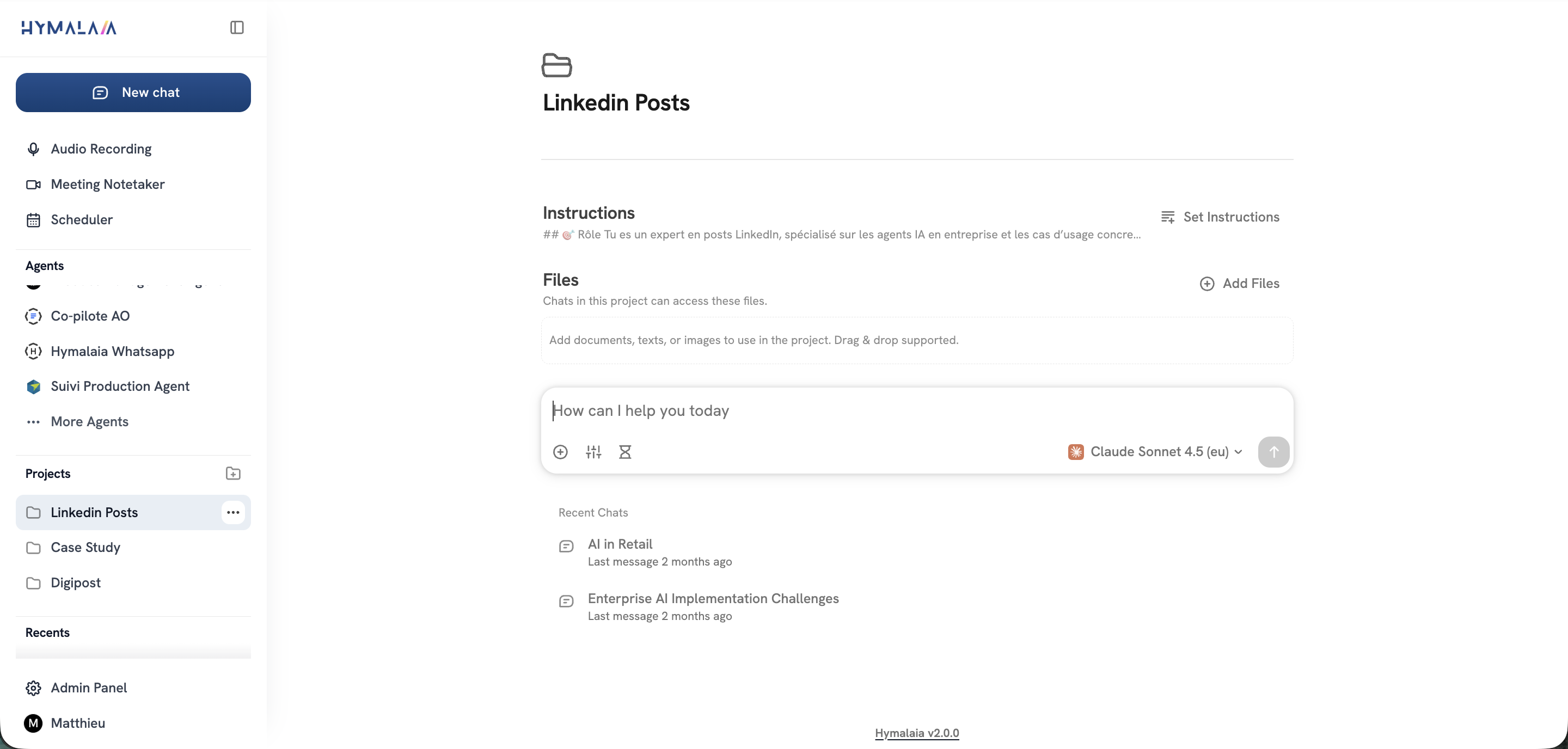
Hymalaia is built for exactly the architecture described in this article. The platform deploys autonomous AI agents that connect to over 50 enterprise systems, including Salesforce, Slack, Google Workspace, and SharePoint, through a governed integration layer that enforces GDPR compliance and role-based access controls. Hymalaia’s retrieval-augmented generation (RAG) engine ensures agents act on accurate, real-time data rather than stale snapshots. Whether you are activating your first integration layer or deploying agents across sales, support, and operations, Hymalaia gives your team the infrastructure to find, analyze, and act at enterprise scale. Explore the full platform capabilities or visit Hymalaia to see how intelligent automation orchestration works in practice.
The five types are personal productivity copilots, vertical automation platforms, integration middleware, task-based automation (RPA and BPA), and autonomous AI agents. Each operates at a different scope, from individual worker assistance to organization-wide autonomous decision-making.
RPA executes scripted, rule-based tasks on structured data and breaks when exceptions occur. Autonomous AI agents analyze unstructured data, adapt to new scenarios, and make independent decisions within defined governance guardrails.
An enterprise AI integration strategy defines how AI tools connect to existing systems through APIs, iPaaS, and governed middleware layers. It specifies data sources, runtime policies, and traceability controls to prevent isolated automation from creating new bottlenecks.
Only 6% of companies generate more than 5% EBIT from AI despite 88% adoption rates. The primary cause is deploying tools without a layered architecture and a documented strategy that names specific use cases, data sources, and governance controls.
Autonomous AI agents are appropriate when processes involve unstructured data, require real-time decision-making across multiple systems, or generate exception volumes that exceed human review capacity. They require functioning integration layers and governance frameworks before deployment.
