TL;DR:
- Organizational AI governance encompasses policies, roles, accountability, and technical controls throughout the AI lifecycle to ensure trustworthy deployment. It relies on a three-tier operating model—strategic, operational, and technical—aligned through clear escalation paths, human accountability, and continuous monitoring. Implementing governance as a living system, with active ownership and alignment to business culture, is essential for compliance and organizational trust.
Organizational AI governance is defined as the enterprise operating framework of policies, roles, accountability structures, and technical controls that constrain and monitor AI systems across their full lifecycle. The industry standard term for this discipline is AI governance, and it covers everything from how a model is trained to how it is audited after deployment. Frameworks like the NIST AI Risk Management Framework, ISO/IEC 42001:2026, and the EU AI Act have formalized what was once informal practice into a structured discipline. For business leaders and compliance officers, understanding what organizational AI governance requires is no longer optional. It is the foundation of defensible, trustworthy AI deployment.
Organizational AI governance is the enterprise operating framework covering policies, roles, accountability, and enforcement that constrain and monitor AI systems across their lifecycle. It produces traceable evidence for accountability, not just a policy document. That distinction matters enormously: a governance framework without enforcement mechanisms is simply documentation.

The importance of AI governance becomes clear when you consider what happens without it. AI systems make decisions that affect hiring, credit, medical triage, and customer pricing. Without defined accountability and audit trails, organizations cannot explain those decisions to regulators, customers, or courts. The EU AI Act, which applies to any organization deploying AI systems that affect EU residents, mandates exactly this kind of traceable accountability.
Governance also addresses the full AI lifecycle, not just deployment. It covers data sourcing, model development, testing, production monitoring, and eventual retirement. Each stage carries distinct risks: biased training data, model drift after deployment, or unauthorized access to sensitive outputs. A mature AI governance framework assigns ownership and controls at every stage, not just at the point of launch.
Pro Tip: Start your governance program by mapping every AI system currently in production, including shadow AI tools used by individual teams. You cannot govern what you have not cataloged.
Effective AI governance rests on four structural elements: policies, roles and decision rights, technical controls, and accountability mechanisms. Each element must be present and connected for governance to function.
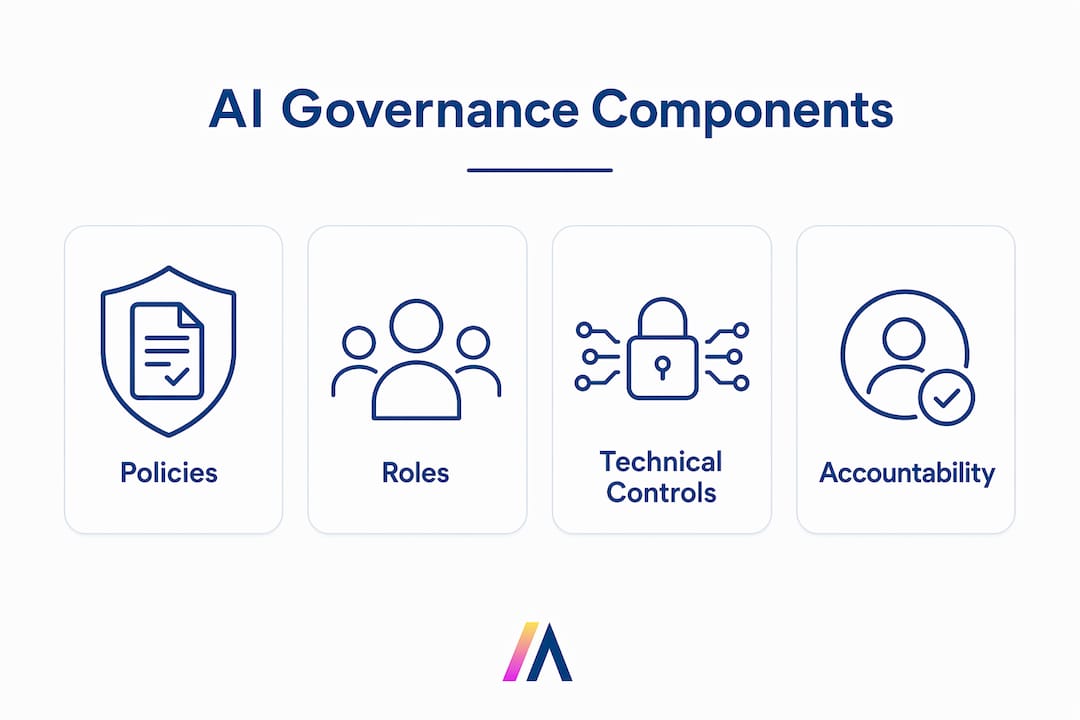
Policies define acceptable AI use, ethical principles, and compliance requirements. They answer questions like: What data can be used to train a model? What outputs require human review before acting? How are third-party AI vendors assessed?
Roles and decision rights assign named humans to governance functions. The Chief AI Officer (CAIO) holds strategic accountability. The Chief Data Officer (CDO) owns data quality and lineage. Data Stewards manage domain-specific compliance. Without named owners, governance stalls.
Technical controls include access management, data lineage tracking, and model performance monitoring. These are the enforcement layer that makes policies real at runtime.
Accountability mechanisms close the loop. They include audit trails, escalation paths, and incident response playbooks that activate when a governance control fails.
Two frameworks dominate enterprise adoption in 2026:
| Framework | Type | Core Focus | Best For |
|---|---|---|---|
| NIST AI RMF | Voluntary risk framework | Govern, Map, Measure, Manage functions | U.S. organizations, federal contractors |
| ISO/IEC 42001:2026 | Certifiable management system | Continual improvement, risk management | Global organizations seeking certification |
| EU AI Act | Mandatory regulation | Risk classification, prohibited uses | Organizations operating in EU markets |
| OECD AI Governance Playbook | Guidance tool | Executive sponsorship, cross-functional coordination | Policy alignment and strategy |
The NIST AI RMF’s four core functions provide a practical template: Govern establishes organizational plans and culture; Map identifies AI risks in context; Measure quantifies those risks; and Manage treats and monitors them. This is not a one-time exercise. It is a continuous cycle.
The ISO/IEC 42001:2026 standard provides requirements for establishing and maintaining an AI management system, supporting responsible AI use and regulatory compliance for organizations of any size. Unlike the NIST framework, ISO 42001 is certifiable, meaning third parties can audit your compliance. That certification carries weight with enterprise customers and regulators alike.
Pro Tip: Treat NIST AI RMF and ISO 42001 as complementary, not competing. Use NIST to build your risk management process and ISO 42001 to formalize and certify it.
Governance principles only create value when they translate into daily operations. The AI governance operating model defines decision rights, accountable roles, escalation paths, and enforcement mechanisms across three tiers.
Strategic tier (board and executive level). The board and C-suite set AI risk appetite, approve governance policies, and hold ultimate accountability. The CAIO chairs the AI governance committee. This tier reviews high-risk AI use cases and sets the boundaries within which the organization operates.
Operational tier (use-case lifecycle governance). Business unit leaders and AI product owners manage governance at the project level. They run risk assessments before deployment, maintain RACI matrices for each AI system, and escalate incidents to the strategic tier when thresholds are breached. RACI matrices assign one accountable role and multiple responsible roles, which prevents governance process stall and clarifies who answers for failures in governance controls.
Technical tier (data platform enforcement). Data engineers and ML engineers embed governance into the infrastructure itself. Access controls, data lineage tracking, and automated monitoring run at this level. Governance embedded in data platforms is technical, automatic, and auditable, moving beyond mere documentation.
The connection between tiers is where most organizations fail. Policies written at the strategic tier must translate into run-time constraints at the technical tier, such as access control and lineage monitoring, with an incident workflow involving escalation authorities to be effective. Without that translation, governance exists only on paper.
A practical example: a financial services firm deploys a credit-scoring model. The strategic tier approves the risk classification. The operational tier runs a pre-deployment fairness assessment and documents it. The technical tier enforces data access controls and logs every model inference. When the model’s fairness metrics drift three months post-launch, the monitoring system triggers an alert, the operational tier investigates, and the strategic tier decides whether to retrain or retire the model. That is governance working as designed.
Notably, 44% of enterprises report governance processes too slow due to bottlenecks. This means the operational tier is the most common failure point, and investing in clear escalation paths and tiered reviews directly reduces deployment delays.
Effective AI governance requires named human oversight with binding authority and accountability at designated checkpoints. Without such named accountability, governance defaults to automation with guardrails, not true governance. That is a critical distinction for compliance officers to internalize.
Human oversight operates across four accountability channels:
These channels are not theoretical. The EU AI Act explicitly requires human oversight for high-risk AI systems, including those used in employment, credit, and critical infrastructure. Organizations that deploy these systems without named, accountable humans at key checkpoints face fines and operational bans.
Practically, human oversight takes two forms. Human-in-the-loop means a human approves every consequential output before it acts. Human-on-the-loop means the system acts autonomously but a human monitors outputs and can override. High-risk use cases require the former. Lower-risk automation can use the latter, provided monitoring is genuinely active and override mechanisms are tested regularly.
For responsible enterprise AI programs, documenting which oversight model applies to each AI system, and why, is a governance requirement, not a suggestion.
AI governance is not a deployment-gate activity. It is a lifecycle commitment. Continuous monitoring of AI systems for drift, performance degradation, fairness shifts, and alert threshold breaches is a best practice, with incident response plans to manage governance risks over time.
The monitoring lifecycle maps to four phases:
| Phase | Key Activities | Governance Output |
|---|---|---|
| Development | Bias testing, data lineage documentation | Risk assessment, model card |
| Deployment | Access control setup, baseline metrics | Deployment approval record |
| Monitoring | Drift detection, fairness tracking, alert management | Incident log, performance report |
| Retirement | Model decommission, data deletion, audit archive | Retirement record, regulatory filing |
Each phase produces evidence. Maintaining technical evidence like metadata policies and lineage throughout the AI model’s lifecycle is crucial for regulatory audits and understanding AI decisions post-deployment. That evidence is what turns governance from a promise into a proof.
Alert thresholds should be set at deployment and reviewed quarterly. A model that was 94% accurate at launch may drift to 87% accuracy six months later due to data distribution shifts. Without a defined threshold and an automated alert, that drift goes undetected until it causes a visible failure. Incident response playbooks should specify who is notified, what investigation steps follow, and what authority is needed to suspend or retrain the model.
For AI governance best practices in 2026, embedding monitoring directly into your data platform is the most reliable approach. Manual monitoring processes degrade over time as teams get busy. Automated, platform-level monitoring does not.
Organizational AI governance succeeds when policies, named human accountability, and technical enforcement are connected across all three tiers of the operating model.
| Point | Details |
|---|---|
| Governance requires enforcement | Policies without technical controls and audit trails are documentation, not governance. |
| Three-tier operating model | Strategic, operational, and technical tiers must be connected with clear escalation paths. |
| Named human accountability | Every high-risk AI system needs a named individual with binding authority at oversight checkpoints. |
| Lifecycle monitoring is mandatory | Continuous drift and fairness monitoring with incident playbooks protects against post-deployment failures. |
| Frameworks are complementary | NIST AI RMF and ISO/IEC 42001:2026 work together: one for risk process, one for certification. |
Most organizations treat AI governance as a project. They write a policy, assign a committee, and consider the work done. That approach fails within 12 months, and I have seen it happen repeatedly across enterprise deployments.
The organizations that get governance right treat it as a live operating system. Policies are versioned and reviewed on a defined schedule. Roles are tied to performance objectives, not just org charts. Technical controls are tested, not assumed. When a new AI use case emerges, the governance process activates automatically, not reactively.
The hardest part is not the framework. Unclear ownership is the most recurring implementation pitfall, and it shows up in every organization that has not assigned a single named executive, typically a CAIO, with real decision authority. Committees without a named decision-maker produce consensus documents, not governance decisions.
I also think the field underestimates how much governance must align with business culture. A governance process that adds six weeks to every AI deployment will be circumvented. The OECD AI Governance Playbook is right that executive sponsorship and cross-functional coordination are prerequisites, but they are prerequisites for speed as well as rigor. Governance that aligns with business objectives gets adopted. Governance that feels like a tax gets avoided.
The regulatory environment in 2026 is accelerating this urgency. The EU AI Act is in enforcement, the NIST AI RMF is referenced in U.S. federal procurement, and ISO 42001 certifications are appearing in enterprise vendor requirements. Organizations that built governance infrastructure early are now moving faster, not slower, because their deployment processes are trusted and repeatable.
— Matthieu
Hymalaia’s enterprise AI platform is built for exactly the governance challenges described in this article. The platform provides role-based access controls, audit trails, and real-time monitoring across all deployed AI agents, giving compliance officers the evidence they need and business leaders the confidence to scale. Hymalaia connects with over 50 enterprise tools including Salesforce, Slack, and SharePoint, so governance controls apply consistently across every data source your AI agents touch. Whether you need cloud, on-premise, or hybrid deployment, the architecture supports your compliance requirements from day one. Explore how Hymalaia’s AI platform can turn your governance framework into an operational reality.
Organizational AI governance is the enterprise operating framework of policies, roles, technical controls, and accountability mechanisms that manage AI systems across their full lifecycle. It produces traceable evidence for regulatory compliance and internal accountability, not just a set of written principles.
The NIST AI Risk Management Framework and ISO/IEC 42001:2026 are the two most widely adopted frameworks. NIST provides a voluntary risk management cycle; ISO 42001 is a certifiable management system standard applicable to organizations of any size.
Human oversight is required because AI systems operating without named, accountable humans at key decision points default to automation with guardrails rather than true governance. The EU AI Act mandates human oversight for high-risk AI systems, with accountability spanning moral, employment, civil, and criminal channels.
Continuous monitoring for model drift, performance degradation, and fairness shifts is the core mechanism. Organizations set alert thresholds at deployment, maintain incident response playbooks, and produce audit evidence at each lifecycle phase from development through retirement.
Unclear ownership is the most common failure point. Without a single named executive, such as a CAIO, holding binding decision authority, governance committees produce documents instead of decisions, and AI governance policies fail to translate into operational enforcement.
