TL;DR:
- AI provides a competitive edge by integrating cost reduction, customer outcome improvements, and faster decision-making into a unified system. AI leaders outperform peers with three times the cost reduction and higher margins by embedding AI into core workflows and proprietary data sources. Success depends on strategic governance, workflow redesign, proprietary data, and long-term commitment rather than merely deploying AI tools.
The role of AI in competitive advantage is to deliver measurable financial outperformance by reshaping cost structures, accelerating decisions, and deepening customer relationships in ways competitors cannot easily replicate. AI leaders achieve 3x greater cost reduction and 1.6x higher EBIT margins than their peers, according to a March 2026 BCG analysis. That gap is not accidental. It reflects a deliberate strategy of integrating AI into core workflows, proprietary data, and financial KPIs. For business leaders and strategy managers, the question is no longer whether to adopt AI. It is how to build an AI-driven edge that compounds over time.
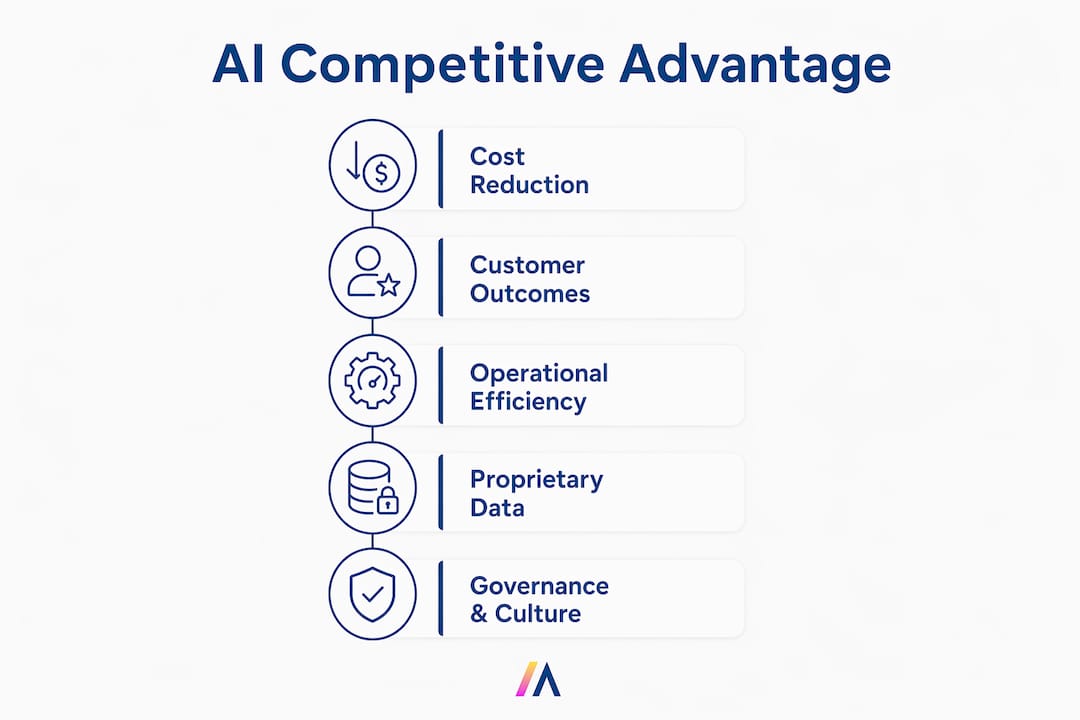
AI creates competitive advantage by doing three things simultaneously: cutting costs, improving customer outcomes, and accelerating the speed at which organizations act on information. Most companies treat these as separate initiatives. The firms pulling ahead treat them as a single, integrated system.

The BCG data makes the financial case clearly. AI leaders generate 2.7x return on invested capital compared to their peers. That multiple does not come from deploying a single AI tool. It comes from redesigning workflows around AI capabilities and tying every initiative to a measurable financial outcome.
The concept of strategic AI advantage is the recognized industry term for what most people call “using AI for advantages.” It describes the durable, compounding edge that comes when AI is woven into the fabric of how a company operates, not bolted on as a feature. Firms like Google, Amazon, and JPMorgan Chase have demonstrated this by building AI into pricing, logistics, and risk assessment at the infrastructure level.
AI reduces costs through two mechanisms: automating repetitive tasks and redesigning the workflows around them. The second part is what most organizations miss.
Automating a process without redesigning it captures only a fraction of the available value. BCG’s research shows that AI integrated with workflow redesign and financial KPIs is what separates leaders from laggards. The automation alone is table stakes. The redesign is where the margin improvement lives.
Agentic AI takes this further. Unlike traditional automation tools, agentic AI systems operate autonomously across HR, finance, and customer service functions. They do not just execute tasks. They monitor conditions, make decisions, and trigger follow-on actions without human intervention. Platforms like Hymalaia deploy these autonomous agents to unify enterprise search and automate complex workflows across Salesforce, Slack, Google Workspace, and SharePoint simultaneously.
Key operational areas where AI delivers measurable cost impact:
Pro Tip: Before deploying AI in any function, map the existing workflow end to end. Identify which steps create value and which exist only because the old process required them. AI works best when it replaces the entire step, not just the person doing it.
AI-driven customer experience is one of the fastest paths to revenue growth available to enterprise leaders today. The numbers from UNSW BusinessThink’s April 2026 research are specific: AI lifts customer satisfaction by 15–20%, increases revenue by 5–8%, and cuts cost-to-serve by 20–30%. Those three outcomes compound each other.
Higher satisfaction drives retention. And a 5% retention improvement can boost profits by 25–95%. That multiplier effect is why customer-facing AI deserves capital allocation equal to, or greater than, back-office automation.
The mechanisms driving these results fall into four categories:
The practical implication for strategy managers is clear. Customer-facing AI is not a cost center. It is a revenue driver with a measurable return that shows up in both the top and bottom lines.
Access to AI models is no longer a differentiator. GPT-4, Claude, and Gemini are available to every company with a credit card. The competitive edge now comes from what you feed those models and how you connect them to your operations.
The Alpha Thesis frames this as Beta versus Alpha. Beta AI capabilities are the models themselves. Every competitor has them. Alpha capabilities are your proprietary data, unique customer relationships, specialized workflows, and speed of decision-making. Those cannot be rented.
The table below shows how this distinction plays out in practice:
| Capability type | Definition | Example | Defensibility |
|---|---|---|---|
| Beta (utility) | Shared AI models available to all | GPT-4, Gemini, Claude | Low |
| Alpha (moat) | Proprietary data and unique workflows | Customer behavior data, internal pricing logic | High |
Wishtree’s 2026 framework formalizes this into a capital allocation strategy. Enterprises that classify AI as moats or utilities invest differently in each. Moat capabilities get built internally and protected. Utility capabilities get rented from vendors to avoid over-investment.
Hymalaia’s retrieval-augmented generation (RAG) architecture is built around this principle. It connects AI agents directly to your proprietary data sources, so every response and recommendation is grounded in your specific operational context, not generic training data.
Pro Tip: Audit your data assets before your AI strategy. The companies winning with AI are not the ones with the best models. They are the ones who know exactly what data they have, where it lives, and how to make it accessible to AI systems in real time.
The gap between AI adoption and AI impact is wider than most leaders expect. 70% of firms use AI, but over 80% report no meaningful productivity improvement over the past three years. That statistic, drawn from a survey of nearly 6,000 executives across four countries, is a direct challenge to the assumption that deployment equals results.
The primary reason is not technology. The leading cause of AI project failure is organizational literacy gaps. Teams do not know how to use AI tools effectively, managers do not know how to measure AI-driven outcomes, and executives do not know how to set realistic timelines.
ROI timelines for AI are typically 2–4 years, longer than traditional technology investments. That reality collides with short-term budget cycles. 71% of CIOs report that AI budgets will be frozen or cut if business impact is not clearly demonstrated within two years. The pressure to show fast results pushes organizations toward visible but low-value use cases, while the high-value transformations that require workflow redesign get deprioritized.
“AI ROI often does not appear in short-term financials because it changes work fundamentally. Leaders should track qualitative value like time returned to employees and the ability to solve problems that were previously unsolvable.” — UNSW BusinessThink, 2026
The path through this challenge requires three things: AI governance frameworks that set clear accountability, outcome metrics tied to financial KPIs rather than feature usage, and executive patience grounded in realistic timelines. Organizations that build these foundations see the returns. Those that skip them become part of the 80% statistic.
Turning AI spending into a sustained competitive edge requires a capital allocation mindset, not a technology procurement mindset. The distinction matters because it changes how you evaluate, fund, and govern every AI initiative.
Here is a practical framework for leaders:
Governance and culture are not soft factors. They are the primary determinants of whether AI investments compound or decay. Leaders who treat AI as a strategic asset, with the same rigor applied to M&A or capital expenditure, consistently outperform those who treat it as an IT project.
Pro Tip: Set a two-year outcome milestone for every AI initiative at the time of funding approval. Define what financial or operational metric will move, by how much, and by when. This forces clarity upfront and gives you the evidence you need to defend budgets when pressure mounts.
AI competitive advantage is built by integrating proprietary data, redesigned workflows, and financial KPIs into a single system, not by deploying AI tools in isolation.
| Point | Details |
|---|---|
| Financial outperformance is measurable | AI leaders achieve 3x cost reduction and 1.6x higher EBIT margins than peers, per BCG 2026. |
| Customer AI drives revenue and retention | A 5% retention gain from AI-driven CX can increase profits by 25–95%, per UNSW research. |
| Proprietary data is the real moat | Alpha advantage comes from unique data and workflows, not from AI models available to all competitors. |
| Most firms see no productivity impact | 80% of AI-using firms report no meaningful productivity gain, primarily due to organizational literacy gaps. |
| Governance determines ROI | AI investments require 2–4 year timelines, outcome-linked KPIs, and structured governance to deliver returns. |
I have spent years watching enterprise AI initiatives succeed and fail. The pattern is consistent enough to state plainly: the companies winning with AI are not the ones with the most tools. They are the ones who decided, early, that AI was a strategic asset and governed it accordingly.
The most common mistake I see is what I call “pilot purgatory.” A team runs a successful proof of concept, shows promising results, and then the initiative stalls because no one owns the path from pilot to production. The technology worked. The organization was not ready.
What separates AI leaders from followers is not technical sophistication. It is the willingness to redesign work around AI rather than layer AI on top of existing work. That distinction sounds simple. Executing it requires leadership commitment that most organizations underestimate.
The future I see is one where AI moats compound aggressively. The firms that built proprietary data pipelines and aligned AI to business objectives in 2024 and 2025 are already pulling away. The window to close that gap is narrowing, but it is not closed. The leaders who act with urgency and strategic discipline in 2026 will be the ones writing the case studies in 2028.
— Matthieu
Hymalaia is built for enterprise teams that need to move from AI experimentation to AI advantage. The platform deploys autonomous AI agents that connect directly to your proprietary data across Salesforce, Slack, Google Workspace, SharePoint, and more than 50 other enterprise tools. Its RAG architecture grounds every AI response in your specific operational context, not generic training data. That means faster decisions, more accurate analysis, and workflows that reflect how your organization actually operates. Security, GDPR compliance, and role-based access controls are built in from the start. If you are ready to turn your enterprise data into a strategic AI advantage, Hymalaia is the platform built to get you there. Explore Hymalaia’s enterprise AI platform and see how it fits your strategy.
AI creates competitive advantage by reducing costs, improving customer outcomes, and accelerating decision-making in ways that compound over time. BCG research shows AI leaders achieve 3x greater cost reduction and 2.7x return on invested capital compared to peers.
AI ROI timelines are typically 2–4 years, longer than traditional technology investments. Organizations that track business outcomes rather than feature adoption see returns faster and defend budgets more effectively.
Over 80% of AI-using firms report no meaningful productivity impact, primarily because of organizational literacy gaps rather than technology failures. Teams need structured training and clear outcome metrics to realize AI’s full value.
AI moats are proprietary capabilities built internally around unique data and workflows. AI utilities are shared models available to all competitors. Durable competitive advantage comes from moats, not utilities.
Measure AI impact through financial KPIs like cost per transaction, revenue per customer, and decision cycle time. Qualitative metrics like time returned to employees and problem-solving capacity also capture value that short-term financials miss, per UNSW BusinessThink research.
