TL;DR:
- Autonomous AI agents independently access data, reason over it, and execute workflows without continuous human input. Their ability to operate 24/7, adapt to complex situations, and scale efficiently drives enterprises to adopt them for operational, strategic, and innovative advantages. Success depends on organizational readiness, including governance, architecture, and accountability frameworks, to unlock their full transformative potential.
Autonomous AI agents are defined as systems that independently access enterprise data, reason across it, and execute multi-step workflows without continuous human initiation. That definition alone explains why enterprises adopt autonomous AI agents at an accelerating pace: these systems do not wait for instructions. They monitor, decide, and act. Deloitte describes them as autonomous reasoning engines that plan, connect to tools, and execute toward goals. KPMG projects that agentic AI could generate $3 trillion in productivity gains over the next decade. Meta’s Business Agent already demonstrates 10X to 100X output multipliers in production environments. The motivation is not theoretical. It is operational, financial, and strategic.
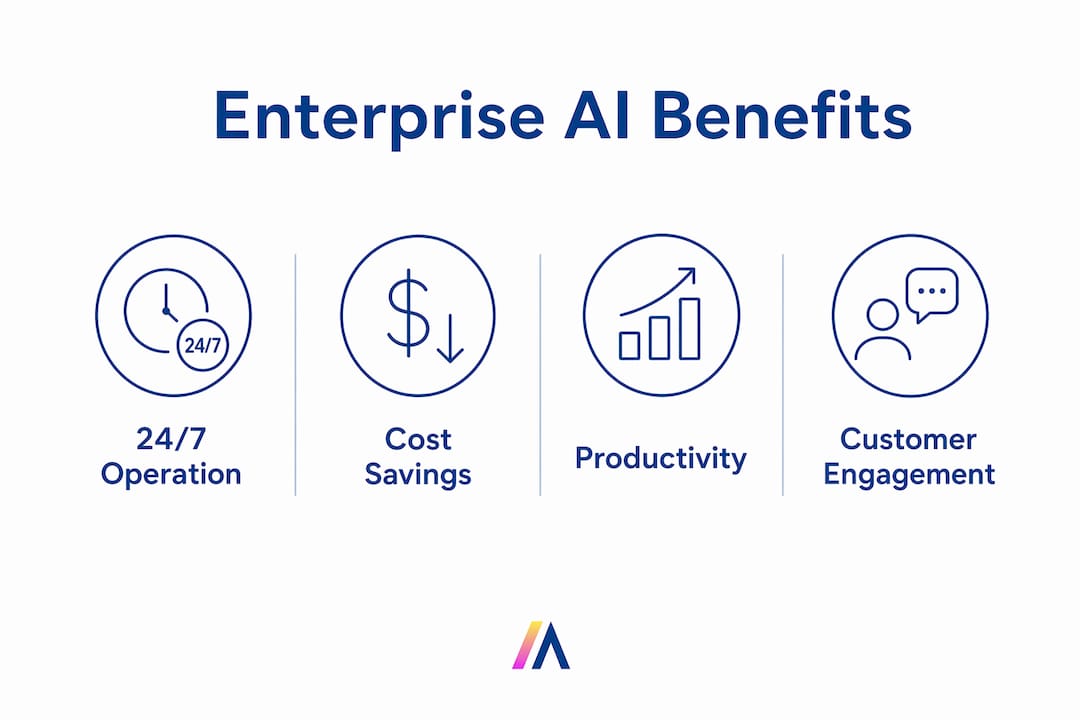
The most immediate driver of enterprise adoption is continuous operational responsiveness. Human teams work in shifts, take vacations, and context-switch. Autonomous agents do not. Agentic AI monitors and responds to processes automatically, around the clock, without degradation in quality or speed. For a global enterprise running customer support, supply chain monitoring, or financial reconciliation across time zones, that capability alone changes the economics of operations.
The contrast with traditional automation matters here. Rules-based robotic process automation (RPA) tools like UiPath or Automation Anywhere execute fixed scripts. They break when conditions change. Autonomous AI agents, by contrast, reason through novel situations. Agents automate entire workflows beyond what rules-based systems can handle, adapting to new inputs and making judgment calls within defined parameters. That is a qualitative shift, not just a speed improvement.
Scaling without proportional headcount growth is the third operational benefit driving adoption. An enterprise that previously needed 50 analysts to process contract reviews can deploy agents that handle the same volume with a fraction of the human oversight. The types of enterprise AI automation available in 2026 span from narrow task agents to orchestrated multiagent systems capable of managing entire business processes end to end.
Key operational benefits enterprises cite most frequently:
Pro Tip: Before deploying agents for scale, map the specific workflows where human bottlenecks create the most measurable delay. Agents deliver the highest ROI when replacing identifiable friction points, not when deployed broadly without a baseline.
The $3 trillion productivity estimate from KPMG is not a marketing figure. It reflects a structural shift in how organizations will allocate cognitive labor over the next decade. Agentic AI reshapes how organizations operate by pairing automation with governance and measurable outcomes. That pairing is what separates genuine enterprise transformation from proof-of-concept theater.
The value creation mechanism works through three channels. First, agents connect directly to enterprise data sources, including CRM systems like Salesforce, knowledge bases in SharePoint, and communication platforms like Slack, to generate context-aware actions rather than generic outputs. Second, they shift human roles from execution to oversight. Deloitte’s research confirms that agentic AI elevates humans to strategic roles while agents handle execution. Third, they enable proactive decision-making by identifying patterns and triggering workflows before problems escalate.
“Agentic AI transforms businesses by automating complex workflows, enabling proactive decision-making and collaborative multiagent ecosystems. This shift elevates humans to strategic roles and challenges traditional automation paradigms.” — Deloitte
The table below summarizes the primary value dimensions enterprises report when adopting AI in enterprises at scale:
| Value dimension | Mechanism | Example outcome |
|---|---|---|
| Productivity multiplier | Agents execute tasks in parallel without fatigue | Contract review time reduced from days to hours |
| Decision speed | Real-time data synthesis and recommended actions | Sales teams receive prioritized lead actions before calls |
| Cost efficiency | Scale without proportional headcount growth | Support volume doubles without adding agents |
| Business model innovation | New service capabilities enabled by agent autonomy | Personalized customer engagement at enterprise scale |
The business model innovation dimension is underappreciated. Enterprises that deploy agents for customer engagement, as Meta’s Business Agent demonstrates, are not just cutting costs. They are creating service experiences that were previously impossible at scale, including real-time personalization, instant booking, and proactive outreach across millions of interactions simultaneously.
KPMG is direct on this point: the main scaling constraint is enterprise readiness, not model capability. The models are ready. Most enterprises are not. Readiness encompasses IT architecture, governance frameworks, operating models, and funding structures. Organizations that skip this assessment deploy agents into fragmented environments and amplify existing operational fragility rather than reducing it.
The governance gap is the most consequential risk. Traditional IT governance frameworks were designed for deterministic software. Autonomous agents learn, adapt, and make decisions that are difficult to audit after the fact. Effective AI agent governance requires new frameworks built around four pillars: accountability, observability, control, and adaptability. Without these, enterprises in regulated industries face compliance exposure that outweighs the productivity gains.
Decision traceability is a specific requirement that many organizations underestimate. In audit-heavy environments, every agent action must capture inputs, rationale, and context. AI deployments in regulated industries require comprehensive decision logs that satisfy both internal audit and external regulatory review. Building this capability retroactively is expensive. Building it into the architecture from day one is not.
The architectural framing matters as much as the governance framework. KPMG warns that treating agents as isolated apps risks fragmenting enterprise architectures and amplifying operational fragility. Agents must be treated as an architectural evolution, integrated with existing data pipelines, identity management, and security controls. Governance-as-code, standardized integration patterns, and role-based access controls are the technical foundations that make scaling safe.
Critical readiness factors to assess before scaling:
Pro Tip: Review the enterprise AI governance best practices framework before finalizing your agent deployment architecture. Retrofitting governance after deployment costs significantly more than embedding it from the start.
Meta’s Business Agent is the most publicly documented enterprise-scale deployment of autonomous AI agents in 2026. It enables businesses to set up AI agents in minutes, achieving 10X or 100X output with personalized, scalable customer engagement. The agent executes booking, lead qualification, and personalized responses with enterprise-grade controls intact. That combination of speed, scale, and control is precisely what enterprise decision-makers are looking for.

The pattern repeats across industries. In financial services, agents monitor transaction streams, flag anomalies, and initiate compliance workflows without waiting for human review cycles. In logistics, agents track shipment exceptions, reroute deliveries, and notify stakeholders in real time. In enterprise sales, agents qualify inbound leads, update Salesforce records, draft follow-up communications, and schedule calls, all within a single workflow triggered by a prospect’s web activity.
The comparison below illustrates how AI agents in business translate across different enterprise functions:
| Use case | Agent capability | Primary benefit |
|---|---|---|
| Customer service | 24/7 response, escalation routing, personalization | Response time reduced from hours to seconds |
| Sales operations | Lead scoring, CRM updates, outreach sequencing | Pipeline velocity increases without adding headcount |
| Financial compliance | Transaction monitoring, anomaly flagging, audit logging | Compliance coverage without proportional analyst growth |
| IT operations | Incident detection, triage, resolution initiation | Mean time to resolution drops significantly |
| Supply chain | Exception monitoring, rerouting, stakeholder alerts | Disruption response time measured in minutes, not hours |
What these examples share is a common adoption motivation: the need to execute complex, multi-step processes at a speed and scale that human teams cannot match alone. The enterprise AI adoption checklist for IT leaders in 2026 consistently points to these high-volume, time-sensitive workflows as the highest-value starting points for deployment.
The personalization dimension deserves specific attention. Meta’s Business Agent does not just automate responses. It generates personalized interactions at scale, something that previously required large customer success teams. That capability represents a genuine business model shift, not just an efficiency gain. Enterprises that recognize this distinction move from cost-reduction framing to revenue-generation framing, which changes how they fund and prioritize agent deployment.
Enterprises adopt autonomous AI agents because the combination of continuous operation, workflow intelligence, and scalable execution creates productivity and competitive advantages that no other technology currently delivers.
| Point | Details |
|---|---|
| Operational continuity | Agents operate 24/7 across time zones, eliminating shift-based gaps in customer service, monitoring, and compliance. |
| Scale without headcount | Enterprises automate high-volume workflows without proportional hiring, as confirmed by Deloitte’s agentic AI research. |
| $3 trillion productivity potential | KPMG’s estimate signals that agentic AI is an infrastructure-level investment, not a departmental tool. |
| Governance is the real constraint | KPMG identifies enterprise readiness, not model capability, as the primary barrier to safe and scalable adoption. |
| Real-world proof exists | Meta’s Business Agent demonstrates 10X to 100X output multipliers in production, validating the adoption case. |
I have watched organizations sprint toward AI agent deployment with genuine excitement and then stall six months in because their data environments were fragmented, their governance models were undefined, and their teams had no clear accountability for agent errors. The technology worked. The enterprise was not ready for it.
The insight I keep returning to is this: the advantages of AI technologies are real, but they are not self-executing. An agent deployed into a broken data architecture will automate broken processes faster. That is not a win. The enterprises that extract the most value from autonomous agents are the ones that treat deployment as an architectural decision, not a software purchase.
My honest recommendation for technology strategists is to resist the pressure to deploy broadly and fast. Start with one high-volume, well-defined workflow where the inputs are clean, the success metrics are clear, and the governance model is documented. Prove the value there. Then expand. Phased deployment with active evaluation is not timid. It is how you build the organizational muscle to scale safely.
The other thing I would push back on is the framing of agents as cost-reduction tools. The most transformative deployments, including Meta’s Business Agent, are creating new service capabilities that were previously impossible. If you are only measuring agent ROI in headcount avoided, you are leaving the most interesting value on the table.
— Matthieu
Hymalaia’s enterprise AI agent platform gives your teams the infrastructure to find, analyze, and act on enterprise data through governed, scalable autonomous agents. The platform connects with over 50 enterprise tools, including Salesforce, Slack, Google Workspace, and SharePoint, and supports RAG-powered responses, role-based access controls, and GDPR-compliant data handling. Whether you are deploying your first agent workflow or scaling across business units, Hymalaia provides the governance architecture and integration depth that enterprise environments require. Explore the platform and see how Hymalaia accelerates ROI from day one, without sacrificing control or compliance.
Autonomous AI agents are software systems that independently access data, reason across it, and execute multi-step workflows without continuous human initiation. Deloitte defines them as autonomous reasoning engines that plan, connect to tools, and act toward defined goals.
Traditional RPA tools execute fixed rules and break when conditions change. Autonomous agents reason through novel situations, adapt to new inputs, and handle complex, multi-step workflows that rules-based systems cannot manage.
KPMG identifies enterprise readiness as the primary constraint, specifically fragmented IT architecture, undefined governance models, and unclear accountability structures. Deploying agents without addressing these factors amplifies operational risk rather than reducing it.
Key metrics include workflow cycle time reduction, cost per transaction, support volume handled without headcount growth, and decision speed improvements. KPMG’s $3 trillion productivity estimate provides the macro frame, but individual deployments require use-case-specific baselines.
Effective governance requires accountability frameworks, observability tools, control mechanisms, and decision traceability logs. In regulated industries, every agent action must capture inputs, rationale, and context to satisfy audit and compliance requirements.
