TL;DR:
- Business intelligence AI agents function as modular units that automate distinct stages of data processing and decision-making. They operate under coordinated orchestration schemas and are best deployed with a governed semantic layer to ensure accuracy and compliance. Starting with a centralized, modular architecture and adding hierarchical or hybrid topologies only as needed optimizes scalability, transparency, and trust in enterprise BI systems.
Business intelligence AI agents are specialized software components that automate distinct stages of the BI workflow, from raw data acquisition through adaptive decision execution. Unlike monolithic analytics platforms, these agents operate as modular units coordinated by orchestration schemas that assign tasks, manage transitions, and reconcile outputs. The MDPI framework identifies five core agent types in modern enterprise BI systems: the Data Collection Agent, Data Preprocessing Agent, Analytical Agent, Decision-Making Agent, and Central Orchestrating Agent. Platforms like Hymalaia deploy this multi-agent model to unify enterprise data sources and automate complex analytical workflows at scale. Understanding which agent type does what, and how they coordinate, is the foundation of any serious AI for data analysis strategy in 2026.
In 2026, BI agent systems commonly use four core functional agents coordinated by a Central Orchestrating Agent. Each agent holds a distinct responsibility, and that separation is what makes the architecture both scalable and auditable.
Data Collection Agent (DCA): Acquires raw data from structured and unstructured sources including databases, APIs, event streams, and third-party platforms like Salesforce or SharePoint. The DCA handles authentication, rate limiting, and schema detection so downstream agents receive consistent input.
Data Preprocessing Agent (DPA): Cleans, normalizes, and transforms raw data into analysis-ready formats. This agent handles deduplication, null-value imputation, type casting, and feature engineering. Without a well-configured DPA, analytical models receive noisy input that degrades output quality.
Analytical Agent (ANA): Applies statistical models, machine learning algorithms, and pattern recognition to preprocessed data. The ANA generates insights, forecasts, and anomaly flags. It is the agent most visible to end users because its outputs feed dashboards and reports.
Decision-Making Agent (DMA): Translates analytical outputs into adaptive policies or recommended actions. The MDPI framework applies reinforcement learning exclusively within the DMA, which preserves modularity and keeps the rest of the pipeline interpretable. This means the DMA learns from feedback loops, such as whether a recommended pricing adjustment actually improved margin, without contaminating the cleaner logic of upstream agents.
Central Orchestrating Agent (COA): Coordinates all four functional agents, manages workflow transitions, handles exceptions, and routes outputs between stages. The COA is the conductor. It does not process data itself but determines sequencing, parallelism, and retry logic across the entire pipeline.
Pro Tip: When deploying a multi-agent BI system, define the COA’s exception-handling rules before go-live. Ambiguous handoff logic between the DPA and ANA is the most common source of silent data quality failures in production.
The functional agents work autonomously with asynchronous communication, which means each agent can scale independently based on load. A spike in data ingestion does not force the ANA to wait. This architecture is what separates enterprise-grade BI AI tools from simple query automation.

Orchestration topology choice impacts latency, debugging complexity, and fault tolerance. Choosing the wrong topology for your data flow structure is one of the most expensive architectural mistakes a BI team can make.
| Topology | Best for | Key trade-off |
|---|---|---|
| Centralized | Simple workflows, small agent counts | COA becomes a bottleneck at scale |
| Pipeline | Sequential, dependency-ordered tasks | Failure in one stage halts the chain |
| Hierarchical | Multi-domain BI with sub-coordinators | Higher coordination overhead |
| Parallel | Independent subtasks needing speed | Result merging adds reconciliation complexity |
| Hybrid | Mixed dependency structures | Routing logic is harder to debug |
Centralized topology places one COA in control of all agents. It is the simplest to implement and the most common starting point. The risk is that the COA becomes a processing bottleneck as agent count grows.
Pipeline topology sequences agents so each stage feeds the next. Pipeline topology suits sequential dependency tasks, making it ideal for ETL-style BI workflows where data must be collected before it can be cleaned, and cleaned before it can be analyzed. The weakness is that a failure in the DPA halts everything downstream.
Hierarchical topology introduces sub-coordinators beneath the primary COA. This suits large enterprises running BI across multiple business units, where a sales analytics sub-agent cluster and a supply chain sub-agent cluster each need local coordination before reporting upward.
Parallel topology runs independent agents simultaneously and merges results. It accelerates processing but requires careful reconciliation logic to avoid conflicting outputs when two analytical agents reach different conclusions from overlapping data slices.
Hybrid topology combines routing schemes from multiple topologies. Real-world BI systems often start centralized then evolve toward hierarchical or hybrid architectures as operational demands grow. The flexibility is real, but so is the debugging complexity.
Pro Tip: Map your BI workflow’s task dependency graph before selecting a topology. If most tasks are sequential, start with pipeline. If tasks are domain-separated, go hierarchical from day one rather than retrofitting later.
Semantic layers prevent metric drift and ambiguity by contracting metric definitions and data lineage as fixed context for AI agents. This is the difference between an agent that guesses what “revenue” means from raw table column names and one that queries a governed definition confirmed by your finance team.
The practical impact is significant:
The governance framework for AI agents must extend beyond the semantic layer to cover the full agent chain. If a sub-agent touches a sensitive data source during a multi-step reasoning workflow, that access must be logged, traceable, and auditable. Without this, organizations face unknown data exposures that surface only during compliance audits.
Architecture choice determines how well your BI AI agent system scales, how easy it is to debug, and how much you can trust its outputs. Three dominant patterns exist in enterprise deployments today.
The MDPI framework’s modular approach assigns each agent a single, well-defined responsibility. Separating learning to the decision-making agent reduces complexity and improves transparency across the system. When the DMA is the only agent using reinforcement learning, you can audit its policy updates without worrying that the DPA or ANA have silently changed their behavior. This architecture is the recommended starting point for enterprise BI projects because it supports independent scaling, targeted debugging, and modular extension without system-wide refactoring.
Some platforms concentrate learning and decision logic in a single model or agent. This simplifies initial deployment but creates two serious problems at scale. First, the central model becomes a black box. When an output is wrong, tracing the error through a monolithic system is significantly harder than isolating a single agent’s behavior. Second, the central model becomes a performance bottleneck as data volume grows. Teams that start here often face expensive architectural migrations within 18 months.
Distributing reinforcement learning or fine-tuning across several agents sounds appealing because it allows each agent to specialize. In practice, limiting reinforcement learning to the decision-making stage improves interpretability compared to complex distributed learning. When multiple agents learn simultaneously, their interactions create emergent behaviors that are difficult to predict, reproduce, or explain to a compliance officer. This approach is best reserved for research contexts or highly mature BI teams with dedicated MLOps infrastructure.
For most enterprise BI projects, modular functional decomposition with a governed semantic layer and a clearly defined COA is the architecture that delivers the best balance of performance, transparency, and maintainability.
Effective BI AI agent systems combine modular functional agents, topology-matched orchestration, and semantic-layer governance to deliver accurate, auditable, and scalable analytics.
| Point | Details |
|---|---|
| Five core agent types | DCA, DPA, ANA, DMA, and COA each own a distinct BI workflow stage. |
| Topology selection matters | Match pipeline, hierarchical, or hybrid topology to your actual task dependency structure. |
| Semantic layers prevent drift | Governed metric definitions stop silent inconsistencies across multi-step agent reasoning. |
| Modular architecture wins | Limiting learning to the DMA preserves interpretability and simplifies debugging at scale. |
| Governance must trace agent chains | Real-time lineage across sub-agents is required for compliance, not just the primary agent layer. |
I have reviewed enough enterprise BI deployments to say this plainly: most failures are not model failures. They are architecture failures. Teams spend months selecting the best analytical model for their ANA, then deploy it inside a monolithic orchestration layer with no semantic grounding, and wonder why analysts do not trust the outputs.
The orchestration topology question is underrated. I have seen organizations deploy a parallel topology because it sounded fast, only to spend weeks debugging reconciliation conflicts between two analytical agents that were both correct on their own data slices but contradictory when merged. A pipeline topology would have solved the problem before it started.
The governed AI versus assistive AI distinction from Omni Analytics is the clearest framing I have encountered for evaluating business intelligence AI tools. If a vendor leads with “chat with your data,” ask what semantic layer grounds the agent’s metric definitions. If the answer is vague, the product is assistive, not governed. For regulated industries, that distinction is the difference between a useful tool and a compliance liability.
My practical advice: start with a centralized topology and a modular five-agent architecture. Add a semantic layer before you add more agents. Introduce hierarchical or hybrid orchestration only when centralized coordination genuinely becomes a bottleneck, not because the architecture diagram looks more sophisticated. Complexity added before it is needed is the single biggest predictor of BI AI projects that stall in production.
— Matthieu
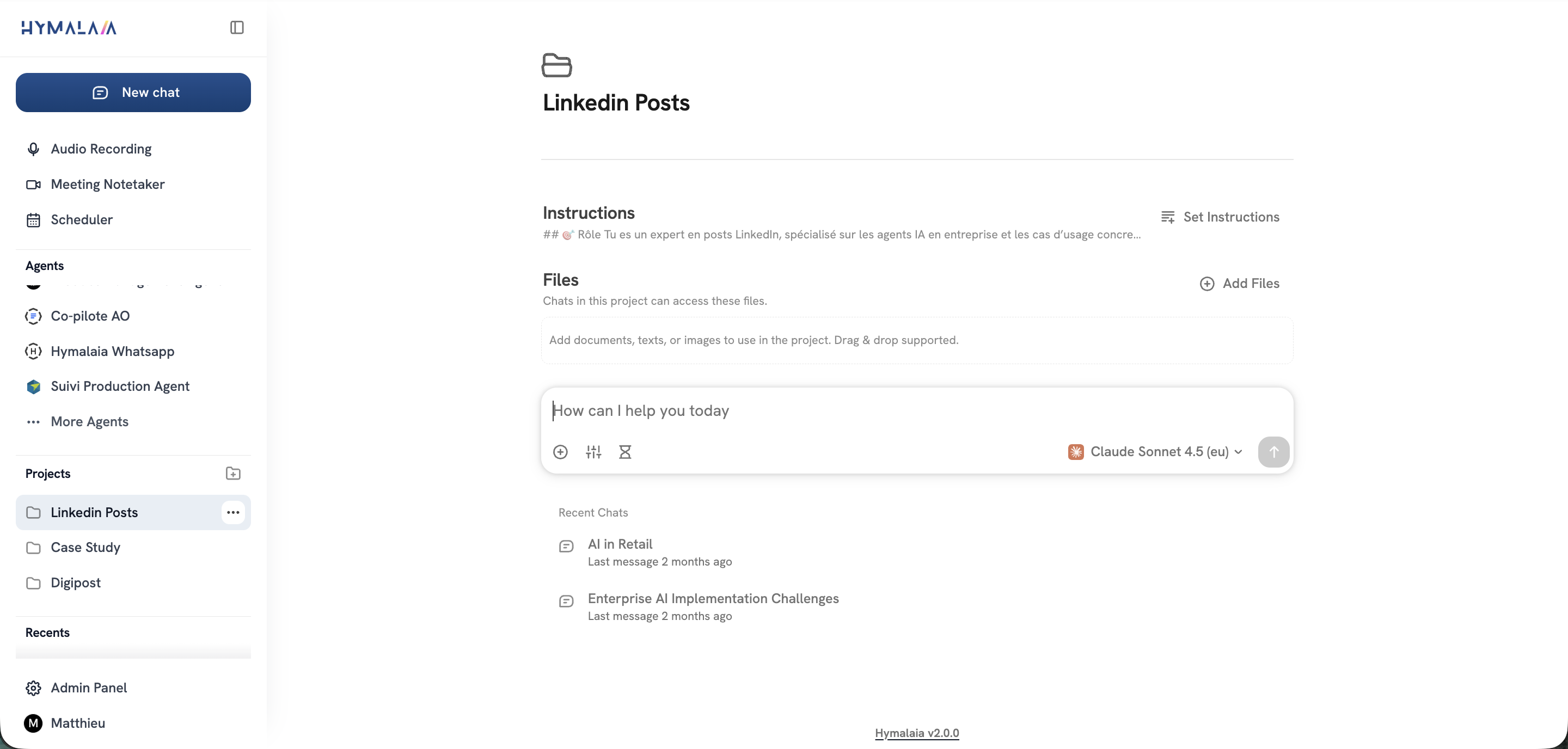
Hymalaia’s enterprise AI agent platform is built for exactly the architecture this article describes. Modular agents, governed semantic integration, and multi-agent orchestration are core platform capabilities, not add-ons. Hymalaia connects with over 50 enterprise data sources including Salesforce, Slack, Google Workspace, and SharePoint, giving your agents accurate, permissioned data from day one. The platform’s advanced RAG and agent features support real-time data lineage, role-based access controls, and GDPR-compliant workflows. If you are ready to move from assistive analytics to governed, autonomous BI, Hymalaia is the platform built for that step. Book a demo and see multi-agent BI in action.
The five core types are the Data Collection Agent, Data Preprocessing Agent, Analytical Agent, Decision-Making Agent, and Central Orchestrating Agent. Each owns a distinct stage of the BI workflow and communicates asynchronously with the others.
Pipeline topology works best for sequential, dependency-ordered BI workflows, while hierarchical topology suits multi-domain enterprise environments. Most teams start centralized and evolve toward hybrid architectures as complexity grows.
Semantic layers lock metric definitions and data permissions into fixed context for AI agents, preventing metric drift and enabling explainable, auditable outputs. Without this grounding, agents guess at metric meanings from raw schema, which erodes analyst trust.
Governed AI grounds every agent action in permissioned, defined analytic context with traceable outputs. Assistive AI adds a natural language interface on top of existing tools without enforcing metric consistency or auditability.
Reinforcement learning is most effective when confined to the Decision-Making Agent, where it adapts policies based on outcome feedback. Distributing learning across multiple agents creates emergent behaviors that are difficult to debug and explain to compliance teams.
