TL;DR:
- Effective cross-source AI data analysis requires a centralized, schema-normalized data infrastructure with robust access controls and audit logging. Implementing staged workflows, reflective query loops, and multi-agent architectures ensures accurate, trustworthy insights while mitigating common issues like schema changes and data duplication. Continuous monitoring, validation, and human oversight are essential to maintain reliable outputs and maximize business value.
Your data is everywhere. CRM records live in Salesforce, ad spend data sits in Google Ads, customer behavior flows through your analytics platform, and operational metrics are buried in a data warehouse you’ve been meaning to clean up for two years. This fragmentation isn’t just inconvenient. 42 to 65% of customer journeys are partially or fully unobservable due to data fragmentation and privacy restrictions, causing up to 26% marketing budget waste. This cross-source data analysis AI agents guide exists to help you fix that. You’ll get the infrastructure prerequisites, a concrete implementation process, troubleshooting techniques, and a measurement framework that actually holds up under scrutiny.
| Point | Details |
|---|---|
| Infrastructure comes first | Centralized data warehouses with schema normalization are non-negotiable before deploying AI agents. |
| Reflective loops prevent errors | AI agents using Plan-Generate-Execute-Reflect-Retry cycles produce far more reliable SQL queries across sources. |
| Deduplication is critical | Explicit event IDs and multi-layer quality checks prevent data inflation and conflicting agent outputs. |
| Human review points matter | Governance and human oversight checkpoints are what separate trusted AI workflows from risky ones. |
| Measure attribution accuracy | KPIs tied to attribution correctness and reduced analyst workload validate your AI agent investment. |
Before a single AI agent touches your data, you need to get your infrastructure in order. This is where most enterprise deployments stumble. Teams rush to configure agents before establishing a foundation that can support them, and the result is unreliable outputs that erode trust quickly.
The starting point is data centralization. Centralized warehouses like Postgres or Snowflake combined with MCP connectors enable complex cross-source SQL joins that direct API proxies simply cannot execute. If your data lives in siloed systems with no unified layer, AI agents will hit walls constantly.
Here is what your infrastructure checklist should include before deployment:
| Infrastructure Component | Purpose | Example Tools |
|---|---|---|
| Data warehouse | Central query layer for all sources | Snowflake, BigQuery, Redshift |
| ETL pipelines | Sync and normalize source data | Airbyte, Fivetran, dbt |
| MCP connectors | Enable agent access to warehouse | Custom API connectors, MCP SDKs |
| RBAC and access policies | Govern agent data permissions | Okta, native warehouse IAM |
| Audit logging | Ensure traceability and compliance | Datadog, warehouse query logs |
Pro Tip: Before you configure any AI agent, run a data quality audit on your warehouse. Identify null rates, duplicate keys, and conflicting field definitions across sources. Agents amplify whatever data quality you already have, good or bad.
With infrastructure in place, you can move to configuration and deployment. AI agents for data integration don’t get stood up in a single afternoon. This is a staged process that requires deliberate design decisions at each step.
Map your data sources and define integration scope. Document every system the agent needs to access, the API endpoints or warehouse tables it will query, and the business questions it needs to answer. Don’t try to boil the ocean. Start with one high-value use case, such as cross-channel attribution for paid marketing.
Integrate APIs and establish data contracts. Connect each source to your warehouse layer via APIs or ETL pipelines. Define data contracts that specify field formats, update frequencies, and schema version expectations. This protects you when upstream systems change.
Train agents with domain-specific context. Provide each agent with a curated knowledge base that includes your business logic, metric definitions, and attribution models. An agent that knows your internal definition of a “qualified lead” will produce far more relevant outputs than one querying raw data blindly.
Configure autonomous workflows with human review checkpoints. AI-driven data analysis techniques work best when agents can operate autonomously for routine queries but surface results for human review before critical business decisions are made. Define exactly where those review gates sit.
Implement server-side tracking with event deduplication. Using an explicit event_id in server-side tracking prevents 40%+ data inflation from duplicate server and client-side event counts. This is non-negotiable for attribution accuracy.
Deploy multi-agent architecture for complex domains. When your analysis spans multiple business units or highly technical domains, a single agent isn’t enough. Specialized multi-agent systems using deterministic rule engines for cross-domain dependency checks produce fully traceable outputs at scale. Think of each agent as owning one domain, with a supervisor agent coordinating the whole workflow.
Establish error handling and retry cycles. Configure your agents to log failed queries, surface error reasons, and retry with refined parameters before escalating to a human reviewer.
| Approach | Best for | Tradeoff |
|---|---|---|
| Single agent, broad scope | Simple, low-volume queries | Lower accuracy on complex joins |
| Single agent, narrow scope | One business domain, deep expertise | Requires multiple deployments |
| Multi-agent with supervisor | Enterprise-wide, cross-domain analysis | Higher setup complexity |
| Hybrid (AI + human review) | High-stakes decisions, regulated industries | Slower throughput, higher trust |
Pro Tip: When building your initial agent workflow, log every query the agent generates, even successful ones. This query history becomes training data for improving future agent behavior and catching subtle reasoning errors early.
Even well-planned deployments run into friction. Knowing where things typically break down helps you design defensively from the start.

The most frequent culprit is API versioning. Source systems update their APIs, schemas shift, and agents that worked fine last quarter start returning errors or, worse, silently wrong results. Build automated schema validation checks that run daily and alert your team when upstream fields change or disappear.
SQL hallucination is a real problem in cross-platform analytics work. Agents using large language models to generate SQL queries can produce syntactically valid but logically incorrect queries. The fix is a reflective loop architecture where agents follow a Plan-Generate-Execute-Reflect-Retry cycle, iteratively refining queries based on execution feedback rather than serving up the first attempt as final output.
Here are the most common issues teams encounter and the mitigations that work:
“The risk isn’t that AI agents will analyze your data incorrectly. The risk is that they’ll analyze it confidently and incorrectly, and no one will check.”
Treating your AI agent deployment as a cross-platform analytics guide problem, rather than just a technology problem, is what separates teams that build trust in their outputs from those that end up reverting to manual spreadsheets six months later.
Getting AI agents deployed is an achievement. Proving they’re working correctly is where the real discipline comes in. Data synthesis with AI tools only delivers business value when you can verify the outputs are accurate and the downstream decisions are better.
Start with full observability. Every agent workflow should produce an audit trail that captures which data sources were queried, what transformations were applied, what the intermediate outputs were, and what the final result was. AI-powered operational analytics that maintain this kind of traceability give you the foundation for regulatory compliance and internal governance reviews.
Pro Tip: Run parallel validation for the first 60 days after deployment. Have analysts manually verify a random 10% sample of agent outputs against the source data. Track the error rate weekly. This gives you a statistically meaningful confidence baseline.
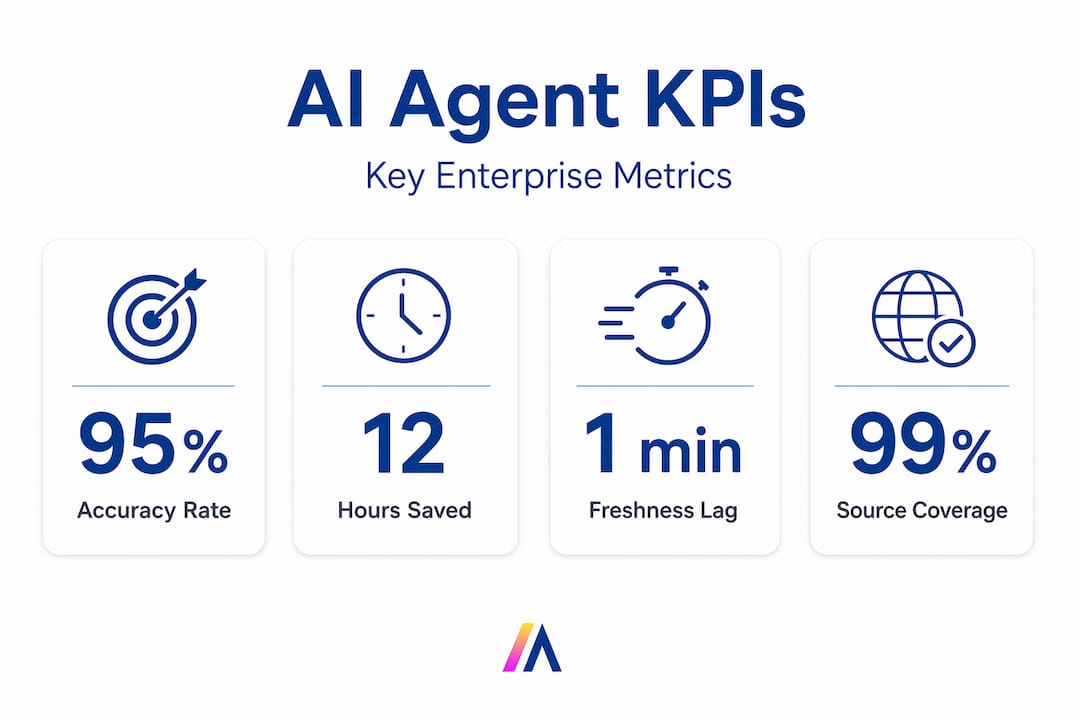
Use this KPI framework to quantify your AI agent’s impact:
| KPI | What it measures | Target benchmark |
|---|---|---|
| Attribution accuracy rate | % of conversions correctly attributed to source | >90% verified against ground truth |
| Analyst hours saved per week | Reduction in manual data pipeline work | 38 hours saved weekly is achievable |
| Data freshness latency | Time between source update and warehouse availability | Under 4 hours for marketing data |
| Query error rate | % of agent-generated queries failing or returning wrong results | Below 2% after reflective loop tuning |
| Cross-source coverage | % of customer journey touchpoints captured across all data sources | Track improvement against your baseline |
Continuous improvement requires governance. Assign ownership of each agent workflow to a specific analyst or team. Schedule monthly reviews of query logs, output accuracy rates, and schema change incidents. AI agents that learn from feedback cycles and are governed by accountable humans are the ones that deliver sustained value. Analytics agents connecting 200+ integrations have demonstrated that maintaining business context across sources is what separates trusted workflows from unreliable ones.
I’ve seen dozens of enterprise teams approach AI agent deployment with the same mistaken belief: that configuring the agent is the hard part. It’s not. The hard part is everything that happens before and after.
In my experience, the teams that struggle most are the ones that treat this as a purely technical exercise. They stand up connectors, configure agents, and then wonder why analysts don’t trust the outputs. What they’ve skipped is the human infrastructure. Defined ownership, documented business logic, explicit review checkpoints, and a culture that treats AI-generated insights as hypotheses to be validated rather than conclusions to be acted on.
The contrarian view I’d offer is this: more automation is not always better. I’ve worked with teams that reduced their human review gates to accelerate throughput and saw their attribution accuracy degrade quietly over three months before anyone noticed. The combination of AI reasoning and human oversight isn’t a transitional phase you graduate out of. For high-stakes data environments, it’s the permanent design.
My practical advice for scaling AI agent deployments in enterprises: start with one domain, one agent, and one clear business question. Prove the output is correct. Document why it’s correct. Then scale. Teams that rush to multi-agent architectures before validating a single agent’s reliability create technical debt that takes months to unwind.
The goal isn’t an AI-run analytics function. The goal is an analytics function that runs better because of AI.
— Matthieu
If you’re ready to move from fragmented data to unified, AI-driven intelligence, Hymalaia’s enterprise AI agent platform is built for exactly this challenge. Hymalaia connects with over 50 enterprise tools including Salesforce, Slack, Google Workspace, and SharePoint, enabling your teams to query across all your data sources through a single, governed layer. The platform’s advanced RAG and agent capabilities maintain full audit trails, support role-based access controls, and deliver deterministic, traceable outputs your analysts can actually trust. Whether you deploy in the cloud, on-premise, or in a hybrid environment, Hymalaia scales with your data complexity. Explore the platform to see how enterprise teams are turning fragmented data into real decisions.
Cross-source data analysis with AI agents refers to using autonomous AI systems to query, join, and synthesize data from multiple disparate sources such as CRMs, ad platforms, and data warehouses. The goal is to produce unified insights that no single source could deliver alone.
Without reflective loop architecture, AI agents can generate syntactically valid but logically incorrect SQL queries across sources. A Plan-Generate-Execute-Reflect-Retry cycle significantly reduces this error rate by refining queries based on execution feedback.
Use explicit event IDs in server-side tracking and implement multi-layer deduplication rules across agent outputs. This prevents data inflation of 40% or more that commonly results from overlapping server-side and client-side event counts.
Track attribution accuracy rate, analyst hours saved per week, data freshness latency, query error rate, and cross-source coverage. These metrics give you a complete picture of both output quality and operational efficiency gains.
It depends on the complexity of your data domains. A single, narrowly scoped agent works well for one business domain. For enterprise-wide analysis spanning multiple functions, multi-agent architectures with a supervisor agent coordinating domain-specific agents produce more accurate and traceable results.
