TL;DR:
- Real-time AI-powered business intelligence enables organizations to act on live data, detecting anomalies and automating responses as events unfold. Success depends on a layered architecture, governed semantic definitions, and strong business objectives, with people adoption being critical for ROI. Delaying investment risks losing competitive advantage, as unified data and context are essential for reliable, actionable insights.
Most business decisions are made on data that is already hours or days old. Your dashboards refresh overnight, your reports arrive Tuesday morning, and by the time the insights reach the right person, the market has moved. Real-time business intelligence with AI changes that equation entirely. Instead of reacting to what happened, you act on what is happening. This guide walks you through the architecture, preparation steps, and execution roadmap to implement AI-powered BI that delivers decisions at the speed your business actually operates.
| Point | Details |
|---|---|
| Architecture is foundational | Real-time BI requires a layered stack covering ingestion, stream processing, storage, and a semantic layer. |
| Semantic layer prevents AI errors | A governed semantic layer stops AI agents from producing hallucinated or conflicting insights across tools. |
| Pre-compute to cut costs | Running AI agents over pre-computed structured results reduces both latency and LLM inference costs. |
| Align BI with business goals first | Technical deployments fail without clear KPIs and business objectives defined before implementation begins. |
| People adoption drives ROI | Successful AI BI projects follow the 10-20-70 rule: 10% algorithms, 20% data, 70% people and process. |
Real-time BI is not simply a faster dashboard. At its core, it is a system that ingests live data from operational sources, processes it continuously, and surfaces AI-driven business insights to decision-makers as events unfold. The AI layer does far more than visualize trends. It detects anomalies, predicts outcomes, explains root causes, and triggers automated responses.
The layered architecture of real-time analytics covers four distinct zones: ingestion (capturing events from databases, APIs, and SaaS platforms), stream processing (transforming and aggregating data in flight), a serving layer (storing pre-computed results for fast query response), and a semantic layer (translating raw metrics into governed business definitions that AI agents can reason over accurately). Each layer has a distinct role. Treating the whole system as a single tool is one of the most common causes of project failure.
Here is what AI adds on top of that architecture:
Common enterprise use cases include real-time revenue monitoring for sales teams, live inventory management for supply chain, dynamic fraud detection in financial services, and AI-powered operational analytics for executive business performance monitoring.
Pro Tip: Do not buy AI analytics tools expecting them to work out of the box. The quality of your real-time BI output is determined almost entirely by the quality of your data pipeline and semantic definitions, not the sophistication of the model.

Getting the technical architecture right matters. Getting the preparation right matters more. Many enterprise deployments stall not because the technology fails, but because the data is inconsistent, the governance is absent, or the business objectives are vague.
Follow these steps before you write a single line of pipeline configuration:
Audit your data quality. Map every source you plan to connect. Identify missing values, conflicting field definitions across systems, and refresh cadences that are too slow for real-time use. A CRM record that updates once per day cannot feed a sub-second pricing model.
Build an AI-ready semantic layer. Governed, unified metrics prevent the situation where your sales tool defines “revenue” differently than your finance platform. Every AI agent that queries your data needs a single, authoritative source of metric definitions or its outputs will contradict each other.
Define business objectives before selecting tools. The competitive edge in enterprise AI comes from accumulated business process logic, not the underlying model. Know what decisions you are trying to accelerate and for which teams before evaluating platforms.
Establish a governance and compliance framework. Define data access policies, role-based permissions, and audit trails from day one. For regulated industries, GDPR and data residency requirements must be embedded in the architecture, not bolted on afterward.
Select technology partners intentionally. Evaluate platforms on integration depth, not just feature lists. A platform that connects to your existing Salesforce, SharePoint, and Slack data without custom middleware saves months of engineering time.
Pro Tip: Treat the semantic layer as a product, not an infrastructure task. Assign a business owner to it alongside the technical owner. When business definitions change, the semantic layer must change with them or your AI agents will start producing insights that no one trusts.
Execution breaks down into four architectural phases, each building on the previous one.
Deploy the ingestion layer. Use change data capture (CDC) to stream operational database events in real time. Connect SaaS sources through API event webhooks. The best real-time data stacks minimize component count by combining CDC, stream processing, and serving within a single platform wherever possible, which reduces failure points and operational overhead.
Implement streaming SQL and materialized views. Rather than running batch queries, define incremental materialized views over your event streams. Streaming materialized views with SQL deliver sub-second analytics freshness without the cost of querying raw data on demand for every AI request. This is the architectural decision that separates fast BI from real-time BI.
Integrate AI agents with live context. Connect your AI agents to the serving layer through the semantic layer. AI agents fail in production not because of compute limitations but because they lack business-aware context. When agents query governed, pre-computed metrics rather than raw tables, they produce consistent, explainable answers.
Automate decisions and reporting. Configure AI agents to trigger workflows based on real-time signals. Examples include automatically escalating a support ticket when sentiment drops below threshold, alerting a sales manager when a deal stalls, or generating an automated business report when a revenue metric deviates by more than 5% from forecast.
The following table summarizes the architecture layers with their primary tools and latency targets:
| Layer | Function | Target latency |
|---|---|---|
| Ingestion | CDC, API event capture | Under 500ms |
| Stream processing | Streaming SQL, materialized views | Under 1 second |
| Serving layer | Pre-computed results storage | Under 100ms query response |
| Semantic layer | Governed metric definitions | Stateless, always current |
| AI agent layer | Reasoning, NLQ, automation | Under 3 seconds end-to-end |
Once you have the core stack running, focus on latency optimization through pre-computation. Running LLMs over pre-computed structured results is significantly cheaper and faster than querying raw streaming data for every inference request. Budget your LLM calls for reasoning tasks, not data retrieval.
Even well-planned deployments hit predictable obstacles. Knowing them in advance cuts resolution time significantly.
AI hallucinations from context gaps. When AI agents query data without a governing semantic layer, they make assumptions about metric definitions that produce wrong answers. The fix is not a better model. It is a better context engineering approach that provides agents with verified, governed context at query time.
Data silos slowing integration. Most enterprises have 20 or more disconnected data sources. Prioritize the three to five sources with the highest decision impact and integrate those first. Do not attempt a full-organization integration in phase one.
LLM cost overruns. Unconstrained AI querying over raw data is expensive. Pre-compute your most frequently queried metrics and route AI agents to those results. Reserve real-time raw data querying for exception cases where freshness is non-negotiable.
Latency spikes under load. Real-time BI systems degrade under high concurrency if the serving layer is underpowered. Test at two to three times your expected peak load before go-live.
Low adoption among business users. Empowering people with explainable AI insights is the key to adoption, not just providing access. Train teams on how to interpret AI outputs, not just how to use the interface. Pair rollout with change management planning from the start.
Pro Tip: Run a “trust audit” three months after go-live. Ask business users whether they actually use AI-generated insights to make decisions or whether they verify them manually every time. If the answer is mostly the latter, you have a context quality or explainability problem, not a technology problem.
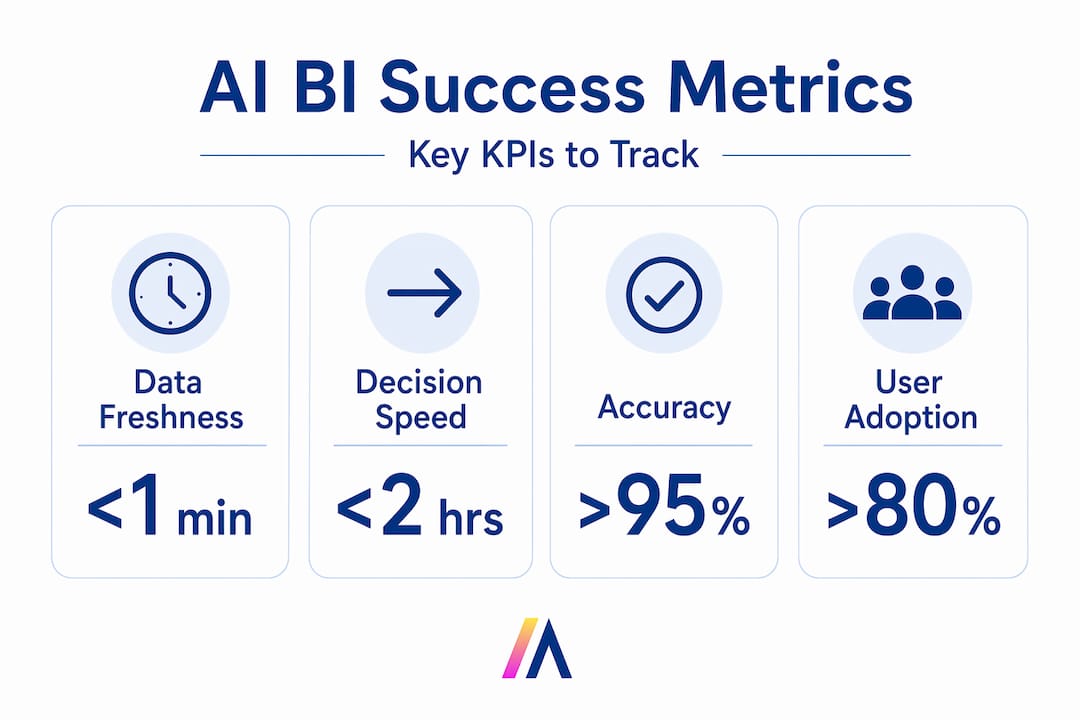
Defining success before you launch is not optional. Without clear KPIs, you will have no way to distinguish a well-functioning system from an expensive one.
| Metric category | What to measure | Why it matters |
|---|---|---|
| Data freshness | Average lag from event to insight | Confirms real-time capability is working |
| Decision speed | Time from insight to business action | Shows whether BI is changing behavior |
| AI accuracy | Rate of correct vs. disputed AI outputs | Validates semantic layer and context quality |
| User adoption | Percentage of team using AI insights weekly | Indicates trust and workflow integration |
| Business impact | Revenue, cost, or efficiency delta post-deployment | Ties investment to measurable outcomes |
Continuous monitoring with causal analysis is where real-time AI BI moves from reporting to intelligence. AI tools that combine always-on monitoring with root cause analysis and experiment tracking give you not just what is happening, but why and what to do next. That is the standard to hold your system to. Revisit your semantic definitions quarterly as your business evolves, and scale your serving layer capacity ahead of anticipated data growth to avoid degradation.
The 10-20-70 rule for AI transformation applies here directly: 10% of success comes from the algorithm, 20% from data quality, and 70% from how well your people adopt and act on the system. Invest accordingly.
I have worked alongside organizations that delayed real-time BI investment because they believed their existing dashboards were “good enough.” In every case, that position became untenable within 18 months. Competitors who moved earlier were making pricing decisions in minutes, spotting demand signals before they appeared in weekly reports, and compounding those advantages quarter after quarter.
What I have learned is that the technology is rarely the bottleneck. The semantic layer and context engineering discipline are what separate deployments that work from those that generate expensive skepticism. I have seen organizations spend significant budget on AI analytics tools only to find their agents producing contradictory revenue figures because no one had unified the metric definitions across source systems. That is a governance failure masquerading as an AI failure.
My contrarian view: stop obsessing over which AI model to use. The proprietary business process logic embedded in your data and workflows is worth more than the model running over it. Invest in your semantic layer, your data pipelines, and your people before you evaluate the latest LLM release. And when you do roll out AI BI to your organization, treat predictive operational efficiency as a measurable business outcome, not a technology milestone. That framing changes how you prioritize and how you succeed.
— Matthieu
Hymalaia’s enterprise AI agent platform is built for exactly what this guide describes. ️ It connects to over 50 enterprise data sources including Salesforce, Slack, Google Workspace, and SharePoint, giving your AI agents live, governed context across every operational system. The platform’s retrieval-augmented generation (RAG) architecture means agents query structured, trusted data rather than raw tables, keeping costs low and answers accurate.
For business leaders ready to move from weekly reports to real-time intelligence, Hymalaia delivers AI agents that find, analyze, and act on live data across your organization. GDPR-compliant, role-based access controls, and flexible deployment options (cloud, on-premise, or hybrid) give your governance and security teams confidence from day one. Explore the full platform capabilities or book a demo to see real-time business intelligence in action inside your own data environment.
Real-time business intelligence with AI combines live data pipelines with AI agents that analyze, interpret, and act on data as events occur. Unlike traditional BI, it delivers insights in seconds rather than hours or days.
AI agents produce inconsistent or hallucinated insights when they lack a governed semantic layer. Without unified metric definitions, agents make conflicting assumptions about business data, which produces unreliable outputs regardless of model quality.
Pre-compute your most frequently queried metrics using streaming materialized views and route AI agents to those results rather than raw data. This approach significantly reduces both inference costs and query latency.
Track data freshness (lag from event to insight), decision speed (time from insight to action), AI output accuracy, weekly user adoption rates, and measurable business outcomes like revenue or cost impact.
Timeline varies by data complexity and integration scope, but AI-assisted implementation tools can reduce transformation timelines by up to 35%. Most enterprise deployments reach an initial production state within three to six months with phased rollout.
