TL;DR:
- Connecting enterprise tools to a unified AI platform involves integrating multiple applications under a governed AI layer that automates and analyzes data flows. Success requires a comprehensive tool inventory, a clear architecture, and strict governance to ensure security and scalability across all processes. Prioritizing governance over connectors and adopting operational discipline are essential for sustainable enterprise AI integration.
Connecting enterprise tools to a single AI platform is defined as the practice of unifying disparate business applications, data sources, and workflows under one governed AI layer that can analyze, act, and automate across all of them simultaneously. Organizations running 15 to 50 specialized applications can eliminate 80% of manual data handling by automating just 20 to 30 critical data flows. The industry term for this discipline is enterprise AI integration, and it spans everything from low-code connector configuration to full Integration Operations (IntOps) programs. Platforms like Arahi AI, Agent Bricks, and Hymalaia make this achievable without multi-year IT programs. Done correctly, the result is faster decisions, less redundant work, and a governance model that scales with your organization.
Before you configure a single connector, you need three foundational assets in place: a complete tool inventory, a defined integration architecture, and a governance framework that covers identity, permissions, and audit trails.

Tool inventory means cataloging every application your teams actively use, including Salesforce, Slack, Google Workspace, SharePoint, SAP, and any homegrown systems. Without this map, you will build integrations that duplicate effort or miss critical data sources entirely.
Integration architecture is the structural decision about how data moves. Your primary options are point-to-point connections, an enterprise service bus (ESB), an API-led connectivity model, or an AI agent layer that sits above all of them. For most enterprises in 2026, the AI agent layer is the fastest path to unified visibility because it abstracts the underlying complexity.
Governance frameworks define who can access what data, under which conditions, and with what audit record. This is not optional. Effective AI integration requires agents to inherit user identity and permissions to access only authorized data, preventing data leakage and compliance failures.
Here is a summary comparison of leading platforms for enterprise AI integration:
| Platform | Primary Strength | Deployment Speed | Best For |
|---|---|---|---|
| Arahi AI | Pre-wired connectors to 1,500+ apps | Hours to days | Rapid AI agent deployment |
| Agent Bricks (Databricks) | Governed agent orchestration with token passing | Days to weeks | Regulated industries needing strict data controls |
| Celigo | Centralized monitoring and error handling | Days | IT teams managing large integration portfolios |
| MuleSoft | API-led connectivity at enterprise scale | Weeks to months | Complex multi-cloud architectures |
| Boomi | Low-code integration with broad connector library | Days to weeks | Mid-to-large enterprises modernizing legacy stacks |
| Hymalaia | AI agent management with built-in governance | Hours to days | Enterprises needing unified search, analysis, and action |
Cost is a real variable here. Real-time integration costs 3 to 5 times more than batch processing, which means your architecture choice directly determines your operating budget. Evaluate whether your use cases genuinely require real-time data or whether near-real-time batch processing delivers equivalent business value at a fraction of the cost.
Pro Tip: Before selecting a platform, run a prototype AI workflow with your three highest-volume data flows. The deployment friction you encounter in that test will tell you more about platform fit than any vendor demo.
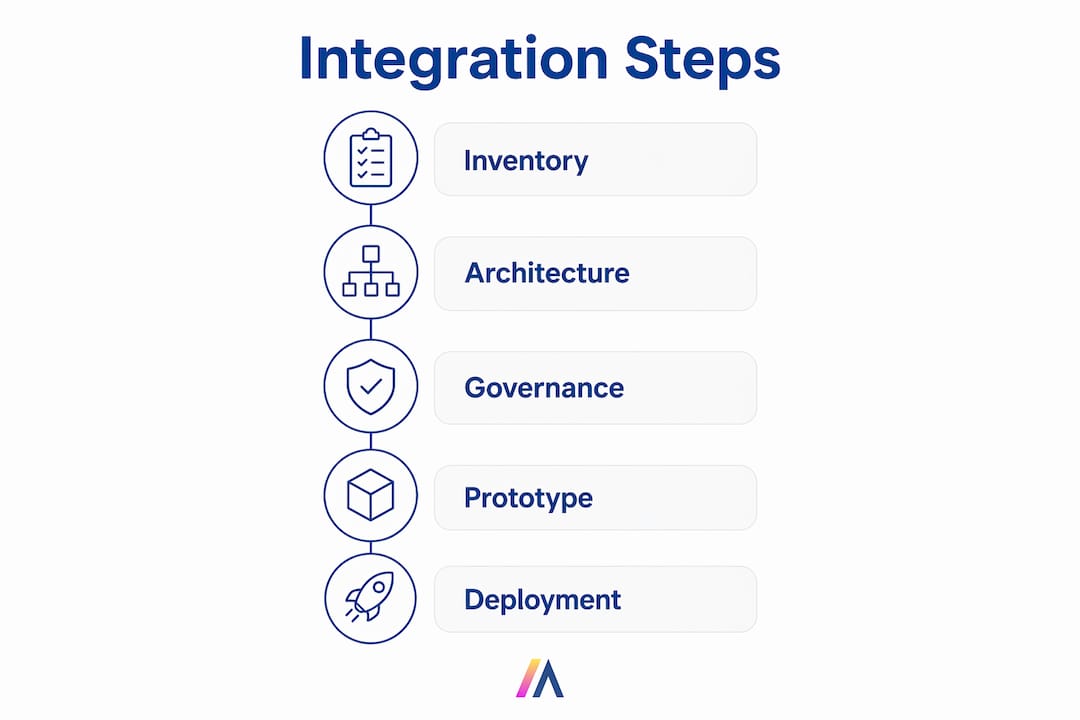
Successful enterprise AI integration follows a repeatable sequence. Skipping steps, particularly the governance and testing phases, is the primary reason integration projects stall or create new security risks.
Assess and map your current state. Document every tool, every data flow, and every team that depends on each connection. Identify the 20 to 30 data flows that carry the highest transaction volume or business impact. These are your integration priorities.
Select your integration architecture and platform. Match the platform to your constraints: deployment timeline, security requirements, connector coverage, and internal technical capacity. If your team lacks deep API expertise, a low-code AI agent platform that supports production-grade deployments in as little as one afternoon is a legitimate enterprise option, not a shortcut.
Configure connectors and AI agents. Use pre-built connectors wherever they exist. Platforms like Arahi AI offer pre-wired connections to over 1,500 applications, which means your team configures rather than builds. For custom systems, REST APIs or webhook-based connectors are the standard approach. Define what each AI agent is authorized to read, write, and execute before it goes live.
Establish identity and permissions governance. Every AI agent must operate with on-behalf-of token passing, meaning it acts with the permissions of the authenticated user, not with a blanket service account. Unified governance platforms manage agents alongside data, models, and external tools with identity enforced end-to-end. This is the mechanism that prevents one user’s AI query from surfacing another user’s confidential data.
Test integrations against failure scenarios. Do not test only the happy path. Simulate API timeouts, permission denials, and malformed data payloads. Platforms like Celigo centralize monitoring, error handling, and governance, enabling IT teams to manage large-scale integrations with automated failure handling. Build your error handling logic before you deploy to production.
Deploy and monitor with centralized dashboards. Once live, every integration should report status, volume, and error rates to a single operations dashboard. This gives your IT team the observability needed to catch degradation before it becomes a business disruption.
Pro Tip: Assign a named integration owner for each connected tool. Ownerless integrations accumulate technical debt silently. When a connector breaks at 2 a.m., you need one person whose phone rings.
The most dangerous assumption in enterprise AI integration is that it is primarily a technology problem. Integration is fundamentally an operations problem, requiring managed services with reliability guarantees to handle multi-vendor complexity. The technology is largely solved. The operations discipline is where most projects fail.
Here are the specific pitfalls that derail integration programs:
“The enterprises that succeed with AI integration are the ones that treat it like running a product, not completing a project. They staff it, monitor it, and iterate on it continuously.”
Scalability is also a hidden challenge. An integration that handles 10,000 daily transactions smoothly may degrade at 100,000 without architectural adjustments. Design for 10x your current volume from the start.
Platform selection is a strategic decision, not a procurement exercise. The right platform for your organization depends on five criteria evaluated against your specific environment.
| Criteria | What to Evaluate | Why It Matters |
|---|---|---|
| Connector breadth | Number of pre-built connectors to your existing tools | Reduces custom development time and cost |
| Governance technology | Identity enforcement, RBAC, audit logging, GDPR compliance | Determines your compliance posture and data security |
| Deployment flexibility | Cloud, on-premise, hybrid options | Matches your infrastructure and data residency requirements |
| Scalability | Kubernetes-based orchestration, auto-scaling, message volume limits | Protects performance as usage grows |
| Vendor ecosystem | Partner network, marketplace integrations, support SLAs | Affects long-term maintainability and vendor lock-in risk |
Vendor ecosystem matters more than most IT managers initially expect. A platform with 50 native connectors but a strong partner network often outperforms a platform with 200 connectors and no support structure. When a connector breaks or a new tool needs integration, your path to resolution runs through that ecosystem.
Assess cost structures carefully. Licensing models vary widely: per-message pricing, per-connector fees, compute-based billing, and flat enterprise contracts each create different cost curves as your integration volume grows. A platform that appears affordable at pilot scale can become the largest line item in your IT budget at full deployment.
Pro Tip: Request a proof-of-concept with your three most complex integrations, not your easiest ones. Vendors always demo their strengths. You need to see how the platform handles your edge cases, legacy systems, and security requirements before you sign a contract.
Deployment speed is a genuine differentiator. Scaling AI agents securely at enterprise level requires platforms that combine pre-built governance controls with flexible agent configuration, so your team ships value in days rather than quarters. Evaluate whether the platform’s default configuration meets your security baseline or requires significant customization before it is production-ready.
Connecting enterprise tools to a single AI platform succeeds when you combine a governed integration architecture, user-level identity enforcement, and an operational mindset that treats integration as a continuous discipline rather than a one-time project.
| Point | Details |
|---|---|
| Start with a tool inventory | Map every application and data flow before selecting a platform or configuring connectors. |
| Enforce identity at the agent level | Use on-behalf-of token passing so AI agents access only data the requesting user is authorized to see. |
| Choose architecture before platform | Decide between point-to-point, ESB, API-led, or AI agent layer models based on your scale and security needs. |
| Treat integration as operations | Assign owners, monitor health, and iterate continuously rather than treating integration as a completed project. |
| Evaluate platforms on governance first | Connector breadth matters, but governance technology, deployment flexibility, and scalability determine long-term success. |
Most conversations about connecting enterprise tools focus on connectors and APIs. After working with enterprise integration programs across industries, I have found that the organizations that succeed long-term are almost never the ones with the most connectors. They are the ones that built governance infrastructure first and treated it as a strategic asset.
The shift I keep seeing underestimated is the move from IT-only integration thinking to what Celigo calls Integration Operations. Enterprises that build Integration Centers of Excellence achieve scalable, governed AI connectivity. That is not a technology claim. It is an organizational design claim. You need cross-functional teams, documented standards, and named accountability for every integration in your portfolio.
The other thing I would push back on is the assumption that low-code platforms are less serious than custom-built integrations. In my experience, the opposite is often true. A well-configured low-code AI agent that deploys in an afternoon and inherits your existing governance controls is more secure and more maintainable than a custom integration built by a contractor who left six months ago. The role of APIs in AI integration is evolving fast, and platforms that abstract that complexity without sacrificing control are where the real productivity gains live.
The leaders who get this right stop asking “which tool should we integrate next?” and start asking “what decisions do we need to make faster, and what data do those decisions require?” That reframe changes everything about how you prioritize, govern, and measure your integration program.
— Matthieu
Hymalaia is built specifically for enterprises that need to connect business applications, analyze data across systems, and automate workflows without sacrificing security or compliance. ️
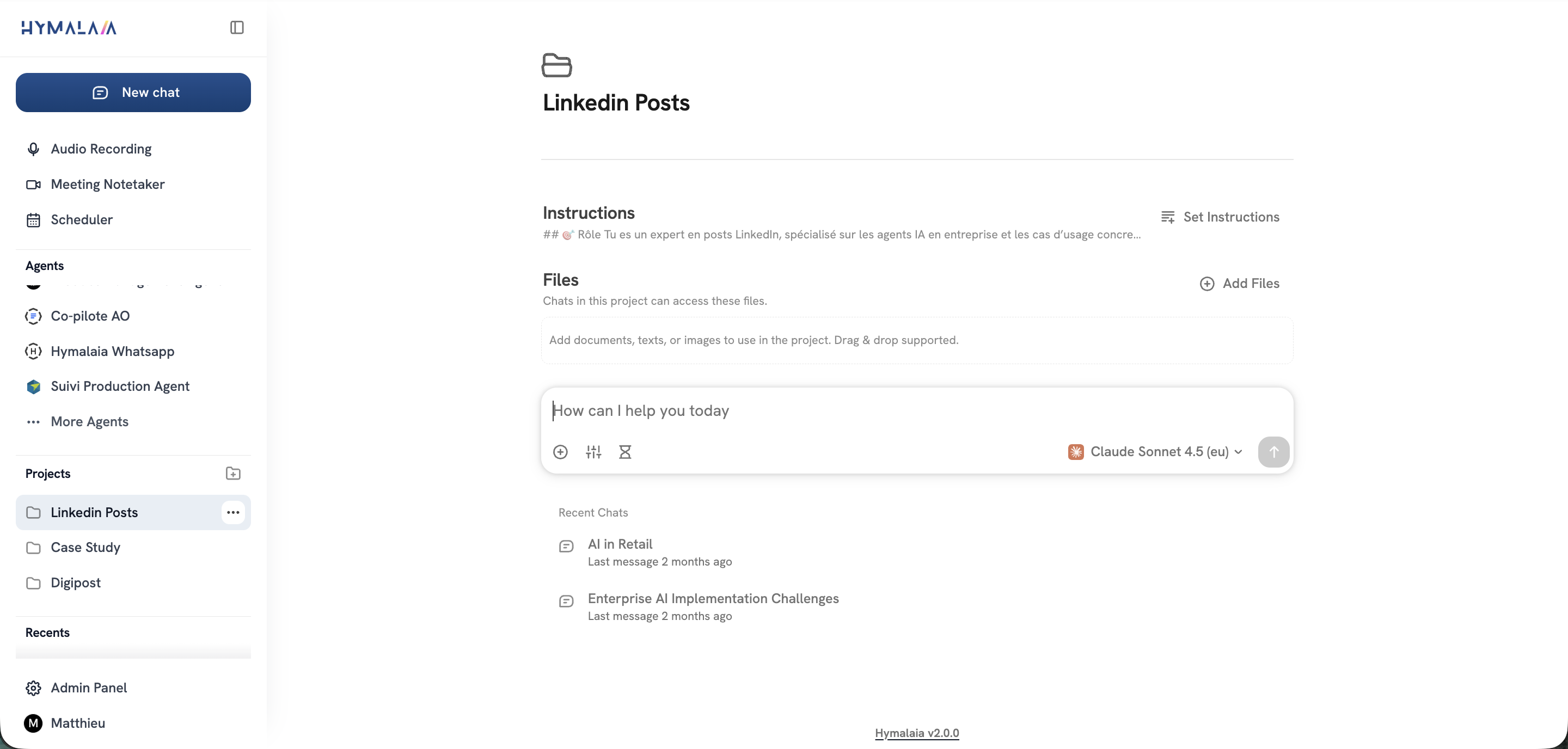
Hymalaia connects to over 50 enterprise tools including Salesforce, Slack, Google Workspace, and SharePoint through managed OAuth connectors with built-in RBAC and GDPR-compliant data handling. Its AI agents use retrieval-augmented generation (RAG) to surface accurate, real-time answers from your connected data sources, and they execute actions across your tool stack from a single interface. Deployment options include cloud, on-premise, and hybrid environments, so your data residency requirements are never a constraint. If you want to see how Hymalaia fits your specific integration architecture, book a demo and bring your three hardest integration challenges. That is where the conversation gets useful.
It means routing data, queries, and automated actions from multiple business applications through one governed AI layer that can analyze and act across all of them. The AI platform handles identity enforcement, data retrieval, and workflow execution without requiring users to switch between tools.
Deployment timelines range from a single afternoon for pre-wired low-code platforms to several months for complex API-led architectures. Low-code AI agent platforms with pre-built connectors to over 1,500 applications can reach production-grade deployment within hours for standard use cases.
The most critical risk is AI agents operating with shared service account credentials instead of user-specific permissions. This allows agents to access data the requesting user is not authorized to see. On-behalf-of token passing, where the agent inherits the authenticated user’s identity, is the standard mitigation.
Calculate the cost of manual data handling across your highest-volume workflows, then model the reduction from automating your top 20 to 30 data flows. Automating critical data flows can eliminate 80% of manual data handling in enterprises running 15 to 50 specialized applications, which translates directly to measurable labor cost reduction.
An Integration Center of Excellence is a cross-functional team that owns integration standards, governance policies, and scalability decisions across the enterprise. It shifts integration from a reactive IT task to a proactive operational discipline, which is the organizational model behind scalable AI connectivity at enterprise scale.
