TL;DR:
- Role-based access control (RBAC) is essential for securing AI in enterprises by defining permission boundaries based on organizational roles. Proper adaptation involves request-level enforcement, layered ABAC, and maintaining a non-human identity registry to manage AI agent lifecycles effectively. These architectural practices ensure compliance, minimize risks, and enable auditability in dynamic AI environments.
Role-based access control (RBAC) is defined as a security model that assigns system permissions based on predefined organizational roles, and it is the foundational privilege boundary for securing AI implementations in enterprise environments. As AI agents proliferate across platforms like Salesforce, SharePoint, and Google Workspace, the importance of access control in AI extends far beyond traditional user authentication. RBAC governs what both human users and autonomous AI agents can read, write, and execute. Without it, AI systems become vectors for privilege escalation, data leakage, and compliance failure under frameworks like GDPR, HIPAA, and SOC2. The role of role-based access control in AI is no longer optional governance hygiene. It is a core architectural requirement.
Traditional RBAC was designed for human principals: an employee gets a role, the role carries permissions, and those permissions persist until revoked. AI agents break every assumption in that model. An AI agent is not a person. It operates continuously, executes dozens of tool calls per session, and often acts on behalf of multiple users simultaneously.

The two dominant models for AI agent authorization are agent-as-principal and on-behalf-of (OBO). In the agent-as-principal model, the AI agent holds its own identity and role assignments independent of any user. In the OBO model, the agent inherits permissions from the user who triggered it. Both carry risks. Agent-as-principal can lead to over-broad standing permissions. OBO creates silent privilege escalation when an agent runs under a privileged user session and gains access far beyond what the specific task requires.
The fix is request-context binding. Every downstream call should carry an immutable, signed context object describing the originating user, tenant, session, request ID, and the policy decisions that authorized the call. This shifts the privilege boundary from login time to request time, which is the only enforcement point that actually matters in agentic workflows.
Key risks that emerge when RBAC is not adapted for AI agents:
Pro Tip: Treat every AI agent tool call as a new authentication event. Evaluate permissions per call, not per session, to contain the blast radius of any single compromised agent.
Designing RBAC for AI systems requires deliberate architectural choices that go beyond mapping users to roles. The following patterns define a production-grade access control architecture for AI environments.
Define agents as first-class principals. Each AI agent receives its own identity in your identity provider, whether that is Microsoft Entra ID, Okta, or a custom NHI registry. This separates agent permissions from user permissions entirely.
Apply per-tool scoping. Rather than granting an agent broad read/write access to a data source, scope each permission to the specific tool call it needs. An agent querying Salesforce for contact data should not hold write permissions to opportunity records.
Implement request-context binding. Immutable context propagation across every agent call prevents OBO models and per-tool scoping from becoming advisory-only controls. Without signed context, downstream services cannot verify the authorization chain.
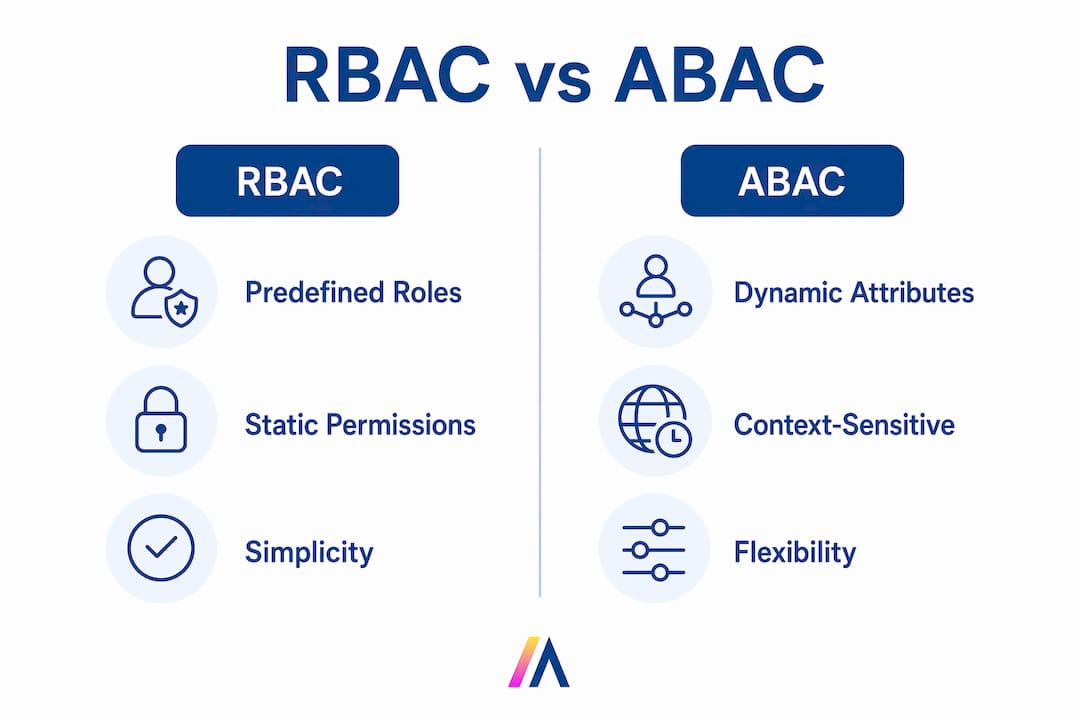
Layer ABAC on top of RBAC. RBAC provides coarse-grained access as the structural foundation, while attribute-based access control (ABAC) handles dynamic conditions: time of day, geographic location, data sensitivity scores, and real-time risk signals. RBAC alone cannot evaluate these runtime variables.
Enforce tenant isolation. In multi-tenant AI deployments, every permission evaluation must include tenant context. Cross-tenant data leakage through shared agent sessions is one of the most common and least visible failure modes in enterprise AI.
The table below compares RBAC and ABAC across the dimensions most relevant to AI security teams:
| Dimension | RBAC | ABAC |
|---|---|---|
| Permission basis | Predefined organizational role | Dynamic attributes (user, resource, environment) |
| Evaluation timing | Login or provisioning | Per request, real-time |
| Granularity | Coarse (role level) | Fine (attribute combination level) |
| AI agent suitability | Foundation layer | Runtime enforcement layer |
| Audit complexity | Lower | Higher, requires attribute logging |
Pro Tip: Start with RBAC to define your permission structure, then add ABAC policies for the specific conditions your AI agents encounter in production. Trying to build ABAC from scratch without an RBAC foundation creates unmanageable policy sprawl.
In Kubernetes environments, RBAC hardening frameworks use penalty functions combining risk scores, complexity metrics, and constraint violations to refine role bindings and reduce over-privilege automatically. This approach is directly applicable to AI workloads running in containerized infrastructure. For teams building zero trust security for AI, per-request evaluation is the technical implementation of the “never trust, always verify” principle.
The governance gap in most enterprise AI deployments is not in the RBAC policy itself. It is in the lifecycle management of the identities those policies govern. Extending human RBAC controls to AI agents without adapting lifecycle and approval processes creates security gaps: unmanaged service accounts, absent access reviews, and unclear ownership.
A non-human identity (NHI) registry is the operational solution. NHI registries record each agent’s identity, owning team, systems accessed, privilege scope, and expiration or review dates. Without this registry, your security team cannot answer basic questions: How many AI agents are currently active? Which ones have write access to production data? When was the last access review?
The AI agent lifecycle has three critical governance moments:
The compliance implications are direct. SOC2 Type II audits require evidence of access reviews for all principals, including non-human ones. HIPAA requires demonstrable access controls on any system touching protected health information, regardless of whether the accessor is human. Treating AI agents as second-class identity citizens is not a gap that auditors overlook.
Pro Tip: Tag every AI agent credential with a maximum TTL (time to live) at provisioning. Credentials that expire automatically are far safer than those that require manual revocation, which often never happens.
For teams building out AI governance frameworks, NHI lifecycle management should be a first-tier control, not an afterthought added after the first audit finding.
Logging is the enforcement proof for every RBAC policy you write. A permission boundary that is not logged is a boundary that cannot be verified, investigated, or demonstrated to a regulator.
The EU AI Act requires high-risk AI systems to maintain automatic logging and lifecycle traceability of access control events. Critically, logging is difficult to retrofit into an existing AI system. Teams that deploy AI agents without logging infrastructure from day one face significant rework costs when compliance deadlines arrive.
| Compliance framework | Logging requirement | AI-specific challenge |
|---|---|---|
| EU AI Act | Automatic event logging for high-risk systems | Agent actions span multiple services and sessions |
| GDPR | Audit trail for personal data access | AI agents access personal data at scale and speed |
| HIPAA | Access logs for all PHI interactions | Multi-agent chains obscure the originating accessor |
| SOC2 Type II | Evidence of access reviews and controls | NHI credentials often lack formal review processes |
Effective audit logging for AI systems requires three technical properties. First, logs must be immutable. Any log that an agent or its operator can modify after the fact is not an audit log. Second, logs must carry signed context. Each log entry should include the request ID, originating user, tenant, agent identity, and the policy decision that authorized the action. Third, permissions must be evaluated at every handoff between agents in multi-agent workflows, and each evaluation must produce a log entry. Without per-handoff logging, an authorization chain that starts legitimately can drift into unauthorized territory with no visible record.
Integration with existing security information and event management (SIEM) platforms like Microsoft Sentinel or Splunk is the practical delivery mechanism. AI agent logs should flow into the same pipelines as human access logs, enabling correlation and anomaly detection across both principal types. Teams exploring human-in-the-loop oversight for AI systems will find that meaningful oversight is only possible when complete, attributed logs are available in real time.
RBAC is the structural permission boundary for AI systems, but it requires request-level enforcement, non-human identity governance, and ABAC layering to be effective in agentic environments.
| Point | Details |
|---|---|
| Request-level enforcement | Evaluate permissions per tool call, not per session, to prevent privilege escalation in AI agents. |
| NHI registry requirement | Maintain a centralized registry of all AI agent identities with scopes, owners, and review dates. |
| RBAC plus ABAC architecture | Use RBAC for structural roles and ABAC for dynamic runtime conditions like data sensitivity and geography. |
| Lifecycle governance | Provision, review, and deprovision AI agent credentials on a formal schedule with TTL enforcement. |
| Compliance-ready logging | Deploy immutable, signed, per-request logs from day one to meet EU AI Act, GDPR, and SOC2 requirements. |
Most teams I see struggling with AI access control are not failing because they lack policies. They are failing because they designed their RBAC at the wrong level of abstraction. They mapped AI agents to existing user roles, granted session-level permissions, and assumed that their existing identity infrastructure would carry the load. It does not.
The shift that actually changes outcomes is moving the privilege boundary from authentication time to request time. That requires signed context propagation, per-tool scoping, and ABAC layering. None of those are policy decisions. They are architectural ones, and they need to be made before the first agent goes to production, not after the first incident.
The second thing I would push back on is the instinct to treat non-human identity governance as a future-state problem. Every week an AI agent operates without a formal identity record, a defined owner, and a scheduled review is a week of compounding risk. The AI data security controls that matter most are the ones you can actually audit. An NHI registry is not overhead. It is the minimum viable governance artifact for any enterprise running AI agents at scale.
The future of AI access control will involve dynamic, policy-as-code systems that evaluate permissions in real time against live risk signals. RBAC will remain the structural foundation, but the enforcement layer will look much more like continuous authorization than static role assignment. Teams that build that foundation correctly today will adapt to that future without rebuilding from scratch.
— Matthieu
Hymalaia’s enterprise AI agent platform is built with RBAC and identity governance as core infrastructure, not add-ons. The platform synchronizes roles directly from Active Directory and Microsoft Entra ID, so your existing organizational role structure governs AI agent permissions without manual duplication. Every agent action is evaluated against scoped permissions at the request level, with immutable logs flowing to your SIEM for compliance reporting against GDPR, SOC2, and the EU AI Act.
For IT and security teams managing AI deployments across Salesforce, Slack, SharePoint, and 50-plus enterprise tools, Hymalaia provides the enterprise AI platform that makes access governance operationally manageable. Audit-ready logs, NHI lifecycle controls, and real-time policy enforcement are available out of the box. Book a demo to see how Hymalaia enforces least-privilege access across your entire AI agent fleet.
RBAC defines the permission boundaries for both human users and AI agents within enterprise AI systems, controlling which data sources, tools, and actions each principal can access. It is the foundational access control layer that compliance frameworks like GDPR, HIPAA, and SOC2 require.
AI agents require per-request permission evaluation rather than session-level access, because they execute multiple tool calls autonomously and can inherit excessive privileges from user sessions. Proper RBAC for AI agents requires signed context binding and per-tool scoping that traditional human RBAC does not.
A non-human identity (NHI) registry is a centralized record of all AI agent credentials, capturing each agent’s identity, owning team, privilege scope, and review dates. Without it, enterprises cannot conduct access reviews or demonstrate compliance for AI agent principals.
RBAC establishes coarse-grained role-based permissions, while ABAC evaluates dynamic runtime attributes like data sensitivity, geographic location, and risk scores that static roles cannot capture. Together, they provide both structural governance and context-aware enforcement for AI workloads.
The EU AI Act mandates automatic logging and lifecycle traceability for high-risk AI systems, and this logging must be embedded at deployment rather than retrofitted later. Effective logs must be immutable, carry signed request context, and record permission evaluations at every agent handoff point.
