TL;DR:
- AI automates post-sale workflows such as customer follow-ups, case routing, response generation, and feedback collection. It improves sales forecasting accuracy by analyzing behavioral signals and real-time data, boosting precision and reducing variance. Successful implementation requires structured playbooks, human oversight, and strict data governance to achieve measurable retention and cost benefits.
AI-powered post-sale workflow automation is defined as the use of artificial intelligence to execute, monitor, and improve every customer-facing and operational process that occurs after a purchase closes. The role of AI in post-sale workflow automation spans automated case routing, proactive follow-up communications, sentiment-driven feedback collection, and real-time sales pipeline intelligence. Automating follow-up workflows with AI assistants increases customer retention by up to 45% while cutting operational costs. That single figure explains why enterprise operations managers are treating post-sale AI not as a convenience but as a core revenue protection strategy.
AI targets four core post-sale processes: customer follow-ups, case intake and routing, response generation, and feedback collection. Each one is a candidate for full or partial automation using large language models (LLMs), natural language processing (NLP), and intent classification engines.

| Process | Manual approach | AI-automated approach |
|---|---|---|
| Customer follow-up | Rep sends templated email on a fixed schedule | AI triggers personalized outreach based on behavior signals |
| Case intake and routing | Agent reads ticket and assigns manually | NLP classifies intent and routes instantly to the right team |
| Response generation | Agent drafts reply from scratch | LLM generates a draft response; agent reviews and sends |
| Feedback collection | Survey sent days after resolution | Automated trigger fires upon case close; sentiment analysis runs immediately |
Standard AI-driven post-sale support workflows include automated case routing, LLM-drafted responses, and automated feedback collection triggered upon case resolution. This architecture removes the manual handoffs that slow resolution times and introduce errors.
The most impactful automation layer is case routing. NLP reads the incoming ticket, classifies the customer’s intent (billing question, defect report, cancellation risk), and assigns it to the correct queue in seconds. Without AI, that classification step alone can consume 20–30% of a support agent’s day.
Response generation is the second high-value layer. LLMs like those powering GPT-4 or Claude draft contextually accurate replies based on the customer’s history, product data, and policy documents. Agents review and approve rather than write from scratch. That shift cuts average handle time significantly.
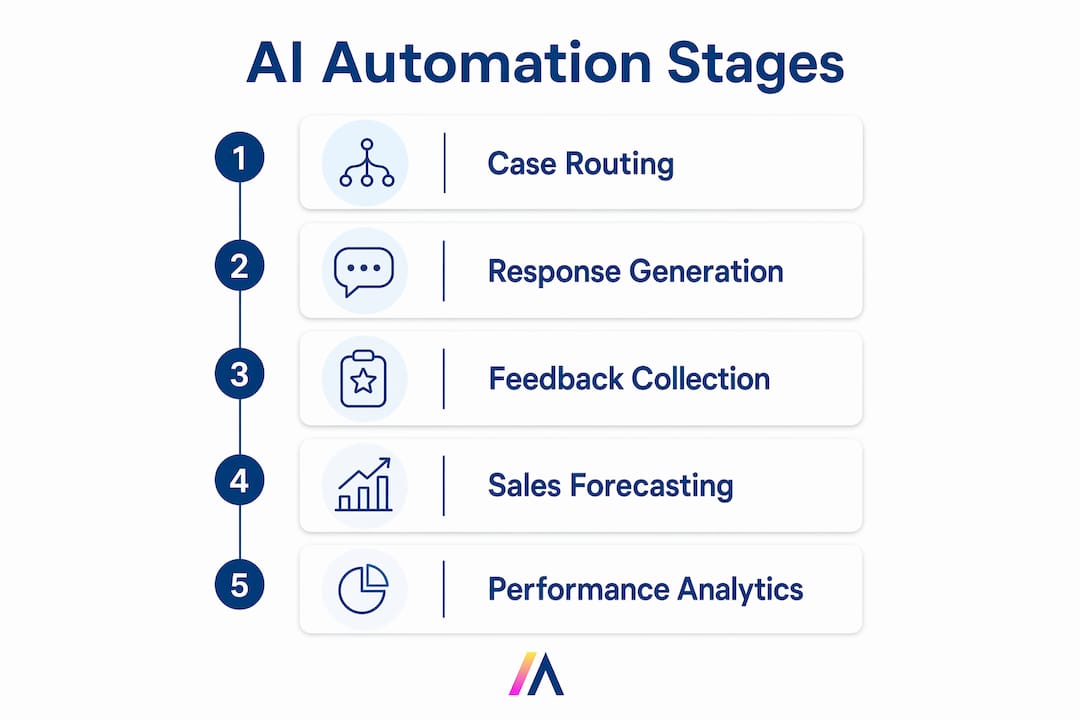
Pro Tip: Start your automation rollout with case routing before tackling response generation. Routing is deterministic and easy to validate. Response generation requires more training data and human review cycles before it reaches production quality.
AI improves the role of AI in sales forecasting accuracy by analyzing behavioral signals, historical transaction data, and real-time pipeline activity simultaneously. Traditional forecasting relies on rep-submitted estimates, which are subjective and lag actual customer behavior by days or weeks.
AI-powered sales forecasting tools improve forecast accuracy by 15–20% and reduce forecast variance by 25%. Reduced variance matters more than raw accuracy gains because it allows finance and operations teams to plan headcount, inventory, and budget with confidence.
Generative AI transforms sales forecasting through LLMs, retrieval-augmented generation (RAG), and multi-source data pipelines for improved revenue predictions. RAG is particularly valuable because it grounds the AI’s predictions in your actual CRM data, support tickets, and contract records rather than generic training data.
The role of AI in sales pipeline management extends beyond forecasting. AI surfaces which deals need attention today, which customers are at expansion risk, and which accounts show early renewal signals. That intelligence feeds directly back into post-sale workflows, closing the loop between sales and customer success. For a deeper look at how AI analytics drive enterprise decisions, the operational layer becomes even clearer.
Successful implementation of AI in post-sale workflows requires more than deploying a tool. It requires a structured playbook, clear governance, and a human oversight model that keeps AI errors from reaching customers.
Map automation by case type first. Top performers separate automation playbooks by case type, applying automated remedies like refunds for simple cases and human escalation for complex support. Never apply a single automation rule across all ticket categories.
Align cross-functional teams before activation. Cross-functional playbooks aligning product, support, and supply chain teams must be explicitly mapped to financial policies like refund thresholds before automation goes live. A support AI that issues refunds without finance approval creates liability, not efficiency.
Build a human-in-the-loop model. Human-in-the-loop models with continuous logging of agent edits reduce hallucinations and fine-tune AI responses over time. Every agent correction becomes a training signal. The AI gets more accurate with each interaction cycle.
Define escalation criteria explicitly. Set hard rules for when AI must hand off to a human: legal disputes, high-value account complaints, regulatory inquiries, and emotionally charged interactions. Vague escalation criteria are the most common cause of AI automation failures in enterprise support.
Enforce data governance from day one. Post-sale AI touches customer PII, financial records, and contract data. GDPR compliance, role-based access controls (RBAC), and audit logging are not optional features. They are prerequisites. Reviewing an enterprise AI adoption checklist before deployment prevents costly compliance gaps.
Pro Tip: Log every instance where a human agent overrides an AI-generated response. Those overrides are your highest-quality training data. Feed them back into your model on a weekly cadence to accelerate accuracy gains.
The business case for automating post-sale processes is grounded in measurable KPIs, not theoretical efficiency gains. Organizations that deploy AI across post-sale workflows report improvements across retention, cost, resolution speed, and customer satisfaction.
Leading enterprises use AI analytics on the post-purchase lifecycle for relationship engineering, specifically event correlation and anomaly detection to detect product defects early. That shift from reactive support to proactive relationship management is the defining characteristic of mature post-sale AI programs.
AI-driven feedback collection uses sentiment analysis and automation to route critical cases to senior support and derive insights for process improvement. The feedback loop does not just measure satisfaction. It identifies systemic product or process failures before they scale into churn events.
Key outcomes enterprises report from AI-driven post-sale automation:
“Post-purchase AI should be treated as a strategic retention engine rather than just a cost-saving tool, requiring cross-functional alignment and systematic playbooks.” — How AI and Analytics Are Shaping the Post-Purchase Experience
The organizations that extract the most value from post-sale AI are those that connect feedback analytics directly to product and supply chain teams. When a spike in defect-related tickets triggers an automatic alert to the product team in Slack or Microsoft Teams, the response time compresses from weeks to hours. That speed is a competitive advantage, not just an operational metric. Exploring conversational AI use cases that connect support data to cross-functional teams shows how this feedback loop operates in practice.
AI-driven post-sale workflow automation delivers measurable retention, cost, and forecasting gains only when organizations combine structured playbooks, human oversight models, and cross-functional data governance.
| Point | Details |
|---|---|
| Retention impact is quantifiable | AI-powered follow-up automation increases customer retention by up to 45%. |
| Case routing is the highest-ROI starting point | NLP-based routing removes manual classification and accelerates resolution time immediately. |
| Forecasting accuracy improves with behavioral data | AI tools improve pipeline forecast accuracy by 15–20% and cut variance by 25%. |
| Human oversight is non-negotiable | Logging agent edits and building escalation criteria prevents AI errors from reaching customers. |
| Cross-functional alignment precedes automation | Playbooks must map to financial policies and involve product, support, and supply chain teams before activation. |
Most operations teams I see start with the flashiest AI capability: generative response drafting. It looks impressive in a demo. It is also the hardest workflow to get right because it requires the most training data, the most human review, and the most governance overhead.
The smarter sequence is to start with case routing and feedback collection. Both are deterministic enough to validate quickly. Both generate the labeled data your LLMs will need later. And both deliver measurable ROI within the first 90 days, which builds the internal credibility to fund the next phase.
The second mistake I see consistently is treating post-sale AI as a support function rather than a revenue function. When your AI detects a churn signal at day 14 post-purchase and triggers a proactive outreach from the account manager, that is not a support action. That is a retention sale. The teams that recognize this distinction connect their post-sale AI outputs directly to their sales pipeline, and their forecasting accuracy reflects it.
The third issue is governance debt. Teams deploy fast, skip the RBAC and audit logging setup, and then face a compliance review six months later that forces a full rebuild. Build governance in from the start. It costs less than retrofitting it.
Post-sale AI is not a cost center optimization. It is a strategic retention engine. The enterprises that treat it that way are the ones pulling ahead.
— Matthieu
Hymalaia is an enterprise AI platform built to deploy autonomous agents that automate post-sale workflows across support, sales, and operations. Its advanced RAG and AI agent features ground every AI response in your live Salesforce, Slack, SharePoint, and CRM data, eliminating hallucinations and keeping outputs accurate. Hymalaia connects with over 50 enterprise tools, supports GDPR-compliant role-based access controls, and deploys in cloud, on-premise, or hybrid environments. Whether you are automating case routing, building a pipeline intelligence layer, or running sentiment analysis on post-sale feedback, Hymalaia gives your teams the infrastructure to execute at scale. Explore the Hymalaia platform and see how enterprise AI agents turn post-sale data into retention outcomes.
AI-powered post-sale workflow automation is the use of LLMs, NLP, and AI agents to execute customer follow-ups, case routing, response generation, and feedback collection after a purchase closes. It replaces manual, time-intensive processes with automated, data-driven workflows.
AI-powered forecasting tools improve accuracy by 15–20% and reduce forecast variance by 25% by analyzing behavioral signals, historical data, and real-time pipeline activity simultaneously.
A human-in-the-loop model requires agents to review and approve AI-generated responses before they reach customers. Continuous logging of agent edits feeds back into the AI model, reducing errors and improving response quality over time.
Start with case routing and feedback collection. Both are deterministic, easy to validate, and generate the labeled data needed to train more complex workflows like LLM-based response generation.
Post-sale AI touches customer PII, financial records, and contract data, requiring GDPR compliance, role-based access controls, and full audit logging before any automation goes live.
