TL;DR:
- AI enhances data governance by enabling real-time monitoring and continuous policy enforcement. Analysts shift from manual audits to validating AI outputs, maintaining oversight and ensuring compliance. Proper governance layers and human review ensure scalable, trustworthy data environments.
AI improves data governance for analysts by replacing periodic manual audits with continuous, automated oversight that catches compliance risks in real time. This shift matters because traditional governance methods rely on scheduled reviews, which miss anomalies between cycles. AI-driven data governance, the recognized industry term for this practice, applies machine learning to monitor data access, classify sensitive records, and enforce policies at scale. Frameworks like GDPR and the EU AI Act now demand exactly this kind of proactive control. Analysts who understand why AI improves data governance for analysts gain a direct advantage in building trustworthy, audit-ready data environments.
Manual governance audits run on schedules. AI governance runs continuously. That difference is the core reason AI-driven governance outperforms traditional methods for compliance and risk control.

AI systems watch data environments around the clock. They detect permission mismatches, flag unusual query patterns, and alert analysts before a policy breach escalates. A periodic audit might catch a problem weeks after it occurs. An AI system catches it within minutes.
The practical benefits for analysts are concrete:
This speed and scale are impossible to replicate manually. A team of analysts reviewing logs by hand cannot process the volume of data events a modern enterprise generates in a single day.
Pro Tip: Set AI monitoring thresholds based on your organization’s actual risk profile, not default vendor settings. A financial services team has different anomaly baselines than a marketing analytics team. Calibrate accordingly.
For analysts working under real-time data governance requirements, this shift from periodic to continuous oversight is not optional. It is the foundation of a defensible compliance posture.
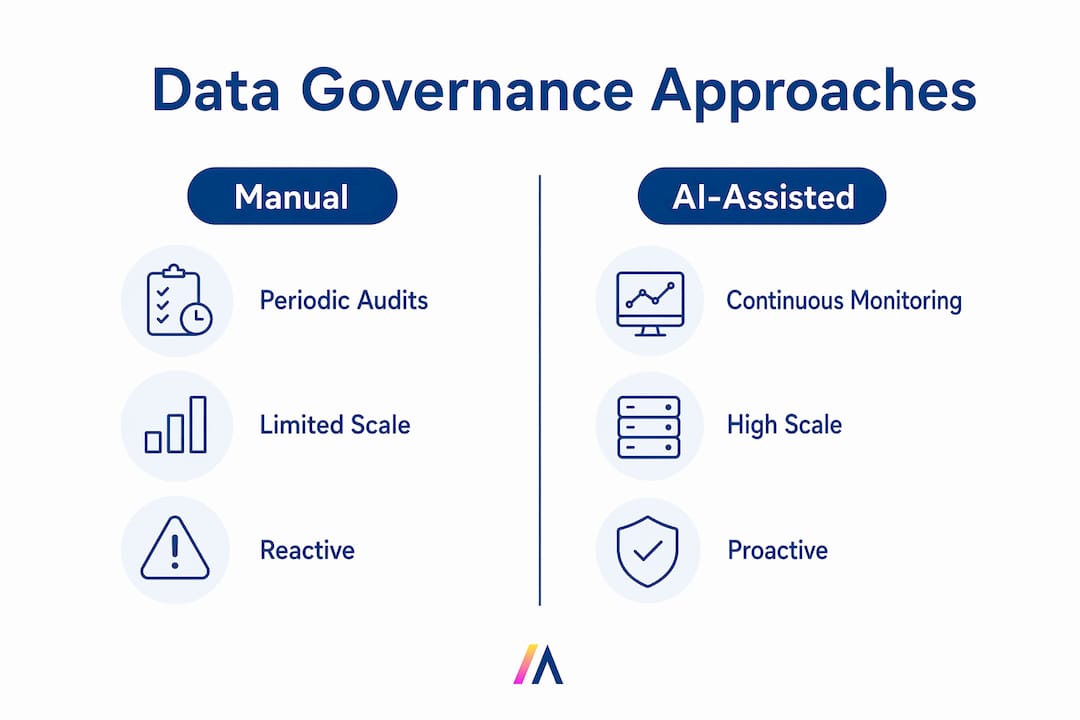
AI does more than monitor access. It actively improves the quality and consistency of the data analysts work with every day.
Enterprise AI governance frameworks report a 45% increase in data quality assessment accuracy when using AI-driven tools for metadata management and anomaly detection. That accuracy gain translates directly into fewer bad decisions built on stale or mislabeled data.
Here is how AI improves data quality management across four key areas:
| Governance area | Manual approach | AI-assisted approach |
|---|---|---|
| Sensitive data classification | Periodic manual tagging | Continuous automated detection |
| Metadata currency | Updated on request | Updated in real time |
| Lineage tracking | Documented manually | Auto-generated and queryable |
| Semantic consistency | Enforced by convention | Enforced by governed definitions |
The table above shows the practical gap between manual and AI-assisted governance. Each row represents a category where AI removes a common failure point that analysts encounter in production environments.
Pro Tip: Treat your semantic layer as a living governance document. AI can maintain it, but analysts must own the business definitions inside it. A metric defined incorrectly at the semantic layer will produce wrong answers at scale.
AI is a force multiplier for analysts, not a replacement. This distinction matters more in 2026 than it did in previous years, as AI capabilities have expanded rapidly and the temptation to over-rely on automated outputs has grown with them.
Analysts are shifting from query writers to governance owners. AI handles the repetitive technical work, including SQL generation, anomaly flagging, and classification. Analysts apply business context, validate outputs, and own final decisions. That division of labor is the right one.
The risks of over-relying on AI in governance workflows are real:
The analyst’s evolving role is to validate AI outputs with deep business knowledge and to own the governance decisions that AI surfaces. AI as a “sounding board” for routine tasks is the right mental model. AI as the final authority is not.
Pro Tip: Build a weekly review cadence for AI-generated governance reports. Automated systems surface issues, but analysts must confirm, contextualize, and act. Passive monitoring is not governance.
The most common governance failure in AI-powered analytics is not a bad algorithm. It is governance logic embedded inside the AI agent itself, where no one can review or update it.
Successful AI governance separates context and metadata from agent logic. The context layer is an external, reviewable set of files containing approved definitions, policies, lineage records, and access rules. AI agents query this layer rather than generating governance logic on their own. When the context layer is wrong, analysts can fix it directly. When governance is baked into the agent, fixing it requires engineering intervention.
A well-built context layer includes:
Governance fails when it lives only inside AI agents because it becomes brittle. A context layer that integrates schema, policies, and approval workflows across teams is the architecture that makes AI governance auditable and sustainable. For analysts, this means governance is no longer a back-office function. It is a shared, living system that every team can read and contribute to.
The distinction between data governance and AI governance is worth stating clearly. Data governance defines the rules for how data is managed and used. AI governance defines how AI systems enact those rules in real time at scale. Both are necessary. The context layer is where they connect. For a deeper look at how these frameworks are evolving, the 2026 AI governance guide covers the structural changes analysts need to understand.
Choosing the right infrastructure for this layer also involves compliance decisions. For teams evaluating LLM providers, GDPR compliance considerations for platforms like Azure, OpenAI, and AWS directly affect how context layers can be built and audited.
AI improves data governance for analysts by automating continuous monitoring, enforcing consistent metadata, and freeing analysts to focus on validation and strategic decisions rather than routine technical tasks.
| Point | Details |
|---|---|
| Continuous monitoring beats periodic audits | AI detects permission mismatches and anomalous queries in real time, not weeks after the fact. |
| Data quality gains are measurable | AI-driven governance tools report a 45% increase in data quality assessment accuracy. |
| Human oversight is non-negotiable | Analysts must validate AI outputs and own governance decisions; automation does not replace judgment. |
| Context layers make governance auditable | Separating governance logic from agent code keeps policies reviewable, updatable, and consistent. |
| Semantic layer consistency prevents bad analytics | Centrally governed definitions stop contradictory outputs before they reach decision-makers. |
I have watched teams deploy AI governance tools and then step back, assuming the work is done. That is the most expensive mistake in this space. AI surfaces issues. Analysts must still own them.
The shift from query writer to governance owner is real, and it is not comfortable for everyone. Analysts who built careers on SQL mastery sometimes resist the idea that AI can handle that layer. But the resistance misses the point. The value is not in writing queries. The value is in knowing whether the answer is right, and why it matters to the business.
What I find most underrated is the context layer conversation. Most teams I have seen treat governance as a configuration task inside their AI tool. They set it up once and forget it. The teams that get durable results treat the context layer as a product. They assign ownership, run reviews, and update definitions when the business changes. That discipline is what separates governance that holds up under audit from governance that looks good in a demo.
The enterprise AI governance practices that work in 2026 share one trait: they treat human review as a feature, not a workaround. AI handles scale. Analysts handle judgment. Neither works well without the other.
— Matthieu
Analysts who want to put these principles into practice need a platform built for the full governance workflow, not just one piece of it.
Hymalaia is an enterprise AI agent platform that connects with over 50 data sources, including Salesforce, Slack, Google Workspace, and SharePoint, to unify search, analysis, and workflow automation in one governed environment. Its retrieval-augmented generation (RAG) architecture ensures AI responses draw from approved, current data rather than hallucinated outputs. Role-based access controls (RBAC) and GDPR-compliant data handling are built in, not bolted on. Audit trails, metadata management, and real-time monitoring come standard. For analysts building AI-powered governance workflows with full human oversight, the Hymalaia platform delivers the infrastructure to do it at enterprise scale.
AI-driven data governance is the practice of using machine learning systems to automate continuous monitoring, sensitive data classification, and policy enforcement across enterprise data environments. It extends traditional governance frameworks by operating in real time rather than through periodic manual audits.
AI improves data quality by automatically classifying PII and PHI, enriching metadata, tracking data lineage, and enforcing consistent semantic definitions. Enterprise frameworks using AI-driven tools report a 45% increase in data quality assessment accuracy.
AI does not replace analysts. It shifts their role from writing queries to validating AI outputs and owning governance decisions. Human judgment remains essential for applying business context and catching errors that automated systems miss.
A context layer is an external, reviewable set of files containing approved data definitions, access policies, lineage records, and approval workflows that AI agents query to enforce governance consistently. Keeping this layer separate from agent logic makes governance auditable and easier to update.
GDPR Article 25 requires data minimization and pseudonymization, which apply directly to AI training data and the multiple data copies AI workflows generate. Analysts must ensure their AI governance architecture enforces these requirements at every stage of the data pipeline.
