TL;DR:
- Effective AI governance in IT involves continuous oversight, explicit ownership, and tiered risk controls to ensure safe and ethical deployment. Traditional governance models are insufficient due to AI’s dynamic risks, requiring automated monitoring and verifiable evidence through specialized platforms. Embedding governance into existing workflows and risk management structures accelerates responsible AI scaling and enhances organizational trust.
IT governance in AI platforms is defined as the system of policies, accountability structures, technical controls, and continuous oversight processes that ensure AI systems are deployed safely, ethically, and in alignment with business objectives. This is the standard industry discipline known as AI governance, and it sits squarely within the broader IT governance mandate that enterprise leaders already manage. The role of IT governance in AI platforms goes well beyond checkbox compliance. Frameworks like the NIST AI Risk Management Framework (NIST AI RMF) and tools like OneTrust AI governance software give organizations the structure to manage AI risk at scale. With regulators in the EU, US, and Asia tightening AI-specific requirements through 2026, the question is no longer whether to govern AI. It is how fast you can build the infrastructure to do it well.
An IT governance framework for AI is built on five foundational components: AI inventory management, policy enforcement, risk assessment, continuous monitoring, and audit trail generation. Each component addresses a distinct failure mode in AI deployment, and none of them work in isolation.
The NIST AI RMF organizes these responsibilities into four functions: Govern, Map, Measure, and Manage. Govern establishes accountability and culture. Map identifies AI risks in context. Measure quantifies those risks with defined metrics. Manage applies controls and tracks outcomes. This four-function model gives IT governance teams a structured language for AI oversight that maps directly onto existing enterprise risk frameworks.
Ownership is the most underestimated component. 83.1% of strategic measures lack an explicit owner, which means most AI governance programs are built on accountability that exists only on paper. Assigning named owners to every AI system in your inventory, with defined KPIs and review cycles, is the single most impactful structural change an enterprise can make.
Pro Tip: Link your AI inventory directly to your existing IT asset management system. This prevents shadow AI, where teams deploy models outside governance visibility, and keeps your inventory current without a separate manual process.
Traditional IT governance, as defined by frameworks like COBIT or ISO 38500, operates on a cycle of policy creation, periodic review, and exception handling. AI governance cannot follow that rhythm. The risks are too dynamic, and the systems evolve too fast for annual policy reviews to catch meaningful drift.
The table below captures the most critical structural differences:
| Dimension | Traditional IT governance | AI platform governance |
|---|---|---|
| Risk profile | Static, well-defined (data breaches, downtime) | Dynamic: model drift, bias, explainability failures |
| Oversight cadence | Periodic audits and reviews | Continuous automated monitoring |
| Decision structure | Top-down hierarchical approval | Lateral, fast-moving models with distributed authority |
| Evidence standard | Policy documents and attestations | Telemetry, model lineage, and verifiable audit logs |
| Accountability | Assigned by role or department | Must be explicitly named per AI system |
The shift from hierarchical to lateral governance is not optional. Traditional top-down structures are too slow to address dynamic AI risks effectively, and the cost of that lag shows up in model failures, regulatory penalties, and eroded user trust. A credit scoring model that drifts toward biased outputs over six months will not wait for your next quarterly governance review to cause harm.
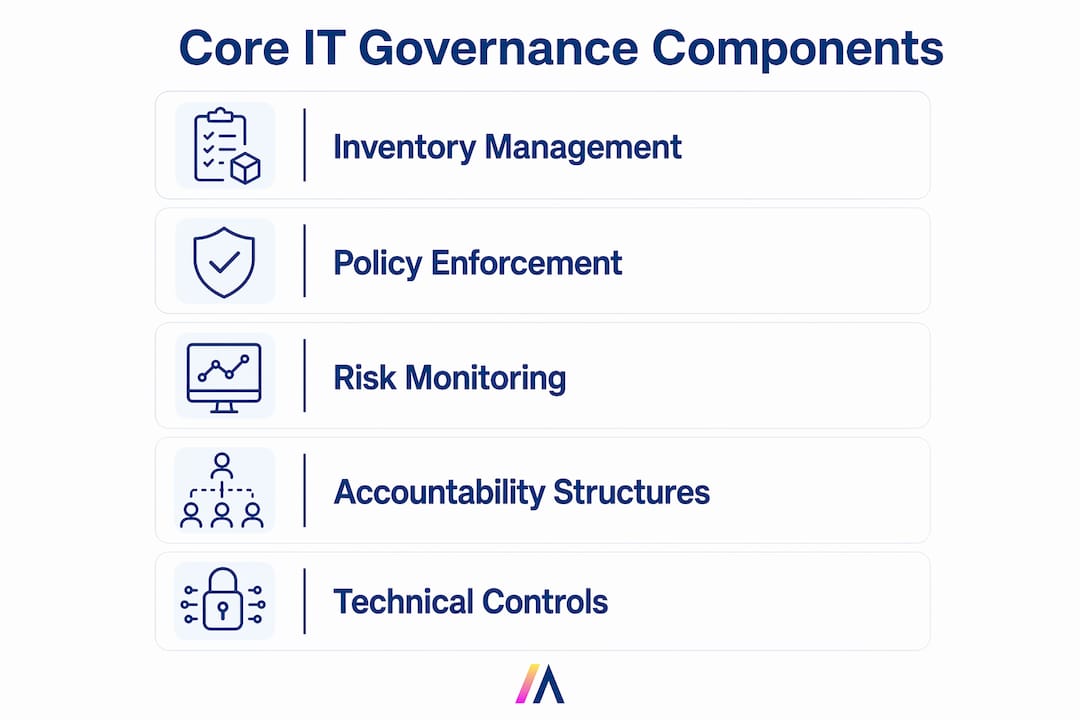
AI also introduces risks that have no analog in traditional IT: explainability requirements (can you justify why the model made a specific decision?), ethical exposure (does the model encode historical bias?), and supply chain risk (is the third-party model you licensed governed to your standards?). Each of these requires controls that traditional IT governance frameworks were never designed to provide.
Pro Tip: Treat model drift monitoring the same way you treat security vulnerability scanning. Set automated thresholds that trigger alerts when model performance degrades beyond defined tolerances, and assign a named owner to respond within a defined SLA.
Moving from governance design to governance execution is where most enterprise programs stall. The following strategies address the most common execution gaps.
Build and maintain a tiered AI inventory. Catalog every AI system by risk tier, from low-risk automation tools to high-stakes decision systems in HR, credit, or clinical contexts. Tier-based risk classification allows you to apply proportionate controls, avoiding the bottleneck of treating a document summarization tool with the same rigor as a fraud detection model.
Assign explicit owners to every governance metric. Embedding AI governance KPIs into existing strategic execution dashboards, such as balanced scorecard systems used in tools like ClearPoint Strategy, prevents phantom ownership where metrics exist but no one is accountable for moving them.
Transition from policy documents to automated telemetry. The roadmap from manual oversight to continuous assurance spans roughly 24 months and moves through phases: inventory, risk assessment, monitoring integration, and finally automated continuous assurance. Start the clock now.
Design for regulatory patchwork. The EU AI Act, NIST AI RMF, and sector-specific rules like HIPAA and FINRA create overlapping compliance obligations. Build your governance architecture around adaptable control layers rather than point-in-time compliance checklists. This lets you map new regulatory requirements to existing controls without rebuilding from scratch.
Embed governance into AI delivery workflows. Governance checkpoints built into your MLOps pipeline, such as mandatory bias assessments before model promotion or required explainability documentation before production deployment, catch issues before they reach users. Governance added after deployment is always more expensive than governance built in from the start.
Enterprises that treat AI governance as a strategic, adaptive capability rather than a compliance obligation consistently scale AI faster and with fewer incidents. The governance investment pays for itself in avoided remediation costs and accelerated deployment confidence.
AI governance platforms like OneTrust, Credo AI, and Collibra centralize the capabilities that manual processes cannot scale: risk management, compliance tracking, accountability assignment, inventory management, and policy enforcement. These platforms give enterprise governance teams a single pane of glass across their AI portfolio.

The infrastructure layer beneath these platforms matters as much as the software itself. Effective AI governance requires technical pipelines that generate verifiable evidence, not just policy documents that promise it. This means model lineage tracking (which data trained which model, and when), telemetry pipelines (what is the model doing in production right now), and identity controls (who accessed or modified the model and when).
Key infrastructure components for enterprise AI governance include:
The distinction between governance as policy and governance as infrastructure is the clearest signal of governance maturity. Organizations that can reconstruct any AI system’s decision path for a regulator or auditor on demand have built real governance. Organizations that can only produce a policy document have not. For a deeper look at the security controls that integrate with these governance layers, the technical requirements are more specific than most teams anticipate.
Effective IT governance in AI platforms requires continuous assurance infrastructure, explicit ownership, and tier-based risk controls, not static policy documents.
| Point | Details |
|---|---|
| Ownership is the critical gap | Only 16.9% of AI governance measures have explicit owners; assign named owners to every AI system. |
| Infrastructure over policy | Governance requires telemetry, model lineage, and audit logs that generate verifiable evidence for regulators. |
| Tier-based risk controls | Classify AI systems by risk level and apply proportionate controls to avoid overgovernance of low-risk tools. |
| Continuous assurance replaces periodic review | Transition from manual policy cycles to automated monitoring within a 24-month roadmap. |
| Strategic integration prevents abandonment | Embedding AI governance into existing dashboards and accountability structures keeps metrics active and owned. |
The most important shift I have seen in enterprise AI programs is the moment a leadership team stops treating governance as a tax on innovation and starts treating it as the infrastructure that makes faster innovation possible. That reframe changes everything about how governance gets resourced, staffed, and measured.
The organizations that scale AI fastest are not the ones with the most permissive governance. They are the ones with the clearest governance. When every team knows exactly which controls apply to which AI system, deployment decisions take days instead of months. When model owners have real accountability and real dashboards, problems surface early rather than in production incidents.
The accountability gap is the issue I return to most often. Treating AI governance as an extension of existing strategic execution structures prevents the abandoned metrics and phantom ownership that kill most programs. If your AI governance KPIs are not in the same system where your leadership team reviews business performance, they will not get reviewed at all.
My strongest advice for 2026: do not build a separate governance program. Extend the one you already have. Map your AI risks onto your existing risk register. Assign AI governance metrics to existing owners. Use your current audit infrastructure to generate AI-specific evidence. The enterprise AI governance practices that endure are the ones that become indistinguishable from normal business operations, not the ones that live in a separate committee with a separate budget and a separate fate.
— Matthieu
Hymalaia is built for exactly the governance challenge this article describes. The platform deploys autonomous AI agents that connect to over 50 enterprise tools, including Salesforce, Slack, Google Workspace, and SharePoint, while maintaining GDPR-compliant data handling, role-based access controls, and audit-ready activity logs. Every agent operates within defined governance boundaries, giving IT leaders the visibility and control that responsible AI deployment requires. If you are building the governance infrastructure to scale AI confidently across your organization, explore what the Hymalaia enterprise AI platform can do for your team.
IT governance in AI platforms defines the accountability structures, technical controls, and oversight processes that ensure AI systems operate safely, ethically, and in compliance with regulatory requirements. It covers the full AI lifecycle, from model inventory and risk assessment through continuous monitoring and audit trail generation.
The NIST AI Risk Management Framework organizes AI governance into four functions: Govern, Map, Measure, and Manage. Enterprise teams use this structure to assign accountability, identify system-specific risks, quantify those risks with defined metrics, and apply proportionate controls across their AI portfolio.
The most persistent challenge is accountability. Only 16.9% of strategic governance measures have explicit owners, which means most programs have metrics that no one is actively managing. Embedding governance KPIs into existing executive dashboards with named owners is the most direct fix.
AI governance platforms centralize capabilities specific to AI risk: model inventory tracking, bias assessment workflows, explainability documentation, and AI-specific compliance mapping. Traditional GRC tools handle policy and audit management but lack the model-level telemetry and lineage tracking that AI governance requires.
The transition to continuous assurance takes approximately 24 months from initial inventory to automated monitoring. Enterprises deploying AI in any customer-facing or decision-making context should begin governance infrastructure work before the first model reaches production, not after the first incident.
