TL;DR:
- Real-time AI data analysis combines continuous ingestion, automated inference, and instant output to enable proactive decisions.
- Success depends more on architectural choices and team trust than on model sophistication alone, with scalable pipelines crucial.
Waiting 24 hours for a batch analytics report while a fraud event unfolds or a machine edge toward failure is not a strategy. It’s a liability. The real-time data analysis AI benefits reshaping enterprise operations go far beyond speed. They include predictive accuracy, automated decision execution, and continuous intelligence that keeps every team working from the same current reality. This article breaks down what to look for in real-time AI analytics, the concrete advantages you gain, how leading organizations apply them, and what architectural choices actually determine whether you see results.
| Point | Details |
|---|---|
| Speed changes the decision type | Real-time AI shifts decisions from reactive reviews to proactive interventions before damage occurs. |
| Architecture matters more than models | Streaming pipelines, not model sophistication alone, determine whether AI delivers sub-second insights. |
| Measurable cost reduction is immediate | Predictive maintenance and fraud detection alone justify adoption for most manufacturing and financial teams. |
| Adoption requires cultural alignment | Teams must trust and act on AI-driven signals, not just have access to them. |
| Pre-computing beats raw inference | Running AI on pre-computed streaming views dramatically lowers costs compared to query-time LLM inference. |
Before evaluating platforms or building business cases, you need a precise definition. Real-time AI data analysis combines continuous data ingestion, automated model inference, and instant output delivery into a single operational loop. The result is a system that surfaces conclusions as events happen, not hours or days after the fact.
This is fundamentally different from near-real-time dashboards that refresh every 15 minutes. True real-time AI data analysis ai benefits require sub-second latency from event to insight. That distinction separates systems that enable truly proactive decisions from those that simply accelerate reporting.
When assessing the best AI platforms for real-time data analysis, the features that matter most are not always the ones vendors lead with. Focus your evaluation on these dimensions:
Pro Tip: When vendors demo their platform, ask to see end-to-end latency from a simulated live event to a visible output. Many platforms are fast at querying but slow at ingestion. The gap is where real-time value disappears.
The advantages of AI in data analysis compound when combined with real-time processing. Here are the benefits that consistently deliver measurable enterprise impact.
1. Accelerated decision-making. When analysts and executives see insights within seconds, they shift from reviewing what happened to deciding what to do next. That shift is the single largest behavioral change real-time AI enables.
2. Reduced unplanned downtime costs. In manufacturing, predictive maintenance via AI can prevent failures that cost upward of $532,000 per hour. Catching a degrading sensor reading 40 minutes before failure is only possible with continuous monitoring.
3. Fraud prevention at transaction speed. Financial services teams use real-time transaction evaluation within 200 milliseconds to block fraudulent activity before it clears. Batch fraud analysis catches patterns after the money has moved.

4. Fewer human errors in analysis. Automated AI inference removes the manual steps where analysts misapply filters, use stale exports, or misread trend direction under time pressure.
5. Proactive issue detection. Instead of waiting for a support ticket volume spike to notice a broken feature, real-time AI flags the signal in the product event stream before users escalate.
6. Continuous operational intelligence. Always-on AI systems represent a shift from manual query-response analytics to proactive, continuous insight generation that keeps the entire organization synchronized.
“56% of early adopters using real-time AI insights have exceeded their organizational goals through improved agility.” The U.S. data analytics market is projected to reach $43.5 billion by 2030, driven largely by real-time AI and cloud adoption.
Concrete real-time analytics applications make the abstract benefits tangible. These scenarios represent where organizations are seeing real returns today.
Pro Tip: Start with a use case where the cost of delay is already quantified in your business. Fraud loss, unplanned downtime, and churn rate are all measured and owned by specific teams. That makes it easier to build a business case and demonstrate ROI after deployment.
You can explore AI-driven operational analytics for a detailed breakdown of how these use cases translate into enterprise decision-making improvements.
Understanding the architecture behind your real-time AI investment separates platforms that deliver on their promise from those that disappoint at scale. The comparison below captures the most important trade-offs.
| Approach | Latency | Cost | Consistency | Best for |
|---|---|---|---|---|
| Batch pipeline (Kafka + Flink + warehouse) | Minutes to hours | Lower compute | Data state inconsistencies | Historical reporting |
| Streaming with materialized views | Sub-second | Moderate | High, continuously updated | Operational AI agents |
| Decision-time analytics (unified boundary) | Sub-second | Higher infrastructure | Highest, no coordination gaps | Real-time decisioning |
| Query-time LLM inference on raw data | Seconds to minutes | Very high | Moderate | Ad-hoc analysis only |
Traditional Kafka + Flink + warehouse pipelines introduce latency and data state inconsistencies because ingestion, transformation, and serving operate as separate systems. Each handoff is a potential delay and a point where data state can diverge.
Pre-computing results in streaming databases significantly lowers costs compared to running LLM inference on raw data at query time. Streaming databases maintain continuously updated materialized views that are instantly queryable, which is why the best AI platforms for real-time data analysis use this pattern rather than raw inference on arrival.
Collapsing ingestion, transformation, and serving into a single transactional boundary eliminates synchronization delays and stale states entirely. This is the architectural direction serious real-time AI deployments are moving toward in 2026.
Real-time data processing benefits only materialize when adoption is deliberate. Follow this sequence to move from evaluation to production.
Pro Tip: Do not try to replace your entire analytics stack on day one. Deploy real-time AI alongside existing reporting infrastructure initially. Let teams compare outputs and build trust in the live signals before decommissioning batch processes.
Data intelligence platforms that integrate AI and ML to automate data governance and unify data silos are the practical enabler here. Without that unification, real-time AI agents operate on partial information and produce unreliable outputs.
I have spent years watching organizations invest in analytics technology and then wonder why decisions still lag. The honest observation is this: most teams underestimate how much their architecture, not their model choice, determines whether real-time AI actually works. I have seen organizations deploy sophisticated ML models on top of batch pipelines and call it real-time because dashboards refresh every minute. That is not real-time AI. It is fast batch. The difference matters enormously.
What also gets underestimated is the cultural shift required. Real-time AI data intelligence benefits only compound when teams are willing to act on automated signals without waiting for a human to double-check every alert. Building that trust takes time, transparent model documentation, and a few early wins that demonstrate reliability.
The AI in business decision-making conversation often focuses on model capabilities. In my experience, the organizations seeing the greatest returns are the ones who invested in their data infrastructure first, then layered AI on top. The model is almost secondary once your pipeline is genuinely real-time.
My practical advice: pick one decision your organization makes daily that would be better with 60-second-old data versus 24-hour-old data. Solve that one problem well. The ROI from that single use case will fund the broader transformation more effectively than any top-down mandate.
— Matthieu
Real-time AI analytics requires more than fast queries. It requires autonomous agents that ingest live data, surface insights, and execute workflows without waiting for human triggers.
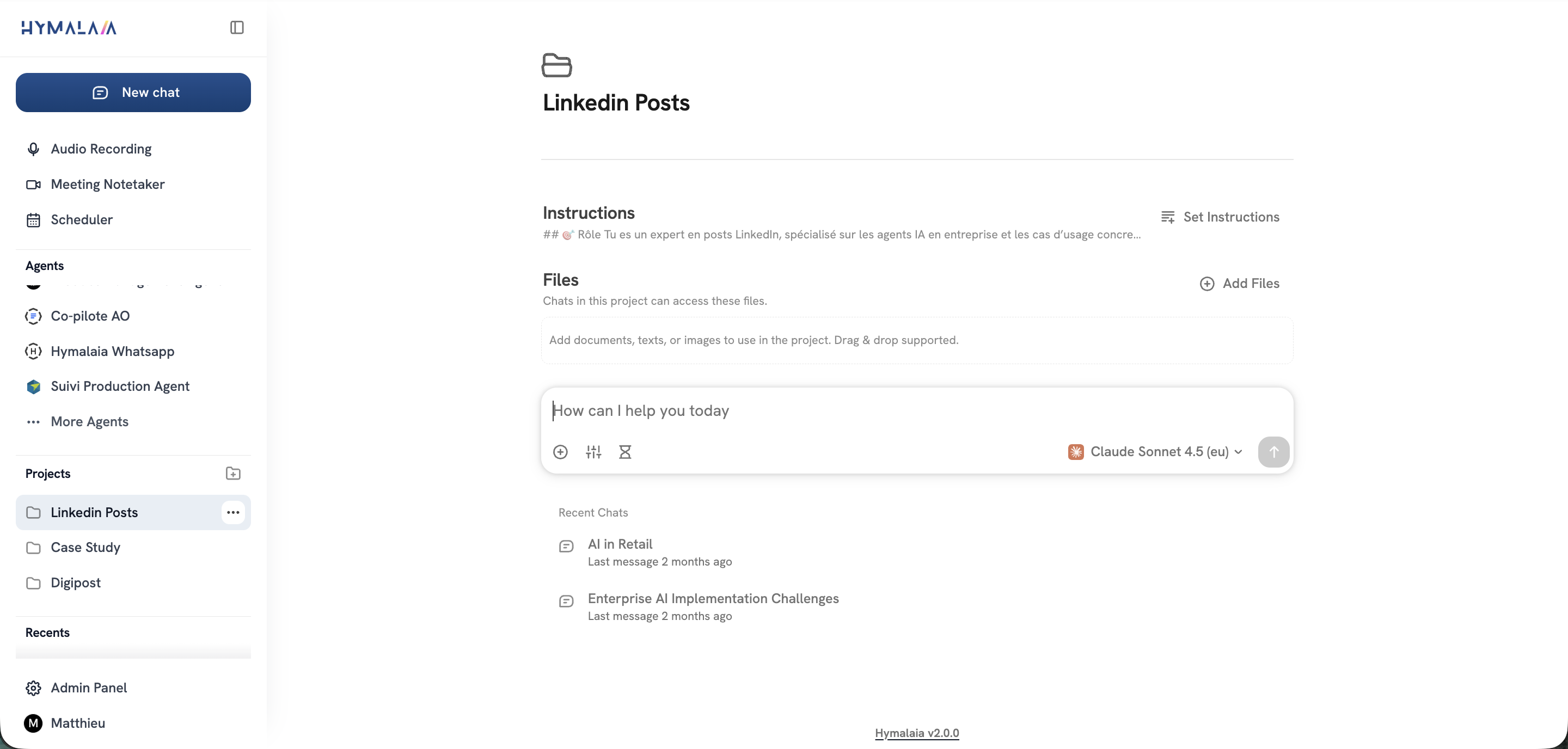
Hymalaia’s enterprise AI agent platform connects to over 50 data sources including Salesforce, Slack, Google Workspace, and SharePoint, keeping every agent always in sync with your live operational data. Retrieval-augmented generation (RAG) ensures AI responses are grounded in current, accurate information rather than stale training data. Role-based access controls and GDPR-compliant architecture mean you get real-time intelligence without compromising governance. Explore Hymalaia’s full platform features to see how agentic AI can accelerate your decisions and automate your most complex workflows today.
Real-time data analysis AI benefits include accelerated decision-making, automated anomaly detection, predictive maintenance, fraud prevention at transaction speed, and continuous operational intelligence without manual intervention.
Streaming pipelines are the architectural foundation for AI agents delivering sub-second decision cycles. Batch-based or polling approaches create data freshness ceilings that prevent true real-time performance.
AI-powered predictive maintenance detects equipment degradation before failure occurs, preventing unplanned downtime that can cost manufacturers over $532,000 per hour in lost production.
Real-time analytics delivers insights within milliseconds of an event occurring. Near-real-time analytics typically introduces latency of minutes through polling or frequent batch cycles, which disqualifies it from time-critical use cases like fraud detection.
Begin with a single use case where the financial cost of delayed decisions is already measured, audit your data pipeline quality first, and deploy real-time AI alongside existing systems before replacing them entirely.
