TL;DR:
- Enterprise AI readiness measures an organization’s preparedness across data, infrastructure, talent, governance, and use-case clarity to ensure sustainable AI deployment. Most failures stem from foundational gaps identified before project initiation, emphasizing the importance of structured assessments aligned with governance frameworks like NIST AI RMF and ISO/IEC 42001. Continuous readiness, driven by comprehensive diagnostics and leadership alignment, is crucial for scaling AI successfully and maintaining compliance.
Enterprise AI readiness is defined as the degree to which an organization is prepared across data, infrastructure, talent, governance, and use-case clarity to implement and sustain AI that produces reliable, compliant outputs without fundamental remediation mid-project. The industry term for this concept is “AI readiness,” and it differs meaningfully from general digital transformation readiness. Where digital transformation focuses on technology adoption broadly, AI readiness zeroes in on whether your organization can deploy AI systems that actually hold up in production. Most AI failures trace back to foundational gaps that existed before the first line of code was written. Frameworks like NIST AI RMF and ISO/IEC 42001 now give enterprise leaders a structured way to close those gaps before they become costly.
Enterprise AI readiness is a prerequisite diagnostic, not a post-deployment checklist. It asks one question before any AI investment: does your organization have the foundations to make AI work and keep it working? That means evaluating five critical dimensions: data quality and accessibility, technology infrastructure, team capability, governance and ethics, and use-case clarity.
This is where many organizations stumble. They treat AI readiness as proof of deployment rather than a condition for it. A company might have world-class data engineers but no governance policy for AI outputs. Another might have clear use cases but fragmented data sitting across Salesforce, SharePoint, and Google Workspace with no integration layer. Strength in one dimension does not compensate for weakness in another. Each dimension compounds the others, and a gap in any one of them can derail an otherwise well-funded AI initiative.
The distinction from digital transformation readiness matters here. Digital transformation asks, “Can we adopt new technology?” AI readiness asks, “Can we sustain AI in production, audit its decisions, and manage its risks continuously?” That is a fundamentally higher bar.
Six dimensions define a complete AI readiness framework, and each one must be evaluated independently. The table below maps each dimension to its core requirement and the most common enterprise challenge.

| Dimension | Core Requirement | Common Enterprise Challenge |
|---|---|---|
| Data Readiness | Clean, accessible, well-governed data | Siloed data across legacy systems |
| Infrastructure | Scalable compute and integration layer | Outdated on-premise architecture |
| Team Capability | AI literacy and technical talent | Skills gaps in ML ops and prompt engineering |
| Governance and Ethics | Policies, controls, and accountability | Absent or undocumented AI policies |
| Use-Case Clarity | Defined business problems with measurable outcomes | Vague mandates like “use AI more” |
| Leadership Alignment | Executive sponsorship and strategic prioritization | Competing priorities across business units |
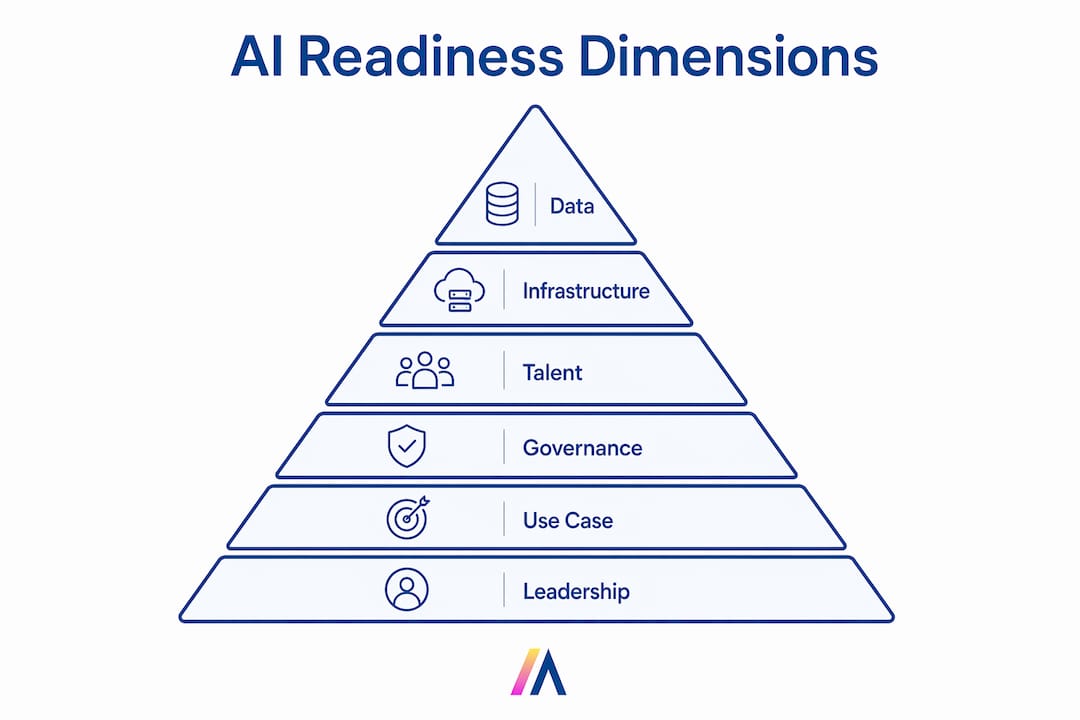
Data readiness is the most foundational of these dimensions. Generative AI in particular is constrained more by data governance and visibility than by model development challenges. Controlling what data AI can access and what it can output is the first real test of enterprise readiness. Without it, even the most capable AI model becomes a liability.
Leadership alignment is the most underestimated dimension. Technical teams can build AI pilots in isolation, but sustainable AI implementation in enterprises requires executive sponsorship that connects AI investments to specific business outcomes. Without that alignment, pilots stall at proof-of-concept and never reach production scale.
Pro Tip: Assess each dimension with a separate scoring rubric before combining scores. A composite score can mask a critical weakness. A “4 out of 5” overall rating means nothing if governance scores a 1.
A structured AI readiness assessment follows a layered sequence. Skipping any layer risks pilot failure or brittle scaling when you move from proof-of-concept to production. The sequence matters because each layer depends on the one before it.
The six critical criteria that any thorough assessment must cover are:
AI readiness assessments produce quantified gap analyses and prioritized remediation roadmaps, often with specific “next 90 days” leadership focus areas. That output is what separates a real assessment from a vendor questionnaire. It gives decision-makers a concrete resource allocation plan rather than a vague maturity score.
The difference between a readiness assessment and a maturity model is also worth clarifying. A maturity model tells you where you are on a spectrum. A readiness assessment tells you whether you are ready to proceed with a specific AI initiative right now. You need both, but the readiness assessment comes first. For a practical starting point, review the AI adoption checklist Hymalaia has published for IT leaders.
Pro Tip: Frame your assessment as a diagnostic that precedes budget approval, not as a report card after the fact. Organizations that run assessments before committing to AI vendors consistently identify deal-breaking gaps early enough to address them without sunk cost pressure.
Governance frameworks are not optional documentation exercises. They are the structural backbone of any enterprise AI strategy that needs to hold up under regulatory scrutiny or an internal audit.
The NIST AI Risk Management Framework organizes AI risk management into four core functions: GOVERN, MAP, MEASURE, and MANAGE. GOVERN establishes accountability structures and policies. MAP identifies AI risks in context. MEASURE quantifies those risks. MANAGE responds to them with controls and escalation paths. The framework is voluntary but widely adopted because it translates policy intent into operational evidence. Think of it as a living governance cycle rather than a static document you file and forget.
ISO/IEC 42001:2023 is the first certifiable international standard for AI management systems. Certification typically takes 6–12 months and applies to any organization building or deploying AI, regardless of size. A critical distinction: ISO 42001 certifies the management system itself, meaning roles, risk assessments, documentation, and continuous improvement processes. It does not certify the quality of your AI models. That distinction matters enormously for audit readiness.
| Framework | Primary Focus | Certification | Key Strength |
|---|---|---|---|
| NIST AI RMF | Risk identification and management | No (voluntary) | Operational evidence and governance cycle |
| ISO/IEC 42001:2023 | AI management system | Yes (6–12 months) | Audit-defensible documentation and roles |
Microsoft Purview illustrates how these frameworks get operationalized in practice. Purview supports responsible AI by providing data governance, audit trails, and AI usage oversight across sensitive data. It enforces data boundaries and monitors AI interactions. What it does not do is replace model development or fairness testing. Many enterprises misunderstand Purview’s scope and treat it as a complete responsible AI solution. It is one layer of a multi-layer governance architecture. For a deeper look at how these frameworks apply in practice, Hymalaia’s guide on enterprise AI governance covers both NIST AI RMF and ISO/IEC 42001 in detail.
Pro Tip: When implementing Microsoft Purview or similar tools, document exactly what the tool covers and what it does not. Auditors will ask. Gaps between your governance policy and your tooling are the most common source of audit findings.
The most frequent readiness failures are predictable, and that makes them preventable. Understanding them before you start is the difference between a successful AI rollout and an expensive pilot that never scales.
The five most common challenges are:
Treating readiness as an ongoing operating model, rather than a one-time gate, is what separates organizations that scale AI from those that accumulate failed pilots. Organizations that approach readiness this way show measurably better AI success rates. Continuous monitoring, auditability, and incident handling are not post-launch concerns. They are readiness requirements from day one.
For leaders working through the organizational side of this, Hymalaia’s resource on aligning AI with business objectives provides a practical framework for connecting AI investments to measurable outcomes. You can also explore what a formal AI readiness assessment involves to understand the full scope of the diagnostic process.
Pro Tip: Align your responsible AI tooling to your governance framework before selecting AI vendors. Choosing a vendor first and then trying to retrofit governance controls is significantly more expensive and often results in incomplete coverage.
Enterprise AI readiness requires simultaneous strength across data, infrastructure, talent, governance, and use-case clarity because weakness in any single dimension will undermine the entire initiative.
| Point | Details |
|---|---|
| Readiness is a prerequisite | Assess all six dimensions before committing budget to any AI vendor or platform. |
| Data governance is foundational | Controlling what data AI can access and output is the first real test of readiness. |
| Governance frameworks are operational | NIST AI RMF and ISO/IEC 42001 require living documentation and audit evidence, not static policies. |
| Assessments produce roadmaps | A real readiness assessment delivers a prioritized remediation plan with near-term leadership actions. |
| Readiness is continuous | Treat AI readiness as an ongoing operating model, not a one-time project milestone. |
I have watched enterprise teams spend months selecting AI vendors before they have answered the most basic readiness questions. The vendor selection process feels productive. It generates demos, proposals, and executive excitement. But it is the wrong starting point.
The organizations that scale AI successfully treat readiness as a diagnostic that precedes every major AI decision. They run structured assessments before budget approval, not after. They document governance policies before they deploy models, not in response to an audit finding. They identify data gaps before they sign contracts, not during implementation when the cost of remediation is highest.
The evolving standards landscape in 2026 makes this discipline more important, not less. ISO/IEC 42001 certification is becoming a procurement requirement in regulated industries. NIST AI RMF adoption is accelerating as regulators reference it in guidance documents. Shadow AI, meaning employees using unauthorized AI tools outside of IT governance, is now a documented risk category that auditors specifically look for.
The uncomfortable truth is that most organizations are not as ready as they think. A confident executive team and a few successful pilots do not equal enterprise AI readiness. What equals readiness is documented governance, clean and accessible data, a skilled team, and a leadership structure that can sustain AI in production through personnel changes, regulatory shifts, and model updates. Build that foundation first. The vendor selection gets much easier once you know exactly what you need.
— Matthieu
Closing readiness gaps requires more than a framework document. It requires a platform that connects your data, enforces your governance policies, and gives your teams the AI capabilities they need to act on insights in real time.
Hymalaia is built for exactly this challenge. The platform connects with over 50 enterprise tools including Salesforce, Slack, Google Workspace, and SharePoint, giving you the data integration layer that readiness assessments consistently identify as a critical gap. Its RBAC controls, GDPR-compliant architecture, and audit trail capabilities align directly with NIST AI RMF and ISO/IEC 42001 requirements. Hymalaia’s autonomous AI agents automate workflows across sales, support, and operations while keeping your governance controls intact. Explore the full platform at Hymalaia’s enterprise AI platform and see how it turns your readiness investment into production-grade AI.
Enterprise AI readiness is a measure of how prepared your organization is to deploy and sustain AI across data, infrastructure, talent, governance, and use-case clarity. It is a prerequisite diagnostic, not a post-deployment review.
A thorough AI readiness assessment typically takes two to six weeks, depending on organizational size and data complexity. The output is a quantified gap analysis and a prioritized remediation roadmap with near-term leadership actions.
NIST AI RMF is a voluntary framework focused on risk identification and management through four functions: GOVERN, MAP, MEASURE, and MANAGE. ISO/IEC 42001:2023 is a certifiable international standard for AI management systems, with certification taking 6–12 months.
Most AI project failures trace back to foundational gaps in data quality, use-case clarity, or governance that existed before the project started. Treating readiness as an ongoing operating model, rather than a one-time gate, significantly improves success rates.
Microsoft Purview supports data governance, audit trails, and AI usage monitoring across sensitive data. It works alongside frameworks like NIST AI RMF and ISO/IEC 42001 but does not replace model development or fairness testing. Platforms like Hymalaia add RBAC controls and compliance architecture on top of governance frameworks.
