TL;DR:
- Most AI initiatives fail early because the use case was never properly validated before development begins. Rigorous validation, including assessing workflow need, data availability, and measurable outcomes, filters ideas down to the most impactful projects. Continuous validation and strategic alignment are essential to ensure AI delivers measurable business value and avoids hype-driven investments.
Most AI initiatives don’t fail because the models are wrong. They fail long before a single line of code is written, because the use case was never properly validated. Understanding what is AI use case validation separates organizations that get measurable results from those stuck in endless pilots. Only about 40% of companies report positive business impact from AI despite widespread adoption, and the gap almost always traces back to poor decisions made at the selection stage, not the deployment stage.
| Point | Details |
|---|---|
| Validation precedes development | Documented proof of data, workflow stability, and success metrics must exist before any building begins. |
| Most ideas don’t survive scrutiny | Rigorous AI use case assessment typically reduces 15 to 20 initial candidates down to 3 to 5 viable options. |
| Verification cost matters | Measuring total task time, including human review of AI output, determines whether a use case is truly worth automating. |
| Frameworks reduce hype-driven choices | Structured scoring models and governance checkpoints keep selection grounded in business impact rather than novelty. |
| Validation is ongoing | Continuous feedback loops and ground truth datasets protect against model drift long after launch. |
AI use case validation is the structured, evidence-based process of confirming that a proposed AI application solves a real workflow problem, has the data to support it, and will deliver measurable business value before any development begins. It is not a brainstorming exercise. A validated use case requires documented proof of data availability, stable workflows, and defined success metrics. Without that documentation, you are funding a hypothesis, not a project.
The importance of AI validation becomes clear when you look at what typically gets cut. Validation commonly filters 15 to 20 initial ideas down to 3 to 5 viable candidates with genuine ROI potential. That filtering is not failure. That is the process working as intended.
Three criteria determine whether a use case clears the bar:
Here is a comparison of strong validation criteria versus the most common pitfalls:
| Validation criterion | Common pitfall |
|---|---|
| Workflow occurs frequently and has clear inputs/outputs | Selecting edge cases that affect few users |
| Data exists, is accessible, and is governed | Assuming data can be collected or cleaned later |
| Success metric is quantifiable and baselined | Using vague goals like “improve efficiency” |
| Output verification is fast and reliable | Ignoring verification time entirely |
| Use case aligns with a strategic business priority | Choosing for novelty or executive enthusiasm |
Pro Tip: Build a one-page validation scorecard for every candidate use case. Force each row to be answered with evidence, not opinion. If a team can’t fill it out, the use case isn’t ready.
Choosing which validated use cases to build first is its own discipline. The most common failure at this stage is hype-driven selection, where generative AI gets evaluated against looser standards than traditional AI, producing an unbalanced and underperforming portfolio.
Structured frameworks prevent that drift. The most effective ones share a common architecture: score each use case across multiple weighted dimensions, rank the results, and apply governance gates before moving forward.
| Evaluation dimension | What to measure | Why it matters |
|---|---|---|
| Business value | Revenue impact, cost savings, risk reduction | Ties AI investment to financial outcomes |
| Technical feasibility | Data readiness, model maturity, integration complexity | Identifies build vs. buy decisions early |
| Strategic fit | Alignment with company OKRs or transformation goals | Prevents orphaned AI projects |
| Risk level | Data sensitivity, regulatory exposure, error consequences | Determines validation rigor needed |
| Time to value | Estimated deployment and adoption timeline | Filters out projects too slow to justify |
Microsoft’s BXT Framework (Business, eXperience, Technology) adds a useful layer: validating AI use cases requires simultaneous confirmation that the business case is sound, the user experience is viable, and the technology is ready. Missing any one of those legs means the use case fails in production even if it passes technical tests.
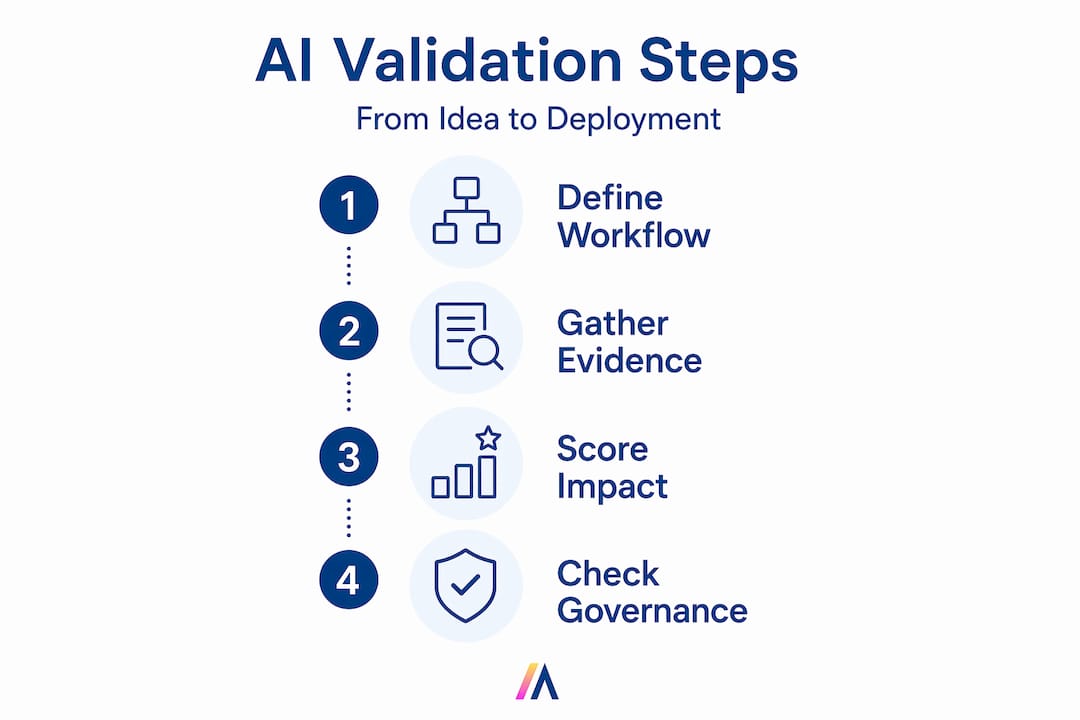
Governance checkpoints belong at every scoring stage, not just at launch. A use case that clears the initial scorecard but fails a data governance review shouldn’t consume engineering resources. Gate the process early and gate it often.
Pro Tip: When using weighted scoring models, calibrate weights with actual stakeholders across business, legal, and technology teams. A score built by one function in isolation will reflect that function’s priorities, not the organization’s.
Validating AI use cases operationally means getting precise about how tasks actually work today, before you assume AI will improve them. The most reliable method is a structured task audit.
A practical audit framework follows these steps:
A practical example: a legal team automating contract review might find that AI flags clauses in seconds, but attorney sign-off requires more time than reading the original contract. The use case, as scoped, produces negative ROI. Re-scoped to first-pass screening of low-risk clauses only, the same underlying technology becomes genuinely valuable. The difference is operational validation.

Passing initial validation does not mean a use case stays valid. Production behavior drifts. Data changes. Business rules evolve. Without ongoing evaluation, what was validated becomes gradually unvalidated, and failures accumulate silently.
Continuous validation in regulated or high-stakes environments requires four specific capabilities:
The goal of continuous validation is not perfection. It is early detection. Catching a model that has started to underperform on a specific decision type, weeks before it causes a visible error, is what separates mature AI programs from fragile ones.
This distinction between piloting and validating matters here. A pilot tests whether a use case works in production. Validation tests whether it should have been built at all. By the time you reach a pilot, the core validation evidence must already be in place or the pilot itself becomes a proxy for decisions that should have been made earlier.
The final layer of AI use case assessment connects individual use cases to organizational strategy. Without this connection, even a technically valid and operationally sound use case can fail to deliver business impact because it is not tied to the decisions and outcomes that matter.
Before finalizing any validated use case for development, decision-makers should confirm:
Explore how to align AI initiatives with business goals to structure this connection systematically across your portfolio. The organizations that get the most from AI are the ones that treat business process optimization as the starting point, not an afterthought.
I’ve watched organizations with serious AI budgets make the same mistake repeatedly: they treat validation as a box to check rather than a discipline to practice. A team presents a promising idea, someone senior gets excited, and suddenly the validation criteria get adjusted to fit the conclusion already reached.
What I’ve learned from working across industries is that the discipline of validating AI use cases only holds when someone in the room has explicit authority to say “this does not meet the bar.” Without that authority, even well-designed scorecards become performative.
The other pattern I see is what I’d call the pilot trap. Organizations use a pilot as a substitute for upfront validation, assuming the pilot will answer the questions that validation should have resolved first. Pilots answer “can it work in production.” Validation answers “should we build this at all.” Conflating the two is an expensive habit.
My advice to any decision-maker starting an AI use case assessment: be more skeptical of the ideas your team is most excited about. Enthusiasm and business value are not the same variable. The use cases that survive rigorous scrutiny and still look good are the ones worth building. The rest are learning experiences you don’t need to fund.
— Louis
Translating a validated use case into a working, governed AI deployment is where most enterprise programs lose momentum. Hymalaia’s enterprise AI agent platform is built to close that gap, connecting validated use cases to real workflows across Salesforce, Slack, Google Workspace, SharePoint, and more than 50 other enterprise data sources.
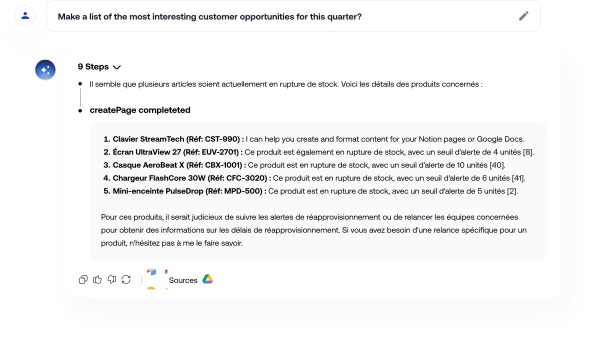
Hymalaia’s RAG-powered agents surface the right data for each decision, while role-based access controls and GDPR-compliant governance keep high-risk use cases within defensible boundaries. Whether your team is evaluating conversational AI ROI or operationalizing a validated workflow, Hymalaia provides the infrastructure to act on what you’ve validated. Book a demo to see how your validated use cases become deployed, measurable AI agents.
AI use case validation is the structured process of confirming that a proposed AI application has a real workflow need, available and usable data, and a measurable business outcome before development begins. It filters candidates based on evidence, not assumption.
Rigorous validation typically reduces an initial pool of 15 to 20 ideas to 3 to 5 viable candidates with genuine ROI potential. Most ideas fail on data availability or the inability to define a measurable success metric.
If the time required for humans to review and correct AI output approaches or exceeds the original task duration, the use case produces little to no efficiency gain. Measuring total task time, including verification, is a required step in how to validate AI scenarios operationally.
Validation determines whether a use case should be built, based on documented evidence of data, workflow, and business value. A pilot tests whether a validated use case works correctly in production. Skipping validation and going straight to a pilot substitutes expensive experimentation for decisions that should be made with data first.
Re-validation should be continuous, driven by automated feedback loops that surface model drift and new edge cases from live data. In regulated industries, risk-based validation frameworks set the frequency and depth of re-evaluation based on the criticality of the use case.
