TL;DR:
- AI customer support agents range from simple chatbots to fully autonomous systems capable of executing multi-step workflows. Choosing the correct agent type depends on the desired resolution power and integration capabilities, with phased deployment reducing risks. Autonomous agents offer the highest resolution but require mature data infrastructure and system integration for effective operation.
AI customer support agents are software systems that range from simple rule-based chatbots to fully autonomous agents capable of reasoning and executing multi-step workflows across enterprise systems. The six main types of AI customer support agents differ by their ability to answer or resolve queries, with deflection rates ranging from 10–60% and autonomous resolution rates reaching 30–50%. That spread matters because the wrong agent type for your use case means paying for capability you cannot use, or deploying something too limited to move your resolution metrics. Customer service managers who understand these distinctions make faster, better procurement decisions.
The clearest way to classify virtual customer support agents is by what they can do autonomously. Each type sits at a different point on the spectrum from scripted response to independent action.

Rule-based chatbots
Rule-based chatbots follow decision trees built from predefined scripts. They answer a fixed set of questions and route anything outside their script to a human agent. Deflection rates sit at 10–20% for rule-based systems. That low ceiling reflects their core limitation: they cannot handle any question not explicitly programmed.
Retrieval-based AI chatbots
Retrieval-based chatbots use natural language processing to match a customer’s question to the closest answer in a knowledge base. They do not generate new responses. They are faster to deploy than generative systems and carry lower hallucination risk, making them a solid fit for regulated industries.
Generative AI chatbots
Generative AI chatbots use large language models (LLMs) to compose responses from context rather than retrieve fixed answers. They handle a wider range of phrasing and topic variation. Combined retrieval and generative approaches, often called retrieval-augmented generation (RAG), push AI chatbot deflection rates to 25–60%. RAG grounds the model’s output in verified company data, which reduces inaccurate responses.
Agent-assist tools (copilots)
Agent-assist tools sit alongside human agents rather than replacing them. They surface relevant knowledge articles, suggest next-best responses, and flag compliance risks in real time. The human agent still types and decides. This model improves agent speed and consistency without requiring full automation readiness.
Voice AI agents
Voice AI agents handle natural language calls with reasoning capability, supporting voice channel automation and complex interactions. They transcribe speech, interpret intent, and respond in natural language over phone or voice interface. For high-volume call centers, voice AI agents reduce average handle time on repeat inquiries without requiring customers to switch channels.
Autonomous AI agents
Autonomous AI agents represent the most capable category. They reason across multiple systems, execute backend actions, and complete multi-step workflows without human intervention. Autonomous agents resolve 30–50% of issues end-to-end. Examples include processing a refund, resetting a password, or updating a shipping address directly inside your CRM or order management system.
The term “AI agent” is frequently misused. Many vendors label basic FAQ bots as agents to capitalize on the category’s momentum. The distinction matters because you are evaluating resolution capability, not just conversation quality.
The core difference is action-taking. A chatbot provides information. An AI agent executes transactions. True AI agents reason over context and execute multi-step workflows autonomously, enabling end-to-end resolutions that a chatbot cannot complete.
Three actions that confirm true agent capability:
Backend integration is the technical requirement behind all three. An agent that cannot connect to your systems of record cannot execute transactions. Before any procurement decision, ask vendors to demonstrate a live backend action in a sandbox environment.
Pro Tip: Run a simple test during vendor evaluation: ask the system to process a refund for a test order. If it provides instructions for how a human should do it, it is a chatbot. If it completes the action itself, it qualifies as an agent.
The ability to reason across systems and context also separates agents from chatbots in ambiguous situations. An agent can pull order history, check account status, and apply a refund policy in sequence. A chatbot answers one question at a time.
Every agent type carries a specific trade-off between deployment simplicity and resolution power. Understanding those trade-offs prevents misaligned expectations after go-live.
Rule-based chatbots deploy quickly and require no AI infrastructure. Their limitation is brittleness: one phrasing variation outside the script produces a dead end. They work well for highly repetitive, low-variance queries such as store hours or return policy lookups.
Generative and retrieval-based chatbots handle broader query ranges and adapt to natural language variation. Their limitation is that they still cannot take action. A customer asking “Can you cancel my order?” gets an answer about the cancellation policy, not an actual cancellation.
Agent-assist tools improve human agent output without requiring full automation. The limitation is that they do not reduce headcount or ticket volume. They are a productivity tool, not a deflection tool.
Autonomous AI agents deliver the highest resolution rates, but they require mature data infrastructure and clean system integrations. Poorly integrated agents produce errors that damage customer trust faster than a slow human response would.
“AI agents most effectively improve customer experience by automating routine tasks and enabling human agents to focus on high-impact interactions.” — Customer Service AI Agents
A phased deployment strategy from rule-based bots to autonomous AI agents yields the best service improvements and adoption success. Start with routing and FAQ automation, move to transactional automation, then deploy autonomous agents once your integrations are stable. Skipping phases increases failure risk.
The handover moment is where most deployments fail. AI agents pass complete conversation context to human agents, preventing customer frustration from having to repeat information. Any system that drops context at handover undermines the customer experience gains from automation.
The table below compares the six agent types across the dimensions that matter most for enterprise deployment decisions.
| Agent type | Autonomy level | Action capability | Deflection/resolution rate | Maintenance effort |
|---|---|---|---|---|
| Rule-based chatbot | None | None | 10–20% deflection | High (script updates) |
| Retrieval-based chatbot | Low | None | 25–40% deflection | Medium |
| Generative AI chatbot (RAG) | Medium | None | 40–60% deflection | Low to medium |
| Agent-assist / copilot | None (human-led) | Suggestion only | Improves agent speed | Low |
| Voice AI agent | Medium to high | Limited transactions | Varies by integration | Medium |
| Autonomous AI agent | High | Full backend execution | 30–50% end-to-end resolution | Low |
AI agents require less maintenance than traditional automation because they are configured with natural language instructions rather than scripted decision trees. That reduction in maintenance overhead is a significant operational benefit for enterprise teams managing large support catalogs. Agentic AI systems can autonomously plan and execute multi-step workflows, orchestrating complex resolutions across multiple systems without human intervention.
The ideal use case for each type follows directly from its autonomy level. Rule-based bots fit static FAQ pages. Generative chatbots fit broad informational support. Autonomous agents fit transactional support at scale, where resolution speed and accuracy directly affect customer retention.
Pro Tip: Map your top 20 ticket types by volume and complexity before selecting an agent type. High-volume, low-complexity tickets are the fastest path to measurable deflection gains.
Selecting the right AI customer support agent type requires matching the agent’s autonomy level and backend integration capability to your specific ticket volume, complexity, and resolution goals.
| Point | Details |
|---|---|
| Six distinct agent types exist | Each type differs by autonomy level, from rule-based scripts to full backend execution. |
| Action-taking defines true agents | Only agents that execute backend transactions qualify as autonomous AI agents. |
| Phased deployment reduces risk | Start with FAQ bots, then transactional automation, then full autonomous agents. |
| Context handover is non-negotiable | Agents must pass full conversation context to human agents to protect customer experience. |
| Maintenance drops with AI configuration | Natural language policy instructions reduce the overhead of managing agent behavior. |
After working with enterprise customer service teams across multiple industries, I have seen the same mistake repeated: teams buy the most capable agent available before their data infrastructure can support it. An autonomous AI agent connected to a fragmented CRM and three disconnected ticketing systems will produce wrong answers and failed transactions. The technology is not the bottleneck. The data is.
The vendors who market “autonomous resolution” rarely lead with the integration prerequisites. That gap between the demo and the production environment is where projects stall. I have seen teams spend six months on integrations they assumed were already solved.
My honest recommendation is to treat the phased adoption approach as a data readiness program, not just a technology rollout. Each phase forces you to clean up a system integration. By the time you deploy autonomous agents, your data is reliable enough to support them.
The other underrated factor is monitoring. Autonomous agents make decisions at a speed and volume that humans cannot review in real time. You need automated quality checks and escalation triggers from day one. Teams that skip this step discover problems through customer complaints rather than internal dashboards.
The customer service automation benefits are real and measurable. But they require the same discipline as any enterprise system deployment. Start simple, validate results, then scale.
— Matthieu
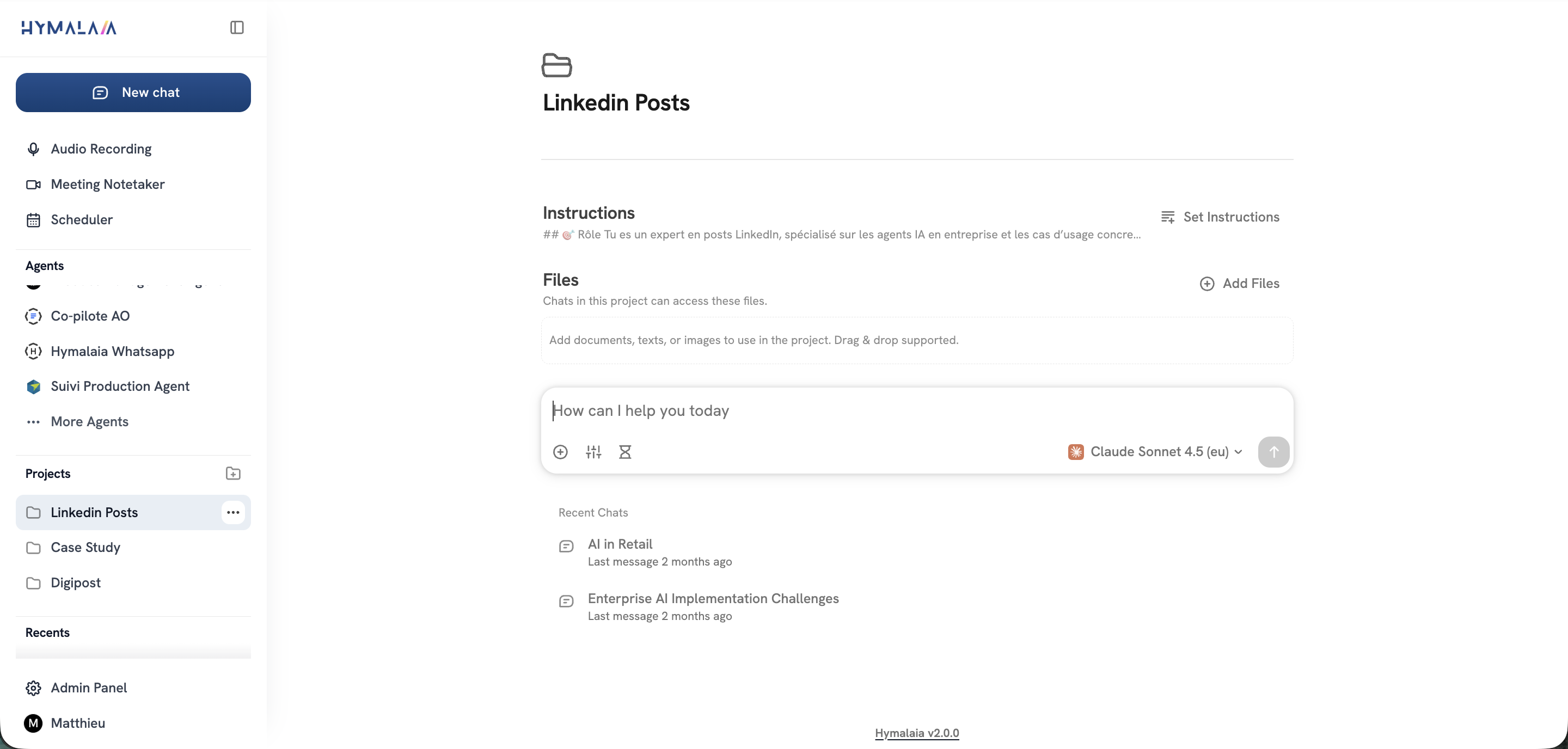
Hymalaia’s enterprise AI agent platform covers the full range of intelligent support agents, from conversational AI for informational queries to autonomous agents that execute backend workflows across Salesforce, Slack, Google Workspace, SharePoint, and over 50 other enterprise tools. The platform’s RAG architecture grounds every agent response in verified company data, which directly reduces hallucination risk in customer-facing interactions. Role-based access controls and GDPR-compliant data handling make it deployable in regulated environments without custom security builds.
For customer service teams ready to move beyond basic chatbots, Hymalaia provides the AI agent platform to deploy, monitor, and scale autonomous support agents with the governance controls enterprise operations require. Request a demo to see a live backend action in your environment.
The six main types are rule-based chatbots, retrieval-based chatbots, generative AI chatbots (including RAG systems), agent-assist copilots, voice AI agents, and autonomous AI agents. Each type differs by its level of autonomy and ability to execute backend actions.
An AI chatbot provides information. An AI agent executes transactions autonomously, such as processing refunds or resetting passwords, by connecting directly to backend systems. The ability to take action is the defining distinction.
Rule-based chatbots deflect 10–20% of tickets, while generative AI chatbots reach 25–60%. Autonomous AI agents resolve 30–50% of issues end-to-end without human involvement.
Autonomous AI agents deliver the highest resolution rates for enterprises with mature system integrations. Teams without clean data infrastructure should start with generative chatbots and scale toward autonomous agents through a phased deployment approach.
Autonomous AI agents pass complete conversation context to human agents when escalating complex or sensitive issues. This context transfer prevents customers from repeating information and maintains service quality at the handover point.
