TL;DR:
- Enterprise AI projects deliver 100% to 300% ROI over three years with median payback in 18 to 24 months. Using appropriate frameworks like TEI, NPV, or productivity models is essential for accurate measurement and faster decision-making. Proper baseline setup, change management funding, and targeted use case selection are critical for achieving and validating positive ROI.
The ROI of enterprise AI deployment is the net financial return an organization gains from AI investments relative to total costs, including infrastructure, talent, licensing, and change management. Mature enterprise AI projects generate between 100% and 300% ROI over three years, with median payback periods of 18–24 months. Those benchmarks vary sharply by project type, which is why CFOs and FP&A teams now demand formal measurement frameworks before approving AI budgets. Understanding the roi of enterprise ai deployment explained through those frameworks is the first step to making defensible investment decisions.
Enterprise AI investment returns do not fit a single formula. Finance teams use three distinct frameworks depending on what the AI project is designed to do.

Total Economic Impact (TEI) applies to cost-displacement projects, such as automating invoice processing or IT ticket routing. TEI captures direct labor savings, error-reduction costs, and avoided headcount growth. It is the framework CFOs prefer when the AI replaces a defined, measurable process.
Net Present Value (NPV) with hurdle rates applies to growth investments, such as AI-powered sales intelligence or demand forecasting. CFOs apply 15%–20% hurdle rates to these projects, discounting future revenue gains to today’s dollars. This separates speculative upside from committed return.
Productivity multiplier models apply to AI copilots and conversational AI tools. These models measure output per employee before and after deployment, then assign a dollar value to the productivity delta. The math is straightforward, but the attribution is not, which is why baselines matter so much.
The total investment side of any AI ROI calculation includes five components:
Separating cost-reduction ROI from revenue-generation ROI leads to 40% faster investment decisions. That speed advantage comes from clarity. Finance teams stop debating which framework applies and start evaluating the actual numbers.
Pro Tip: Assign each AI initiative to one of three categories at the proposal stage: cost displacement, productivity gain, or revenue growth. Then apply the matching framework. Mixing categories in a single ROI model is the fastest way to lose a CFO’s confidence.
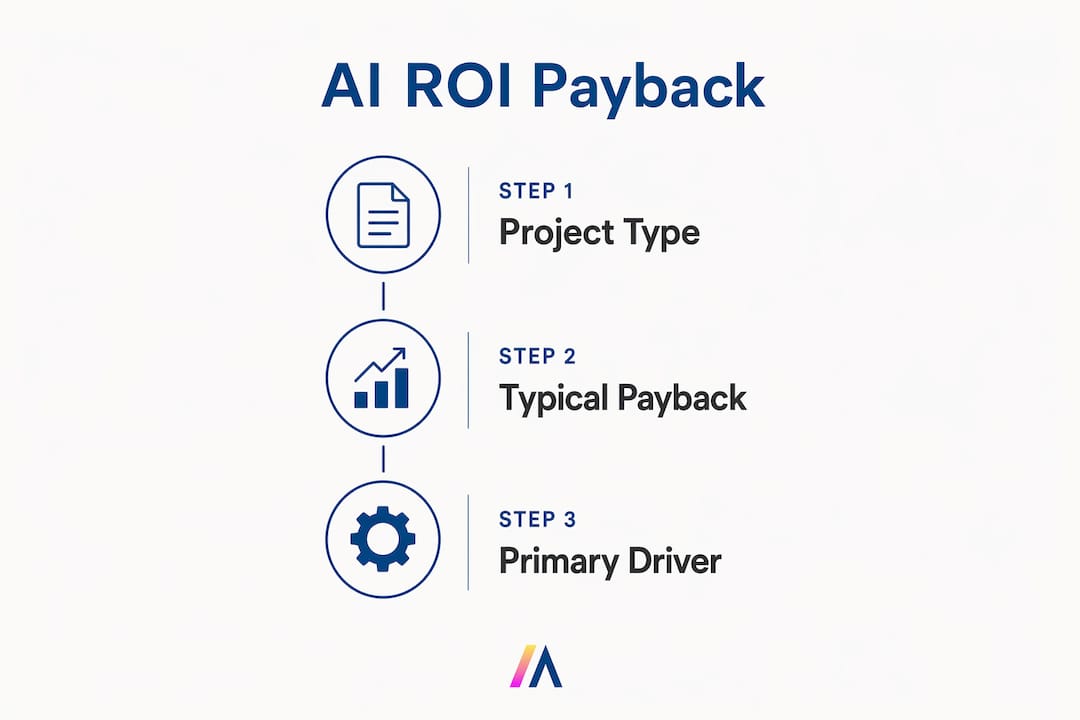
Payback timelines vary more than most enterprise leaders expect. The project type is the single biggest determinant.
| AI Project Type | Typical Payback Period | Primary ROI Driver |
|---|---|---|
| AI copilots and productivity tools | 60–90 days | Output per employee |
| Process automation (repetitive tasks) | 6–12 months | Labor cost displacement |
| Enterprise search and knowledge management | 12–18 months | Decision speed and error reduction |
| Platform and infrastructure investments | 18–30 months | Scalability and multi-use leverage |
AI-powered productivity tools show the fastest ROI realization, often within 60–90 days. Infrastructure investments take 18–30 months because the value accrues across multiple use cases over time, not from a single workflow improvement.
The broader picture is sobering. 85% of executives increased AI spending over the prior year, but only 6% achieved positive ROI in under 12 months. That gap between investment enthusiasm and realized return is not a technology problem. It is a measurement and adoption problem.
Change management underinvestment is the primary cause of delayed ROI. Most organizations allocate less than 10% of their AI budget to training, process redesign, and adoption programs. When employees do not change how they work, AI tools sit underused and the productivity gains never materialize. Realistic stakeholder expectations and a funded adoption program are not optional. They are the difference between a 90-day payback and an 18-month one.
Measurement errors are more common than most finance teams realize, and they are expensive. The most damaging errors fall into four categories.
Skipping the pre-deployment baseline is the top reason AI business cases fail finance scrutiny. A formal baseline must be established 3–6 months before deployment, using ledger-based metrics that account for natural productivity trends, volume changes, and pricing shifts. Retrospective estimates are not audit-worthy. They are guesses dressed up as data.
Failing to net out natural improvements is the second major error. If your customer service team was already improving resolution times before AI deployment, you cannot credit that trend to the AI. ROI calculations must isolate true AI impact by netting out volume changes, pricing impacts, and vendor consolidations. Failure to do so overstates ROI by a significant margin.
Overstating savings without audit controls creates a credibility problem. Overstating AI savings by failing to net out natural improvements results in a 30%–60% drop in defensible savings after audit. That is not a rounding error. It is a material misstatement that damages the AI program’s credibility with the board.
Measuring cost per API call instead of cost per outcome is a technical error with financial consequences. For agentic AI deployments, the right unit of measurement is cost per completed process, incorporating agent chain costs, retries, and human oversight steps. Cost per API call understates true infrastructure spend and makes ROI look better than it is.
Pro Tip: Run a staged rollout where one business unit uses the AI tool and a comparable unit does not. That natural experiment gives your finance team a defensible control group and cuts misattribution risk significantly.
The organizations that prove AI ROI fastest share one structural habit. They treat AI infrastructure as a distinct P&L unit from day one, tracing costs directly to business outcomes rather than burying them in IT overhead. That single practice makes attribution defensible and accelerates finance approval for follow-on investments.
Here is a practical sequence for enterprise leaders:
Pro Tip: Align every AI initiative to a named business objective with a dollar value attached before deployment. If you cannot name the objective and quantify its value, the project is not ready for investment approval.
Investing in AI-powered operational analytics gives leaders the data infrastructure to correlate AI costs with business outcomes in real time. That correlation is what turns an ROI estimate into an ROI fact. You also need to align AI initiatives with clear business objectives from the start, not after deployment when retrofitting a measurement framework is far harder.
Accurate enterprise AI ROI measurement requires a formal baseline, a matched financial framework, and funded change management before deployment begins.
| Point | Details |
|---|---|
| ROI benchmarks | Mature AI projects return 100%–300% over three years, with 18–24 month median payback periods. |
| Framework selection | Use TEI for cost displacement, NPV for growth investments, and productivity multipliers for copilot tools. |
| Payback speed | AI copilots pay back in 60–90 days; infrastructure investments take 18–30 months. |
| Attribution accuracy | Establish a ledger-based baseline 3–6 months before deployment to avoid a 30%–60% ROI overstatement after audit. |
| Change management | Allocate at least 15%–20% of AI budget to adoption programs; underinvestment is the primary cause of delayed ROI. |
The conversation I hear most often among enterprise leaders goes like this: “We deployed the AI, but we cannot prove it worked.” That is not a technology failure. It is a measurement failure that was baked in from day one.
The uncomfortable truth is that most organizations treat ROI measurement as a post-deployment task. They deploy first, then try to reconstruct a baseline from memory or from systems that were never configured to capture the right data. That approach fails finance scrutiny every time.
What I have seen work consistently is treating the measurement infrastructure as part of the deployment itself. Before a single user touches the AI tool, the finance and data teams need a ledger-based baseline, a defined attribution methodology, and a monitoring dashboard. That setup takes four to six weeks. It feels like overhead. It is actually the investment that makes every subsequent ROI claim defensible.
The other pattern I would caution against is impatience. The Deloitte data showing only 6% of executives achieving ROI in under a year is not a failure statistic. It is a calibration signal. Infrastructure investments take 18–30 months to pay back because the value compounds across use cases. Boards that pull funding at month 12 because they have not seen full return are making a capital allocation error, not a technology judgment.
The leaders who get this right align AI goals to specific business objectives before deployment, fund change management adequately, and build measurement into the program architecture from the start. That is not a novel insight. It is just disciplined capital investment applied to a new asset class.
— Matthieu
Enterprise AI investment returns are only as credible as the data behind them. Hymalaia is built to give enterprise leaders exactly that credibility.
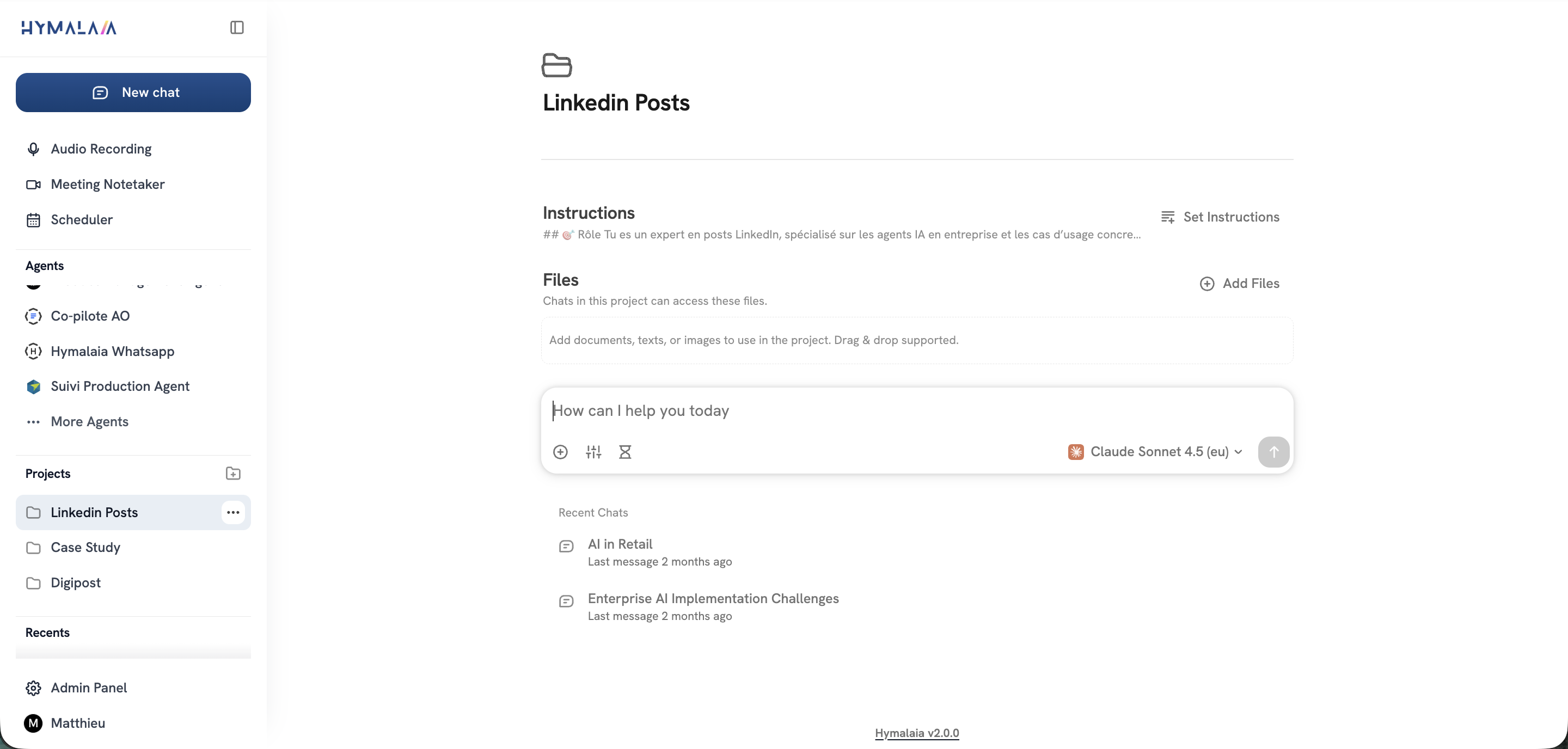
Hymalaia’s enterprise AI platform connects with over 50 enterprise tools, including Salesforce, Slack, Google Workspace, and SharePoint, enabling granular tracking of AI activity across every workflow. Its retrieval-augmented generation (RAG) architecture ties AI responses directly to your operational data, so cost and outcome data live in the same system. Leaders get real-time visibility into AI usage, process completion rates, and business impact metrics without building a separate analytics stack. If you are ready to move from ROI estimates to ROI facts, explore Hymalaia’s platform and see how enterprise teams are measuring and maximizing their AI investment returns today.
Mature enterprise AI deployments generate between 100% and 300% ROI over three years. Median payback periods run 18–24 months, though productivity tools can pay back in as little as 60–90 days.
Establish a ledger-based baseline 3–6 months before deployment, apply the right framework (TEI for cost displacement, NPV for growth), and use staged rollouts to create a clean control group for attribution.
Only 6% of executives achieve positive ROI in under 12 months, according to Deloitte data from 1,854 executives. The primary causes are underinvestment in change management and the absence of a formal pre-deployment measurement baseline.
For agentic AI deployments, the correct unit is cost per completed process, not cost per API call. This captures agent chain costs, retries, and human oversight steps that API-level metrics miss entirely.
CFOs use Total Economic Impact for cost-displacement projects and NPV with 15%–20% hurdle rates for growth investments. Keeping these frameworks separate accelerates investment decisions and prevents mixed-methodology errors that undermine finance confidence.
