TL;DR:
- Conversational AI enables machines to understand and generate human language in context, transforming enterprise interactions. It offers significant operational, employee, and customer experience benefits by automating routine tasks and providing real-time insights. Success depends on leadership engagement, data quality, and aligning AI goals with business objectives through continuous measurement and strategic oversight.
Most executives understand that AI matters. Far fewer can articulate what conversational AI actually does, where it fits inside their organization, and why it is different from the chatbot that frustrated their customers three years ago. Understanding what is conversational AI for executives means moving past the buzzword and into a clear picture of technology that listens, reasons, responds, and acts. This guide cuts through the noise to give you a practical, decision-ready view of how conversational AI works, what it delivers, and where to focus your leadership attention.
| Point | Details |
|---|---|
| More than chatbots | Conversational AI uses NLP, context retention, and agentic capabilities to hold real, purposeful business dialogs. |
| Operational efficiency gains | Automating routine interactions reduces workload, lowers burnout risk, and frees teams for higher-value work. |
| Implementation requires culture | Technology alone does not drive transformation; employee buy-in and active leadership determine outcomes. |
| Measure what matters | Define KPIs tied to response time, customer satisfaction, and revenue impact before deployment, not after. |
| Executives must stay engaged | AI initiatives succeed when leaders remain actively involved, not just as sponsors, but as decision-makers in the process. |
Conversational AI is a category of technology that enables machines to understand, process, and generate human language in context. It is not a single product. It is a collection of capabilities built on three core layers.
Natural Language Processing (NLP) handles the mechanics of language. It interprets grammar, intent, and meaning from unstructured text or speech. Natural Language Understanding (NLU) goes deeper, extracting the intent behind a request and the entities within it. Natural Language Generation (NLG) produces a reply that reads like something a human actually wrote.
What separates modern conversational AI from the rule-based chatbots of the previous decade is context. Earlier systems followed decision trees. Ask a question slightly differently and you fell off the script. Today’s conversational AI retains context across a conversation, remembers prior exchanges within a session, and adjusts its behavior based on what it learns about the user.
The next leap is agentic AI. Rather than simply answering questions, agentic AI assistants can complete tasks inside the conversation itself, including checking order status, processing refunds, or updating records in a CRM. This is the capability set that makes conversational AI genuinely useful at enterprise scale.
Pro Tip: When evaluating a conversational AI platform, ask vendors to demonstrate a multi-turn, context-dependent task that touches at least two enterprise systems. If the demo requires a human handoff to complete the action, the platform is not truly agentic.
The business case for conversational AI is concrete. The gains show up in three places: operational cost, employee capacity, and customer experience.
On the operational side, automating routine inquiries means your customer service team stops spending 70% of their day answering the same twelve questions. Platforms that unify customer data across channels reduce the fragmented experience that frustrates customers and creates rework for agents. Consistency improves. Response times drop. Costs follow.

The employee dimension is often underestimated by leaders focused on customer-facing metrics. 59% of customer service representatives are currently at risk of burnout, driven largely by repetitive, high-volume interactions. Conversational AI absorbs that load. When it does, retention improves and your human agents shift toward the complex, high-value conversations they are actually better at.
From a decision-making perspective, conversational AI changes the information equation for executives. Instead of waiting for a weekly report, you can query your AI assistant directly: “What are our top three support failure points this quarter?” and receive a synthesized, data-backed answer in seconds. That is a different kind of intelligence than a static dashboard.
The customer experience impact is also evolving fast. Conversational AI now detects sentiment and adjusts its responses accordingly, enabling empathetic interactions that feel far less mechanical than earlier systems. A frustrated customer gets a different response than a satisfied one, without a human making that call each time.
Key benefits executives should track:
The technology works. The transformation is harder. This is where the gap between expectation and reality tends to open up.
CEO-led AI transformations frequently fail not because the AI underperforms, but because leaders romanticize the change rather than managing the human reactions to it. Employees who fear displacement do not adopt new tools willingly. That resistance quietly kills ROI.
“CEOs must earn employee buy-in and listen actively to make AI transformations succeed. Culture and engagement are the deciding factors, not technology.” Source: BCG, May 2026
Data quality presents a second challenge that often goes unacknowledged in boardroom planning. Conversational AI is only as accurate as the information it can access. Fragmented data across legacy systems, inconsistent schemas, and missing integration points all degrade performance. Enterprise platforms must support CRM integration, compliance controls, and real-time reporting to be viable at scale. Anything short of that creates gaps the AI cannot bridge.
Security and compliance deserve serious attention. Conversational AI systems interact with sensitive customer data, employee information, and proprietary business records. Role-based access controls, GDPR compliance, and audit logging are not optional features. They are table stakes for any enterprise deployment. Reviewing your organization’s approach to responsible enterprise AI before signing a vendor contract is time well spent.
Pro Tip: Run a data readiness audit before selecting a conversational AI platform. Map which systems the AI needs to access, identify where data is incomplete or inconsistent, and resolve those gaps first. A well-designed AI on poor data will disappoint. A capable AI on clean, connected data will perform.
The use cases for conversational AI span every major business function. Here is where organizations are seeing the clearest returns.
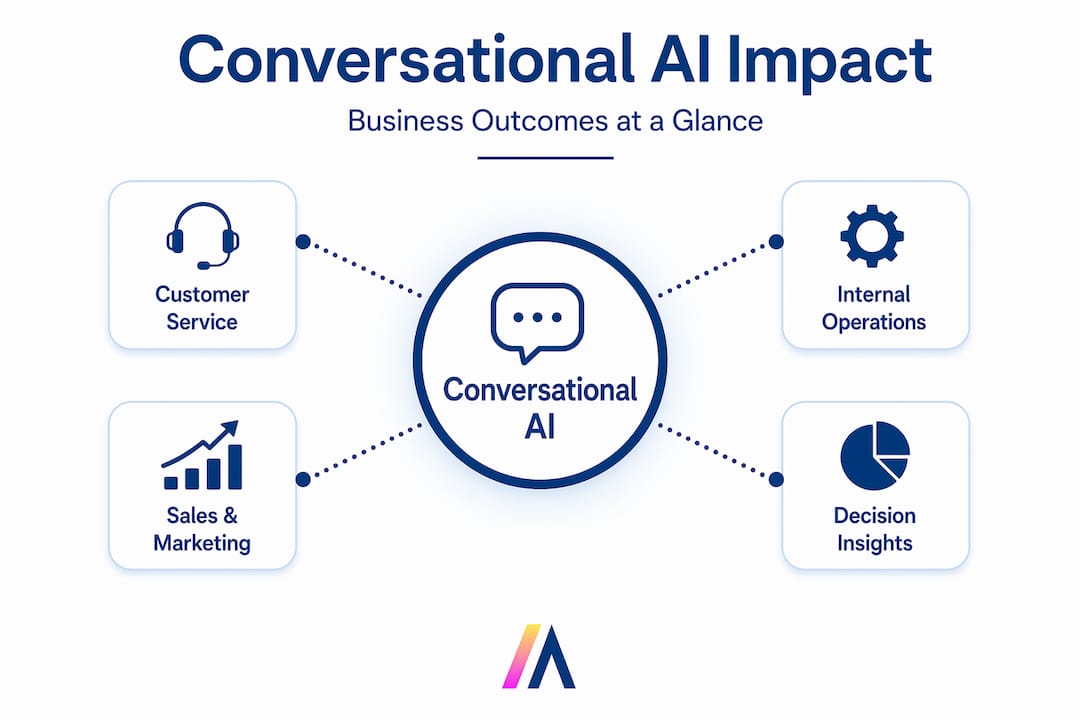
AI handles tier-one inquiries around the clock, resolves common issues autonomously, and hands off to human agents with full context when complexity requires it. The handoff quality matters enormously. Customers should never feel the transfer. The agent should arrive with the full conversation history, the customer’s sentiment profile, and a suggested next step. That is what enterprise conversational AI use cases look like when executed well.
Conversational AI qualifies leads, answers product questions, and guides prospects through the buying process at scale. It does this without adding headcount. When a sales rep enters a conversation, the AI has already pre-qualified the lead, surfaced the relevant purchase history, and flagged the most likely objection.
Employee-facing assistants handle IT requests, policy lookups, onboarding workflows, and leave management without routing every question through a human. This is where AI for enterprise process optimization shows immediate payback. Large organizations spend significant resources answering internal queries that a well-trained assistant can resolve instantly.
| Application area | Primary outcome | Complexity to deploy |
|---|---|---|
| Customer service automation | Response time reduction, cost savings | Medium |
| Sales conversation support | Lead conversion improvement | Medium |
| Internal HR and IT assistant | Employee productivity gains | Low to medium |
| Executive decision support | Faster, data-backed decisions | High |
| Real-time predictive engagement | Proactive customer retention | High |
An AI initiative without measurement is an expense without accountability. Setting your KPIs before deployment forces clarity about what you actually want the technology to achieve.
Executives need real-time data on AI performance to guide investment and course-correct quickly. Monthly reports are not sufficient in fast-moving deployments. Build reporting into your platform selection criteria, not as an afterthought.
The strategic alignment dimension matters just as much as the metrics. Before your first deployment, connect AI objectives to a documented business goal. If your organization is prioritizing customer retention this year, your conversational AI KPIs should map directly to churn indicators. If you are driving revenue growth, align AI initiatives to pipeline metrics and sales cycle velocity. The technology will follow the direction you give it.
Pro Tip: Create a quarterly AI review cadence at the executive level, not just the operations level. Treat it the same way you treat financial reporting. The executives who stay close to their AI performance data make better adjustments, faster.
I have watched executives approach AI transformations in two very different ways. The first group treats conversational AI as an IT project. They fund it, hand it off, and expect a ROI slide at the next board meeting. The second group treats it as a strategic capability that requires their ongoing attention. The outcomes are dramatically different.
75% of CEOs are now placing themselves at the center of AI decision-making, with 90% increasing their AI investment. That is encouraging. But investment without engagement produces expensive shelfware.
In my experience, the biggest mistake is underestimating the people side. I have seen technically sound deployments collapse because middle management felt bypassed, because frontline employees were not trained properly, or because no one communicated what the AI was and was not meant to do. The technology rarely fails first. The culture does.
What I have found actually works is naming a senior executive as the accountable owner of the AI program. Not a champion in name only. A person who reviews performance data, engages with skeptical employees, and is willing to call out when the AI is not performing as expected. That kind of active leadership is what separates the organizations getting real results from the ones publishing press releases.
The other lesson: do not let the perfect be the enemy of the deployed. Start with one high-volume, well-defined use case. Measure it rigorously. Expand from a position of evidence rather than enthusiasm.
— Louis
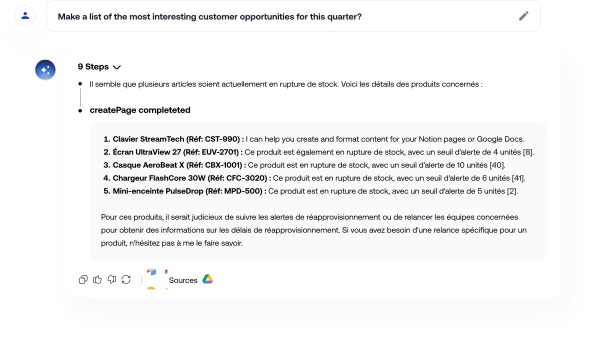
Hymalaia is built for exactly the challenges described in this guide. The platform deploys autonomous AI agents that unify enterprise search, analyze real-time data, and automate complex workflows across sales, support, operations, and executive functions. It connects with over 50 enterprise tools including Salesforce, Slack, Google Workspace, and SharePoint, so your conversational AI operates on complete, synchronized data rather than isolated silos.
For executives focused on governance, Hymalaia provides GDPR-compliant security, role-based access controls, and flexible deployment across cloud, on-premise, or hybrid environments. Real-time performance reporting is built in, so your measurement framework is ready from day one.
Explore the full enterprise AI platform or review the detailed platform capabilities to see how Hymalaia aligns with your organization’s operational and strategic objectives. 🏔️
Conversational AI uses NLP, NLU, and NLG to understand context, retain information across a dialog, and generate human-like responses. Traditional chatbots follow fixed decision trees with no true language understanding.
Conversational AI gives executives on-demand access to synthesized, real-time business intelligence, reduces operational costs through automation, and frees leadership teams from managing high-volume, repetitive workflows.
The most common risks are poor data quality, lack of employee buy-in, and insufficient governance controls. Addressing data integration and compliance requirements before deployment significantly reduces failure rates.
Customer service automation and internal IT or HR assistants typically deliver the fastest measurable returns, often within the first two quarters, due to high interaction volumes and clear deflection metrics.
Track response time reduction, customer satisfaction scores, workload deflection rates, and revenue influence from AI-assisted interactions. Real-time reporting from your AI platform is critical to making timely adjustments.
