TL;DR:
- Conversational sales AI engages and qualifies inbound leads through real-time, context-aware dialogue without human intervention. It significantly increases pipeline size and reduces response times to under 30 seconds, boosting sales efficiency. Enterprises gain valuable buyer insight and reshape sales structures by integrating AI across multiple communication channels.
Conversational sales AI is defined as an always-on, context-aware system that engages, qualifies, and converts leads through natural language dialog without human intervention. Replacing static demo-request forms with AI-driven conversations produces 3.4x more qualified pipeline from the same top-of-funnel traffic. Platforms like Perspective AI, Drift, and Salesforce have each documented measurable pipeline gains from this shift. The benefits of conversational sales AI extend well beyond speed. They reshape how enterprise sales teams qualify leads, structure roles, and generate revenue intelligence at scale.
Conversational AI replaces the static form fill with a dynamic, branching dialog that qualifies leads in real time using BANT criteria: budget, authority, need, and timeline. A visitor who clicks a pricing page gets a contextual question sequence, not a generic contact form. That interaction captures richer data and routes the lead to the right rep faster.

The pipeline impact is significant. Visitor-to-opportunity conversion rates increase by up to 241%, with multi-stage lifts across visitor-to-completion (+271%), completion-to-SQL (+171%), booked-to-showed (+41%), and showed-to-opportunity (+52%). Revenue teams also report up to 27-point increases in AE-rated lead quality. Higher quality leads mean account executives spend less time on dead-end conversations and more time closing.
Pro Tip: Audit your existing lead capture forms before deploying conversational AI. If any form has more than five fields or takes longer than two minutes to complete, it is a direct candidate for replacement with an AI qualification dialog.
AI inbound sales agents reduce lead response times from hours to under 30 seconds. That speed matters because 80% of qualified leads are lost when response time exceeds five minutes. AI eliminates that penalty entirely by engaging every inbound lead the moment they arrive.
The downstream effects on the sales cycle are equally significant:
AI does not replace human sellers. It removes the low-value work that prevents them from performing at their best.
Pro Tip: Track your team’s time-to-first-response metric before and after AI deployment. That single number often tells the clearest story about operational improvement.
Conversational AI systems retain memory across interactions, understand customer intent, and pull in external data from CRM and web history to deliver natural, human-like dialog. Unlike scripted chatbots, these systems reason through multi-step conversations and adapt responses dynamically based on what the buyer says and does. A buyer who visited the enterprise pricing page three times gets a different opening question than one who just landed from a Google ad.
The personalization advantages for enterprise sales teams include:
The conversational AI market is projected to reach USD 41.39 billion by 2030. That growth reflects how broadly enterprises are recognizing the engagement advantage. Personalization at this scale was previously impossible without proportionally large sales teams.
Conversational AI captures behavioral and intent data that a standard lead form cannot. Every question a buyer asks, every topic they avoid, and every moment they hesitate is a signal. AI platforms aggregate these signals into analytics that reveal buyer intent and identify where leads drop out of the funnel.
| Analytics capability | Business impact |
|---|---|
| Conversation pattern analysis | Identifies which qualification questions predict deal closure |
| Intent signal tracking | Flags high-propensity accounts for priority outreach |
| Funnel bottleneck detection | Pinpoints where qualified leads stall before booking |
| Forecasting accuracy | Improves pipeline predictions by grounding them in real engagement data |
| Coaching intelligence | Surfaces conversation gaps that sales managers can address in training |
Deploying conversational AI successfully requires integrating real-time enterprise data from CRM systems, web analytics, and internal databases. That integration is what separates a genuinely intelligent AI agent from a glorified FAQ bot. Platforms like Hymalaia connect with over 50 enterprise tools including Salesforce, Slack, and Google Workspace to enable this depth of data-driven dialog.
The most forward-thinking enterprise sales organizations are redesigning their org charts around AI. The new model assigns AI ownership over all inbound lead qualification, while human reps own outbound prospecting and closing. 78% of B2B SaaS funnels have adopted AI conversational qualification layers in 2026, and those organizations consistently outperform peers still running manual inbound processes.
The structural benefits of this split are clear:
The adoption challenge is real. Sales teams often resist AI integration because they fear displacement. The most successful deployments address this directly by showing reps how AI removes the work they dislike most. Revenue leaders who treat conversational AI as a team-wide strategy rather than a standalone tool consistently outperform peers who deploy it in isolation. For a practical framework on aligning sales teams with AI workflows, the executive adoption guide from Hymalaia covers the organizational change management steps in detail.
The ROI of conversational AI is measurable across multiple dimensions. Lead conversion rates increase by 10% on average when AI qualifies leads contextually based on visitor behavior. Sales productivity rises by 15%. And support cost reductions of up to 92% have been documented in organizations that extend AI to post-sale engagement. Each of these gains compounds when AI operates across the full buyer journey rather than just one touchpoint.
The ROI case is strongest for enterprises with high inbound lead volume and long qualification cycles. A team receiving 500 inbound leads per month and converting 5% to meetings can realistically target 8–10% conversion with AI qualification. That improvement, at enterprise deal sizes, represents significant incremental revenue without adding headcount. For a deeper look at how these gains play out across specific enterprise use cases, the conversational AI ROI analysis from Hymalaia provides concrete examples.
Pro Tip: Build your ROI model before deployment. Use your current visitor-to-meeting conversion rate as the baseline, then project against the documented benchmark improvements. That number gives you a defensible business case for budget approval.
Conversational sales AI delivers measurable pipeline growth, faster sales cycles, and richer buyer intelligence by replacing static lead forms with always-on, context-aware AI qualification agents.
| Point | Details |
|---|---|
| Pipeline growth | AI qualification produces up to 3.4x more qualified pipeline from existing traffic. |
| Response speed | AI reduces lead response time from hours to under 30 seconds, eliminating lost leads. |
| Sales cycle compression | Documented case studies show 30–50% shorter sales cycles with AI inbound agents. |
| Org structure shift | Assign AI to inbound qualification and human reps to outbound and closing for maximum efficiency. |
| Analytics advantage | Conversational AI captures intent signals and funnel data that standard forms cannot collect. |
Sales leaders consistently underestimate the change management side of this deployment. The technology works. The harder problem is convincing experienced SDRs that AI is not coming for their jobs. The teams that navigate this well do one thing differently: they show reps the data on what AI actually handles versus what it hands off. When a rep sees that AI is taking the 2 a.m. form submissions and the “just browsing” visitors, and routing only the genuinely qualified conversations to them, resistance drops fast.
The other mistake I see repeatedly is deploying conversational AI as a point solution on one channel and expecting transformational results. The gains are real but they compound when AI operates across the full inbound surface, website, email follow-up, and messaging channels together. Starting with inbound qualification on your highest-traffic pages is the right move. Scaling from there with CRM integration and cross-channel coverage is where the real pipeline acceleration happens.
My honest advice to any sales leader evaluating this technology: do not wait for a perfect deployment plan. Run a 90-day pilot on your top inbound traffic source, measure visitor-to-meeting conversion before and after, and let the numbers make the case for broader rollout. The AI sales coaching tools that complement conversational AI can then extend those gains into rep development and forecasting accuracy.
— Matthieu
Hymalaia’s enterprise AI agent platform gives sales teams the infrastructure to deploy conversational AI at scale, without building it from scratch.
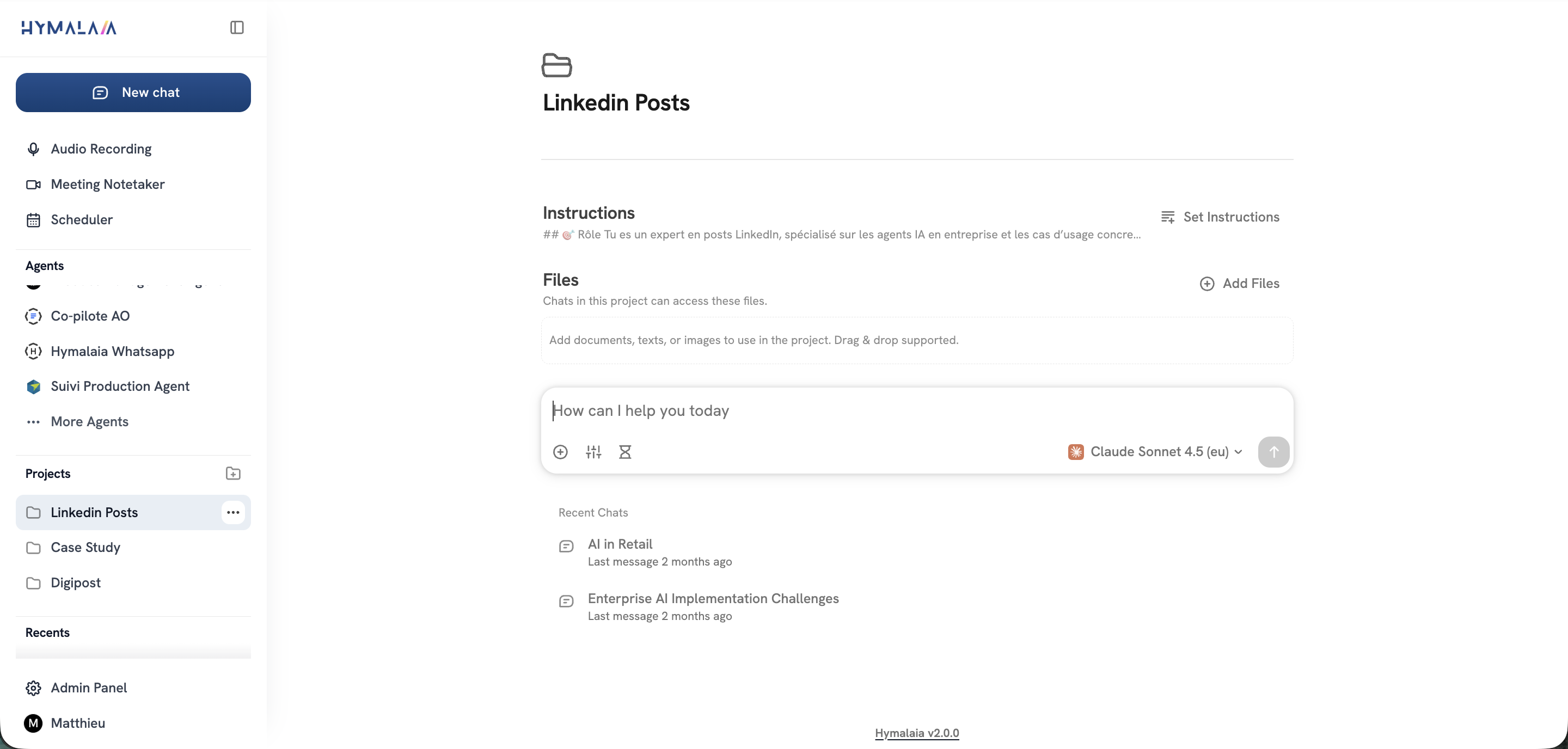
The platform connects with over 50 enterprise tools including Salesforce, Slack, ShareShare, and Google Workspace, enabling AI agents to pull real-time CRM data into every buyer conversation. Its retrieval-augmented generation (RAG) architecture means AI responses are grounded in your actual product, pricing, and customer data, not generic language model outputs. Role-based access controls and GDPR compliance make it deployable in regulated enterprise environments. Sales teams that want to move from manual inbound qualification to AI-led pipeline growth can explore the full platform and see how Hymalaia fits their existing sales stack. The platform features page details the specific agent capabilities available for sales automation.
Conversational sales AI is an AI system that engages, qualifies, and routes inbound leads through natural language dialog in real time, replacing static forms and delayed human follow-up.
Replacing demo-request forms with conversational AI produces up to 241% higher visitor-to-opportunity conversion rates, with a 3.4x increase in qualified pipeline from the same traffic volume.
Conversational AI does not replace human sales reps. It handles inbound qualification and initial engagement so reps can focus on outbound prospecting and closing high-value deals.
AI inbound sales agents respond to leads in under 30 seconds, compared to the industry average of several hours for human follow-up, which eliminates the five-minute response window where most leads are lost.
Enterprise conversational AI platforms integrate with CRM systems like Salesforce, messaging tools like Slack, and productivity suites like Google Workspace to deliver personalized, data-driven buyer conversations.
