TL;DR:
- Autonomous AI workflows enable decision-making and task execution without human intervention. They improve efficiency in areas like insurance, procurement, sales, and marketing by using multi-agent structures. Proper architecture, structured data passing, and trusted escalation points are essential for reliable and scalable automation.
Autonomous AI workflows are self-directed processes where AI agents make decisions, execute tasks, and adapt without human intervention at each step. Unlike legacy automation that follows rigid scripts, autonomous AI agents dynamically understand intent and context to create adaptive decision paths. The practical autonomous ai workflow examples covered here span insurance claims, procurement, sales, and marketing. Each example reflects production-grade architecture that enterprise teams can study and apply. Hymalaia builds on these same principles to help organizations deploy agents that connect across Salesforce, Slack, Google Workspace, SharePoint, and more than 50 other enterprise tools.
A five-agent AI system is the clearest production-grade example of intelligent workflow automation at scale. One documented implementation processes 14,000 claims monthly with minimal manual triage, routing only the most complex cases to human reviewers.
Each agent in the pipeline owns a distinct responsibility:
Structured context passing using JSON schemas connects each agent. That structure keeps the audit trail clean and makes debugging straightforward when an edge case surfaces.
The business result is faster claim resolution and lower operational cost. Human reviewers focus only on genuinely complex escalations, which is where their judgment adds the most value.

Pro Tip: Map your escalation triggers before you build. Define exactly which fraud score thresholds or document gaps should route a claim to a human. Vague escalation rules are the most common reason autonomous claims pipelines stall in production.
Procurement is one of the highest-value use cases for AI-driven workflow examples because it combines data lookup, rule application, and negotiation in a repeatable sequence. Autonomous procurement workflows allow AI to review purchase necessity, consolidate similar orders for volume discounts, and negotiate terms within predefined parameters before routing for approval.
A well-designed procurement workflow follows this sequence:
This sequence removes the back-and-forth that typically delays purchase orders by days. Teams that adopt this approach report faster cycle times and better compliance with preferred vendor agreements because the AI applies policy rules consistently, without the exceptions that human buyers sometimes grant under pressure.
Connecting this workflow to existing email platforms and ERP systems is the key integration step. Enterprise AI automation guides recommend starting with a single product category before expanding to the full catalog.
Sales and marketing teams generate some of the most visible autonomous workflow solutions because the outputs are measurable and the manual workload is high. AI agents automate lead data scraping from LinkedIn, content creation pipelines, and social media scheduling to reduce manual effort and increase campaign agility.
Concrete examples of AI-driven workflow examples in this function include:
The table below shows how autonomous agents compare to traditional manual processes across key marketing workflow tasks:
| Workflow task | Manual process | Autonomous AI agent |
|---|---|---|
| Lead research | 30–60 minutes per prospect | Minutes per batch of 100+ |
| Blog post drafting | 3–5 hours per post | Under 30 minutes with review |
| Social scheduling | Daily manual queue | Continuous, performance-driven |
| Campaign reporting | Weekly manual pull | Real-time, automated alerts |
AI blog publishing automation shows that content teams using autonomous pipelines publish more consistently and spend more time on strategy rather than production tasks. That shift in how teams spend their time is the real productivity gain.
Architecture determines whether an autonomous workflow runs reliably at scale or breaks under edge cases. Autonomous AI pipelines can process over 100,000 items with zero human QA intervention when they use multi-stage cross-model validation and append-only audit logging.
The most important design principles are:
Separate generation from validation. Cross-model adversarial validation prevents echo-chamber bias by ensuring the model that validates output is different from the model that generated it. This single rule catches a large share of errors that self-validating systems miss entirely.
Use structured context between agents. Passing JSON schemas between agents maintains system stability and creates a readable audit trail. Unstructured text passing between agents is the fastest route to unpredictable behavior in production.
Build conditional routing and retry logic. Every stage should have a defined path for failure. Automated fix generation limited to two attempts per item prevents infinite retry loops that consume compute and delay downstream stages.
Maintain append-only audit logs. Compliance teams need to reconstruct exactly what each agent decided and why. Append-only logs make that reconstruction possible without relying on agent memory.
The table below summarizes the nine-stage pipeline architecture documented in production:
| Stage | Function | Human involvement |
|---|---|---|
| Intake | Data ingestion and validation | None |
| Enrichment | Context addition from external sources | None |
| Generation | Primary AI output creation | None |
| Cross-model validation | Adversarial quality check | None |
| Conditional routing | Pass, fix, or escalate decision | None |
| Automated fix | Up to two correction attempts | None |
| Secondary validation | Confirm fix quality | None |
| Audit logging | Append-only record creation | None |
| Escalation | Complex case handoff | Human reviewer |
Pro Tip: Start with rule-based automation before moving to fully autonomous agents. Teams that skip this step often lack the baseline data needed to set reliable escalation thresholds. Progressive adoption builds organizational trust and surfaces edge cases before they reach production at scale.
Data pipeline architecture guides for AI products recommend treating each agent as a stateless microservice. That design makes individual stages replaceable without rebuilding the entire workflow.
Autonomous AI workflows deliver the most value when they combine multi-agent architecture, structured data passing, and clearly defined human escalation points across functions like claims, procurement, and sales.
| Point | Details |
|---|---|
| Multi-agent pipelines scale fast | A five-agent claims system processes 14,000 claims monthly with minimal manual triage. |
| Structured context prevents failures | JSON schemas between agents maintain audit trails and make debugging reliable. |
| Separate validation from generation | Using different models for generation and validation eliminates echo-chamber errors. |
| Progressive adoption builds trust | Starting with rule-based automation before full autonomy reduces production risk. |
| Sales and marketing gain speed | Autonomous agents cut lead research and content production time from hours to minutes. |
The teams that succeed with autonomous AI workflows share one habit: they pick a process that already has clear rules before they automate it. Insurance claims work well because policy rules are documented. Procurement works well because approval thresholds exist. When teams try to automate a process that humans still argue about, the AI inherits the ambiguity and amplifies it.
The second pattern I’ve observed is that trust comes from transparency, not from performance alone. A workflow that processes 100,000 items correctly but produces no audit trail will face more internal resistance than a slower workflow with full logging. Enterprise teams need to show regulators, auditors, and executives exactly what the AI decided and why. Append-only logs are not a technical nicety. They are the organizational permission structure that lets autonomous workflows expand.
The third thing worth saying directly: autonomous AI adoption does not require a big-bang deployment. The organizations I’ve seen move fastest started with one workflow, one department, and one measurable outcome. They built confidence with that result, then expanded. The teams that tried to automate everything at once spent most of their time managing exceptions rather than capturing value.
If you are evaluating where to start, pick the workflow where the cost of a wrong decision is low and the volume of decisions is high. That combination gives you enough data to tune the system quickly and enough safety margin to learn without serious consequences.
— Matthieu
Enterprise teams building their first autonomous workflow often face the same friction: connecting agents to the right data sources, maintaining governance, and getting visibility into what agents are actually doing.
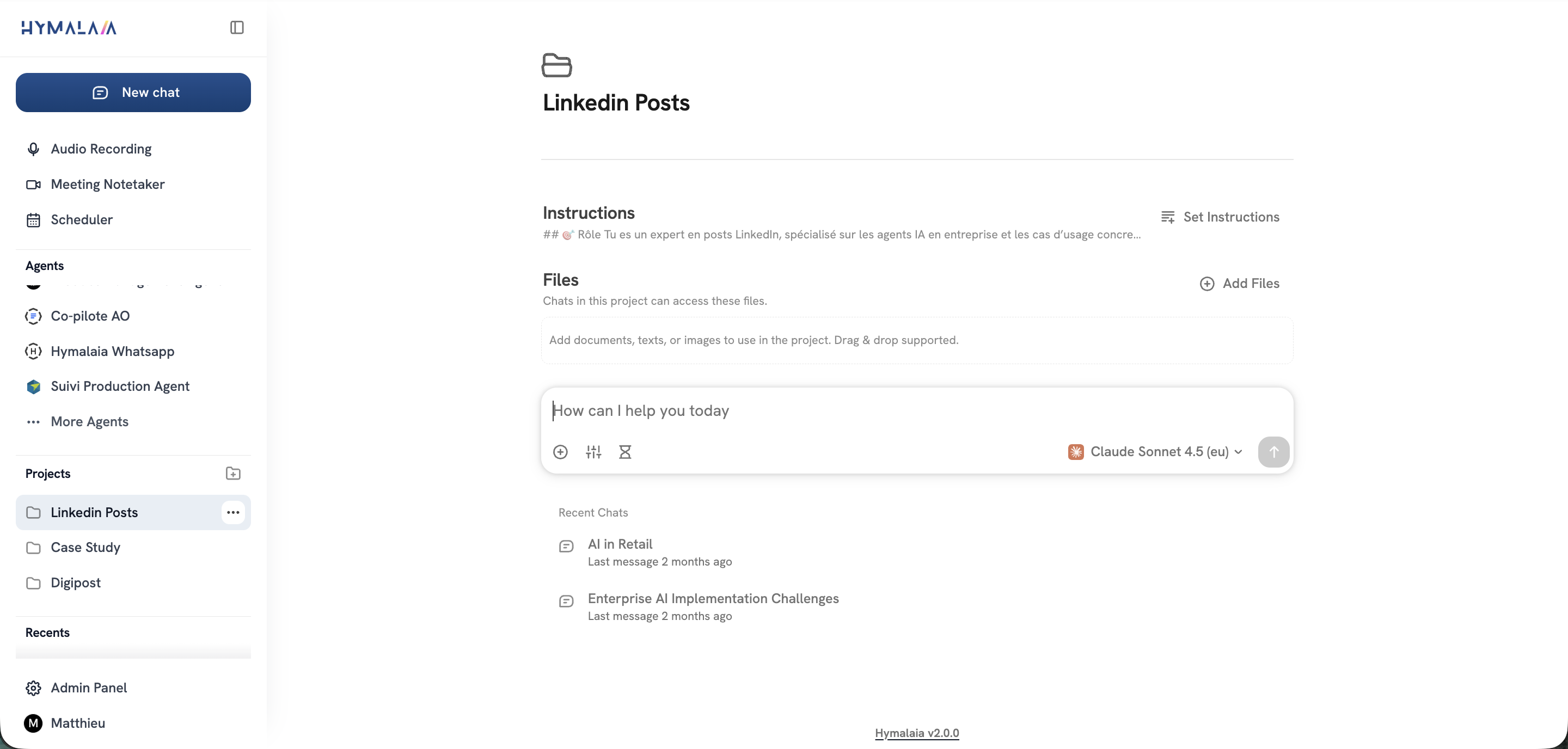
Hymalaia addresses each of those friction points directly. The platform connects with over 50 enterprise tools including Salesforce, Slack, Google Workspace, and SharePoint, so agents have access to the data they need without custom integration work. Role-based access controls and GDPR-compliant architecture keep sensitive data protected at every stage. Real-time monitoring gives operations teams full visibility into agent activity, and the enterprise AI agent platform supports cloud, on-premise, and hybrid deployment. Teams ready to move from concept to production can request a demo to see how Hymalaia fits their specific workflow requirements.
Autonomous AI workflows are multi-step processes where AI agents make decisions and execute tasks without human intervention at each stage. They differ from traditional automation by adapting to context and intent rather than following fixed rules.
Standard automation follows rigid, predefined scripts. Autonomous AI workflows use agents that understand context, handle exceptions, and route decisions dynamically based on real-time data.
Insurance, procurement, sales, and marketing show the clearest production results. Any function with high decision volume and documented rules is a strong candidate for autonomous AI automation.
Production workflows range from three to nine agents depending on complexity. The five-agent insurance claims pipeline is a well-documented example that handles intake, analysis, fraud detection, decisions, and communication.
The biggest risk is skipping structured context passing between agents. Without JSON schemas or equivalent formats, audit trails break down and debugging becomes unreliable at scale.
