TL;DR:
- AI enhances support agent productivity by automating routine tasks and surfacing real-time knowledge. It improves resolution rates, especially for less-experienced agents, while reducing handle time and rework. Success depends on proper knowledge base grounding and fostering agent trust in AI tools.
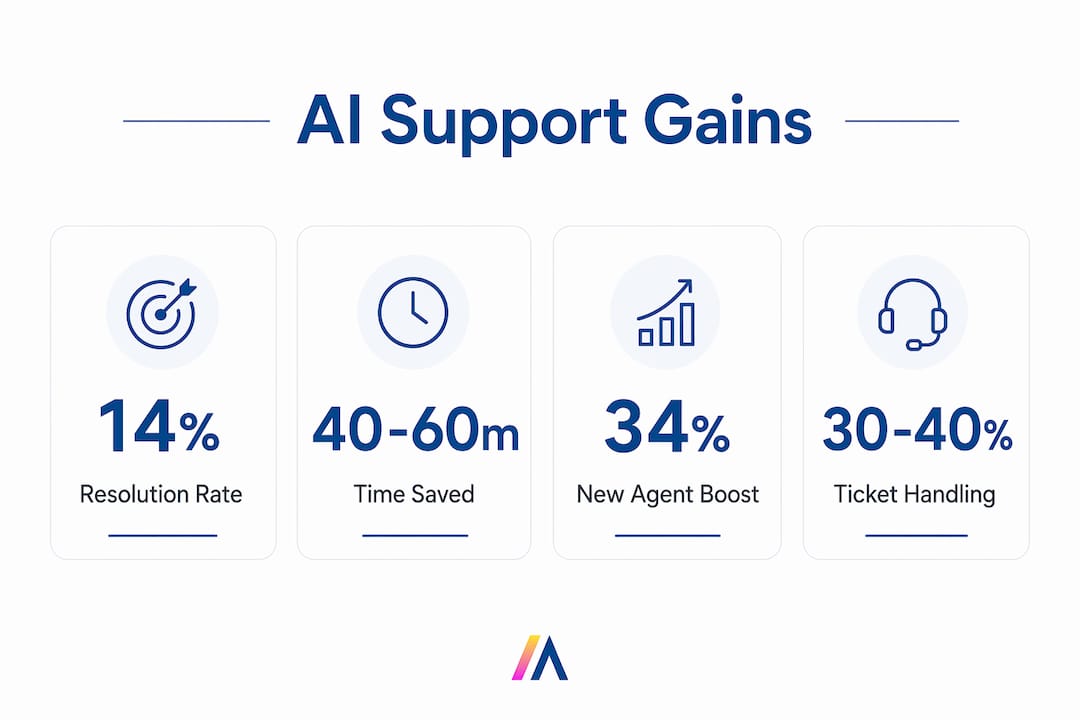
AI improves agent performance in support by automating routine workflows, surfacing real-time knowledge, and augmenting human decision-making during live customer interactions. The industry term for this model is AI-augmented support, and it produces measurable results: agents handle more tickets, resolve issues faster, and deliver more consistent answers. AI saves agents 40–60 minutes daily on manual tasks alone. For support managers running enterprise teams, that time compounds across every agent, every shift, every quarter. The gains are not theoretical. They show up in resolution rates, handle times, and customer satisfaction scores.
AI-augmented support works because it removes the friction that slows agents down. Every minute an agent spends searching a knowledge base, copying data between systems, or manually categorizing a ticket is a minute not spent solving a customer’s problem. AI eliminates that friction at scale.
The productivity gains are specific and documented. AI increases resolution-per-hour rates by an average of 14% across support teams. That figure climbs to 34% for new, less-experienced agents. The gap between those two numbers tells you something important: AI’s biggest impact is not on your best agents. It is on the agents who need the most support.
AI also changes the nature of the work itself. Agents shift from reactive information retrieval to active problem-solving. They spend less time searching and more time engaging. That shift improves both agent satisfaction and customer outcomes, which matters for retention on both sides of the interaction.
Repetitive tasks are the single largest drain on agent productivity. AI addresses this directly by taking over the work that requires no human judgment.
The most common tasks AI handles in enterprise support environments include:
Together, these automations account for the 40–60 minutes of daily time savings cited above. Across a team of 20 agents, that is 800–1,200 minutes of recovered capacity every day.
Pro Tip: Measure baseline handle time and post-call work separately before deploying AI. Agents often underestimate how much time they spend on data entry. Separating the metrics gives you a cleaner before-and-after comparison.

New agents are the most expensive productivity problem in support. They take months to reach the performance level of experienced agents, and in high-turnover environments, that gap never fully closes before the next hiring cycle begins.
AI compresses that learning curve by encoding best-practice knowledge from top performers and making it available to every agent in real time. A new hire handling a billing dispute gets the same suggested phrasing, policy reference, and resolution path that your best agent would use. They do not need six months of experience to access that knowledge. They need the right AI tool.
The performance data supports this directly:
| Agent type | Resolution rate improvement with AI |
|---|---|
| All agents (average) | +14% per hour |
| New or less-experienced agents | +34% per hour |
| Teams with high turnover | Largest absolute gains |
The 34% figure is the most important number in this table. It means AI delivers its highest return precisely where support teams are most vulnerable: with the agents who are newest, least confident, and most likely to escalate unnecessarily or give incorrect answers.
Human-in-the-loop architecture is what makes this safe. AI drafts the response. The agent reviews and sends it. That review step preserves accuracy and prevents the new agent from blindly trusting an incorrect AI output. The largest productivity gains consistently appear in teams where AI acts as a real-time mentor rather than a replacement for agent judgment.
Pro Tip: For seasonal hiring or rapid team scaling, build your AI knowledge base before the hiring wave. Agents who onboard with AI assistance from day one reach full productivity faster than those who learn the tools after the fact.
Agents make dozens of micro-decisions during every customer interaction. Should they escalate? What policy applies? Has this customer contacted support before? What was the outcome? Without AI, answering those questions requires switching between systems, reading through ticket history, and making judgment calls with incomplete information.
AI changes that by surfacing the full picture before the agent types a single word. The specific capabilities that drive better decisions include:
AI assistant tools help agents handle 30–40% more tickets per hour by surfacing relevant knowledge and auto-drafting responses. That capacity increase does not come from agents working faster. It comes from agents spending less time searching and more time resolving.
Providing full customer context during escalation improves first-contact resolution and customer satisfaction. The handoff from AI-assisted agent to senior agent becomes a transfer of context, not a restart of the conversation. That single improvement reduces customer frustration and repeat contacts significantly.
The risk in this section is worth naming directly. AI that is not grounded in a verified enterprise knowledge base will generate confident but incorrect answers. Retrieval-augmented generation, or RAG, is the technique that anchors AI responses to your actual policies, products, and procedures. Without it, the contextual assistance AI provides can be worse than no assistance at all. You can read more about how AI knowledge bases work in enterprise support environments to understand what proper grounding requires.
AI delivers real gains, but only when implemented correctly. The failure modes are specific and predictable.
Poor RAG implementation creates rework cycles. Poorly implemented RAG leads to hallucination-to-rework cycles that erase up to 40% of AI time savings. An agent who sends an incorrect AI-drafted response and then has to re-contact the customer, correct the error, and update the record loses more time than if they had written the response manually.
Overpromising on deflection rates sets false expectations. Generative AI deflection rates of 60–85% are achievable in the first 90 days. Guarantees above 90% are not reliable. The quality and scope of your knowledge base determine where you land in that range.
Agents who distrust AI ignore it. Adoption is a people problem, not a technology problem. Agents who feel AI is monitoring them rather than helping them will work around it. Framing AI as a productivity tool that makes their job easier, not a performance surveillance system, determines whether you get the gains or not.
Measuring the wrong metrics hides real impact. Tracking only ticket volume misses the quality improvements AI delivers. Measure first-contact resolution, average handle time, post-call work, and escalation rates separately to see the full picture.
Skipping continuous improvement stalls results. AI performance degrades when your knowledge base goes stale. Build a review cycle into your operations. Update policies, flag outdated articles, and retrain your AI on new product information at least quarterly.
The industries benefiting most from AI automation in 2026 share one trait: they treat AI implementation as an ongoing process, not a one-time deployment. Support is no different.
AI-augmented support delivers the highest returns when it combines task automation, real-time knowledge grounding, and human-in-the-loop review to protect accuracy while increasing throughput.
| Point | Details |
|---|---|
| Time savings are immediate | AI saves agents 40–60 minutes daily by automating data entry, routing, and knowledge retrieval. |
| New agents gain the most | Less-experienced agents see a 34% resolution rate boost, the highest gain of any agent group. |
| Context improves decisions | Real-time summaries, sentiment signals, and CRM data help agents resolve issues faster and more accurately. |
| RAG grounding is non-negotiable | Ungrounded AI creates rework cycles that erase up to 40% of productivity gains. |
| Adoption requires trust | Agents must see AI as a productivity tool, not a monitoring system, for implementation to succeed. |
Support managers tend to measure AI success by deflection volume. How many tickets did the bot handle? How many did we avoid routing to a human? That framing misses the more durable value AI creates.
The teams I have seen get the most out of AI are not the ones chasing the highest deflection rate. They are the ones who use AI to make every human interaction better. Their agents resolve issues on the first contact more often. Their new hires reach full productivity in weeks instead of months. Their escalation rates drop because agents have the context they need before the customer has to repeat themselves.
The uncomfortable truth is that AI does not replace the need for good agents. It raises the floor. A mediocre agent with excellent AI assistance performs closer to your top performers. But a great agent with excellent AI assistance becomes genuinely exceptional. That asymmetry is where the real ROI lives, and most enterprise teams are not measuring it.
The future of support is not fewer agents. It is agents who handle more complex, higher-value interactions because AI has absorbed everything routine. The teams building toward that model now will have a structural advantage in 2027 and beyond. The teams still treating AI as a cost-cutting tool will keep chasing deflection numbers and wondering why satisfaction scores are not improving.
— Matthieu
Support managers who want measurable gains need an AI platform built for enterprise complexity, not a generic chatbot bolted onto a ticketing system.
Hymalaia deploys autonomous AI agents that connect to over 50 enterprise tools, including Salesforce, Slack, Google Workspace, and SharePoint. Its RAG architecture grounds every AI response in your verified knowledge base, eliminating the hallucination risk that erases productivity gains. Agents get real-time context, suggested replies, and automated ticket handling in a single interface. The platform supports cloud, on-premise, and hybrid deployment with GDPR-compliant data controls. Support teams that want to see what AI-augmented performance looks like in practice can explore the Hymalaia enterprise AI platform and request a demonstration.
AI saves agents 40–60 minutes per day by automating data entry, ticket routing, and knowledge retrieval. That time compounds significantly across large teams.
New agents see a 34% boost in resolution rates with AI assistance because AI gives them instant access to best-practice knowledge they have not yet built through experience. Experienced agents already carry that knowledge internally.
Retrieval-augmented generation (RAG) anchors AI responses to your verified enterprise knowledge base. Without it, AI generates confident but potentially incorrect answers, creating rework cycles that erase up to 40% of time savings.
Generative AI deflection rates of 60–85% are achievable in the first 90 days. Rates above 90% are not reliably attainable and depend heavily on knowledge base quality and scope.
Track first-contact resolution, average handle time, post-call work, and escalation rates separately. Ticket volume alone does not capture the quality improvements AI delivers to individual agent interactions.
