TL;DR:
- AI agents in CRM systems autonomously perceive data, reason through context, and execute workflows without human input. They transform CRMs into active revenue engines by handling lead scoring, outreach, forecasting, and support, reducing manual work for teams. Success depends on high-quality, governed data and active management of human factors and KPIs.
AI agents in CRM management are defined as autonomous digital systems that perceive customer data, reason through context, and execute sales and service workflows without waiting for human commands. The role of AI agents in CRM management has moved from experimental to essential: 45% of sales professionals now interact with AI at least weekly inside their CRM systems, up from 21% in 2024. That doubling in two years signals a structural shift, not a trend. CRM platforms built on agentic AI stop being passive data logs and start acting as live revenue engines that qualify leads, resolve support cases, and forecast pipeline around the clock.

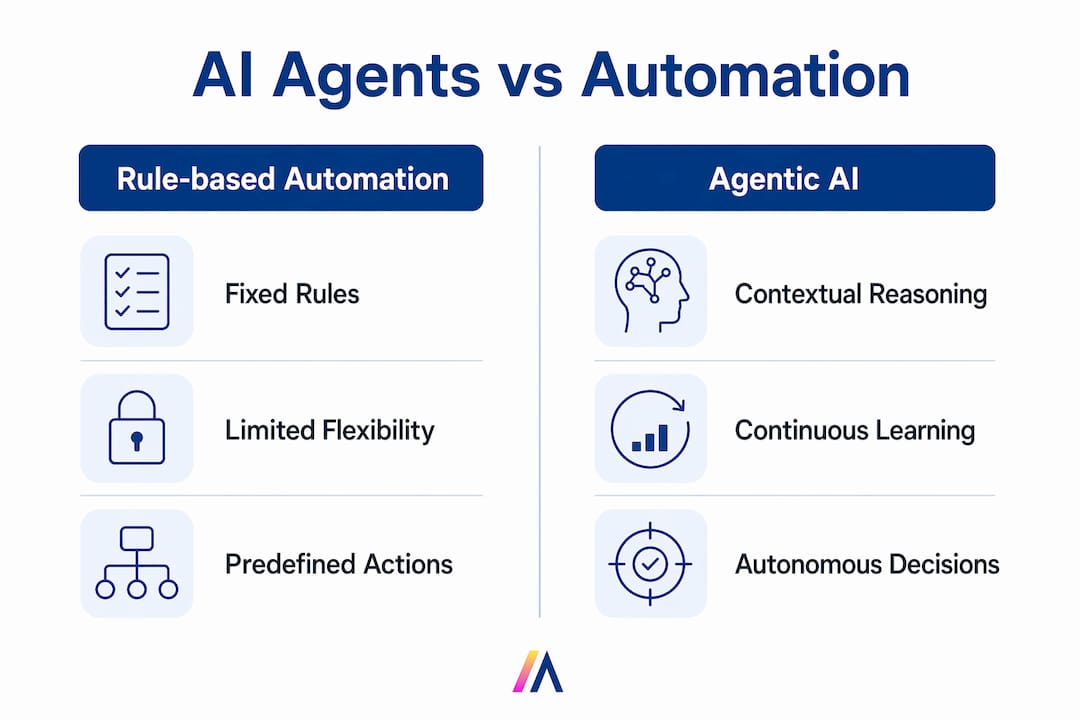
Traditional CRM automation follows hard-coded rules. If a contact fills out a form, the system sends a welcome email. The rule never changes unless a human rewrites it. Agentic AI systems execute workflows autonomously, reading context and deciding the best next action without a fixed script.
The difference comes down to the decision loop. AI agents operate in a continuous cycle: observe incoming data, reason about what it means, plan a response, act on that plan, and learn from the outcome. Agentic AI continuously learns from CRM outcomes to refine its future actions. That means the system gets more accurate over time without manual retraining.
The practical implication for CRM managers is a shift in their own role. Agentic AI transforms the user role from executing tasks to overseeing AI performance and managing exceptions. You stop being the person who updates records and start being the person who sets priorities and reviews edge cases.
| Capability | Rule-based automation | Agentic AI |
|---|---|---|
| Decision logic | Fixed, pre-written rules | Contextual reasoning |
| Adaptability | Manual updates required | Learns from outcomes automatically |
| Scope | Single-trigger actions | Multi-step workflow execution |
| Human role | Task executor | Strategic oversight |
Pro Tip: Before deploying AI agents, map every rule-based workflow your team currently runs. The gaps where rules break down are exactly where agentic AI delivers the most immediate value.
The practical applications of AI in customer relationship management fall into four high-impact categories. Each one removes a specific class of manual work from your team’s plate.
Lead scoring and qualification. AI agents analyze behavioral patterns, firmographic context, and real-time signals to rank leads by conversion probability. They update scores continuously as new data arrives, not just when a rep remembers to check. A lead that visits your pricing page three times in one day gets escalated automatically, without a rep monitoring activity logs.
Personalized outreach at scale. AI agents draft and send follow-up messages timed to each contact’s engagement history. They adjust tone and content based on deal stage, industry, and past interactions. The result is outreach that reads as personal but runs without manual effort.
Real-time sales forecasting. AI-driven CRM systems pull live pipeline data, apply historical win-rate patterns, and generate updated forecasts continuously. Organizations using AI for this purpose report up to 50% improvement in forecast accuracy. More accurate forecasts let leadership allocate resources before problems surface, not after.
Automated customer support with AI. AI agents handle routine support cases end to end: they read the customer’s history, classify the issue, apply the correct resolution, and close the ticket. Complex cases get escalated to a human with full context already attached. This 24/7 operation reduces response times and frees support staff for high-judgment conversations.
The combined effect is significant. AI agents reduce the manual and low-judgment work that currently consumes 50–65% of a sales rep’s time. That time shifts to negotiation, relationship building, and strategic account management. Those are the activities that actually close deals.
Deploying AI agents in a CRM is not a plug-and-play event. Three factors consistently separate successful deployments from expensive experiments.
Data quality comes first. Poor data yields unreliable AI outputs, following the “Garbage In, Garbage Out” principle. An AI agent trained on duplicate contacts, outdated company records, and inconsistent field values will make bad decisions confidently. Before any agent goes live, your team needs to audit, deduplicate, and standardize CRM data. This step is not glamorous, but skipping it guarantees failure.
Governance frameworks must be in place. Effective AI deployment requires rigorous upfront cleansing, structuring, and governance of CRM data. Governance means defining who owns each data field, how records get updated, and what triggers a data quality review. Without governance, data quality degrades faster than AI agents can compensate.
Human factors require active management. Sales teams often fear that AI agents will replace their jobs. That fear reduces adoption and creates workarounds that undermine the system. AI agents augment people by eliminating routine tasks, freeing them for work that requires emotional intelligence and judgment. Communicating that distinction clearly, and backing it up with reskilling programs, determines whether your team uses the system or fights it.
KPIs need to be redesigned. Measuring a rep’s performance by number of calls logged becomes meaningless when an AI agent logs calls automatically. New metrics should reflect the quality of human judgment: deal complexity handled, strategic accounts developed, and customer satisfaction scores on escalated cases.
Pro Tip: Run a 90-day data hygiene sprint before your AI agent deployment. Assign a data steward to each major CRM object type. Clean data is the single highest-return investment you can make before going live.
The business case for AI tools for CRM optimization is now backed by 2026 adoption data, not just vendor projections.
73% of sales professionals using AI-powered CRM report significant productivity increases. That is not a marginal improvement. It reflects a fundamental change in how sales teams spend their time when routine work is automated.
“The shift from AI-assisted CRM to agentic AI is the difference between a system that tells you what to do and one that does it for you.” — Industry analysis, 2026
Forecast accuracy is the metric that most directly affects revenue planning. A 50% improvement in forecast accuracy means leadership can commit to hiring plans, marketing budgets, and capacity investments with far greater confidence. Missed forecasts are expensive. Better forecasts compound value across the entire organization.
Sales rep satisfaction and retention also improve. When reps spend less time on data entry, follow-up scheduling, and report generation, they spend more time on the work they were hired to do. That alignment between job expectations and daily reality reduces turnover. Replacing a sales rep costs significantly more than retaining one, so the productivity gains from AI-driven CRM systems carry a direct retention benefit.
For CRM managers, the post-sale workflow automation gains are equally significant. Renewal tracking, upsell identification, and customer health scoring all run continuously without manual intervention. The CRM becomes a live system of action rather than a historical record.
AI agents transform CRM from a passive data store into an active system that qualifies leads, resolves support cases, forecasts revenue, and learns from every outcome without constant human intervention.
| Point | Details |
|---|---|
| Adoption is accelerating fast | 45% of sales professionals use AI weekly in CRM in 2026, up from 21% in 2024. |
| Agents differ from automation | Agentic AI reasons and adapts; rule-based automation only follows fixed scripts. |
| Data quality is the prerequisite | Clean, governed CRM data is required before AI agents can produce reliable decisions. |
| Productivity gains are measurable | 73% of AI CRM users report higher productivity; forecast accuracy improves by up to 50%. |
| Human roles shift, not disappear | Teams move from task execution to strategic oversight and exception management. |
Most organizations I see are treating AI agents as a faster version of their existing automation. They automate the same workflows they already had, measure the same KPIs, and wonder why the results feel incremental. That framing is the problem.
Agentic AI does not speed up your current process. It replaces the process entirely with one that perceives, decides, and acts in real time. The organizations getting the most from AI in customer relationship management are the ones that redesigned their workflows from scratch, starting with the question: “If an AI agent owned this outcome, what would the process look like?” That question produces very different answers than “How do we automate what we already do?”
The data investment is where I see the most consistent failure. Teams want to deploy agents immediately and treat data cleanup as a later problem. It never works. The AI amplifies whatever is in your CRM. Good data produces good decisions at scale. Bad data produces bad decisions at scale, faster than any human could make them.
My honest recommendation: start with one high-volume, low-complexity workflow, get the data right for that workflow, and measure the outcome rigorously. Then scale. The role of AI in organizational agility is not to replace judgment. It is to free judgment for the decisions that actually require it.
— Matthieu
Hymalaia is built for exactly this transition. The Hymalaia enterprise AI platform connects with over 50 enterprise tools, including Salesforce, Slack, Google Workspace, and SharePoint, giving AI agents access to the full data context they need to make reliable decisions.
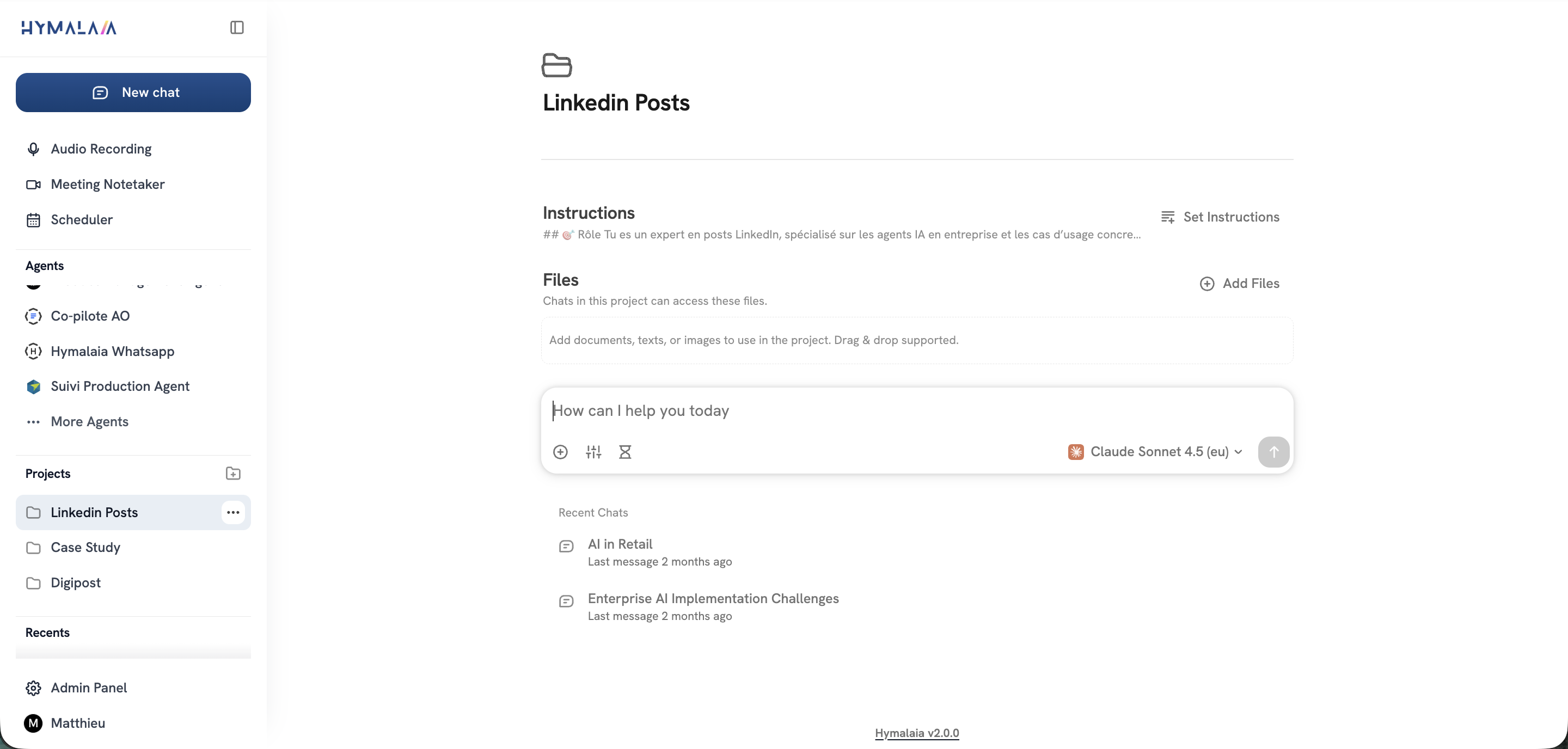
Hymalaia’s core capabilities include retrieval-augmented generation (RAG) for accurate, data-grounded AI responses, role-based access controls for governance, and flexible deployment across cloud, on-premise, and hybrid environments. For CRM teams, that means agents that act on real data, respect data boundaries, and scale without creating compliance risk. Hymalaia also offers enterprise AI consulting and training services to help teams build the data foundations and governance frameworks that make agent deployment succeed from day one.
AI agents in CRM management autonomously perceive customer data, reason through context, and execute tasks like lead scoring, outreach, and case resolution without waiting for human commands. They transform CRM from a passive record system into an active revenue engine.
Standard CRM automation follows fixed, pre-written rules. AI agents use contextual reasoning to decide the best action, adapt based on outcomes, and handle multi-step workflows that rule-based systems cannot manage.
CRM data must be audited, deduplicated, and standardized before deployment. Poor data quality produces unreliable AI outputs regardless of how advanced the model is, making data hygiene the single most critical prerequisite.
73% of sales professionals using AI-powered CRM report significant productivity increases, and organizations using AI for sales forecasting report up to 50% improvement in forecast accuracy.
AI agents eliminate routine, low-judgment tasks but do not replace human roles. They shift the focus of sales reps and CRM managers toward strategic oversight, relationship management, and exception handling, which are areas where human judgment remains essential.
