TL;DR:
- Data residency compliance in AI deployment involves ensuring all data operations occur within legally mandated geographic boundaries through technical and contractual controls. Achieving compliance requires auditing multiple data layers, including input, inference, storage, and logs, to prevent cross-region violations. Implementing architecture patterns like region-pinned endpoints, edge redaction, and federated observability helps organizations maintain ongoing compliance across regulated industries.
Data residency compliance for AI deployment means ensuring all AI-related data storage, processing, and transmission occur within legally mandated geographic boundaries through precise technical and contractual controls. This is not just a storage question. Regulations like the EU AI Act, GDPR, and the US CLOUD Act each impose distinct requirements on where data lives, who can access it, and how AI systems must be architected to stay legal. The EU AI Act sets a hard deadline of August 2, 2026, with fines up to €35 million or 7% of global annual turnover for non-compliant high-risk AI systems. For enterprise compliance officers and IT leaders managing data residency compliance in AI deployment, the cost of getting this wrong is not theoretical.
Data residency compliance in AI deployment is the practice of confining every data operation tied to an AI workload, including input, processing, and output, to a specific geographic region as required by law or contract. The industry also uses the term data sovereignty to describe a related but distinct concept. Understanding the difference between residency, sovereignty, and localization is the first architectural decision you will make, and getting it wrong causes the most common compliance failures.
The practical implication is this: a company can achieve data residency without achieving data sovereignty. If your AI workload runs on a US-based provider’s European data center, your data may reside in the EU but still fall under US legal jurisdiction. Compliance leaders who conflate residency with sovereignty routinely build architectures that satisfy auditors on paper but fail under legal scrutiny. Sector-specific rules add another layer. Financial services firms in the EU, healthcare organizations under HIPAA, and government contractors under FedRAMP each face constraints that go beyond what regional cloud availability alone can satisfy.
Most compliance failures happen outside storage. Telemetry, embeddings, and inference routing are the hidden gaps that cause violations even when the primary database is correctly region-locked. A complete audit covers four distinct data layers.
Pro Tip: Before any audit, map every data flow in your AI system to one of these four layers. Use a data flow diagram that shows region boundaries explicitly. Any arrow crossing a boundary is a potential violation.
Contractual documentation must match your architecture. A valid residency claim requires alignment across three documents: the Master Service Agreement, the Data Processing Addendum with region-specific clauses, and sub-processor disclosures listing every third-party vendor that touches your data. If your DPA says EU-only but your logging vendor ships data to Virginia, the contract does not protect you.
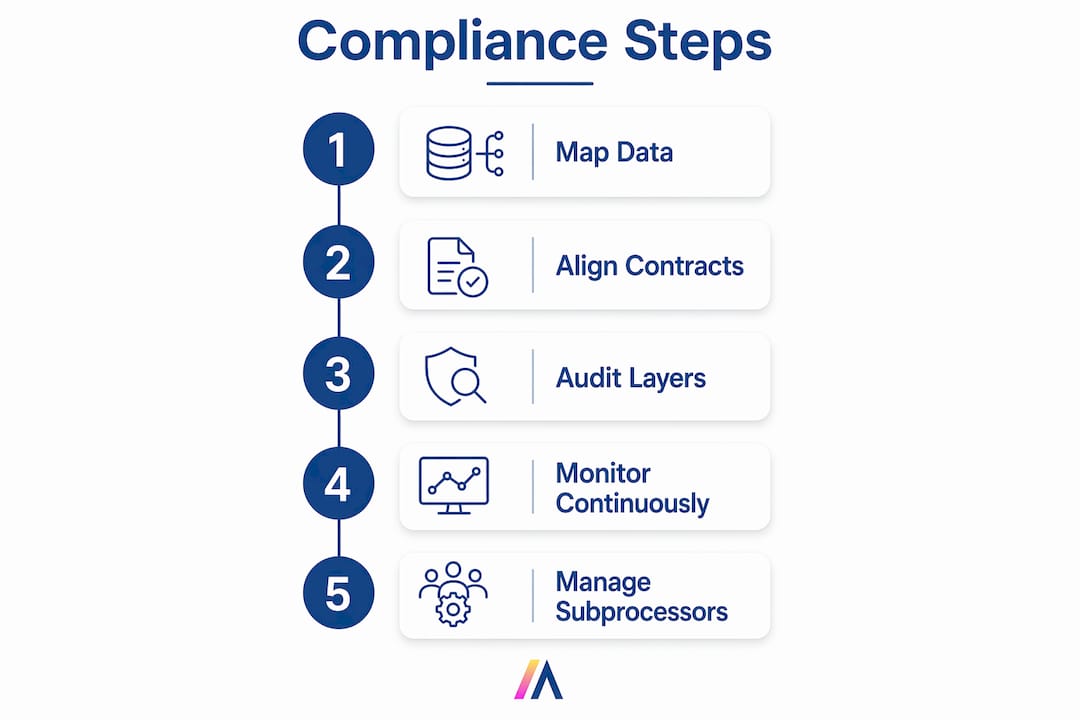
Architecture is where compliance becomes real. Cloud regional availability alone does not guarantee compliance. You need deliberate design patterns that enforce boundaries at every layer. The four most proven patterns for AI deployment best practices in regulated environments are described below.

| Architecture Pattern | How It Works | Pros | Cons | Applicable Regulations |
|---|---|---|---|---|
| Region-pinned endpoints | Model inference and storage locked to a single cloud region | Simple to audit, clear boundary | Higher latency for global users | GDPR, EU AI Act, DPDP |
| Edge redaction | PII stripped at the edge before data crosses region | Reduces compliance scope, enables global routing | Requires accurate PII detection | GDPR, HIPAA, CCPA |
| Federated observability | Logs stored in regional sinks, queried without data movement | Unified dashboard, no cross-region log transfer | More complex infrastructure | GDPR, EU AI Act |
| Sovereign cloud overlay | Dedicated cloud infrastructure operated under national jurisdiction | Strongest sovereignty guarantee | High cost, limited provider options | Government, defense, financial services |
Edge redaction is the pattern gaining the most traction in 2026. Replacing PII with stable placeholders before data crosses regional boundaries prevents cross-region data leakage without requiring every downstream system to be region-locked. A healthcare AI platform, for example, can strip patient identifiers at the EU edge, route the anonymized query to a global model, and reconstruct the response locally. This reduces the compliance perimeter dramatically.
Federated observability solves the logging problem. Logs remain stored within region-specific sinks while a unified compliance dashboard queries regional datasets without moving data. Tools like Grafana with region-isolated Loki instances or AWS CloudWatch with regional log groups support this pattern natively.
Pro Tip: When selecting a sovereign cloud overlay provider, verify that the provider’s operations staff are also subject to the target jurisdiction’s laws. Technical isolation without personnel controls does not satisfy sovereignty requirements in sectors like defense or critical infrastructure.
For AI deployment best practices in multi-region enterprises, the recommended approach is to combine region-pinned endpoints for inference with edge redaction for input handling and federated observability for monitoring. This three-layer combination covers the full audit surface without requiring a fully sovereign infrastructure.
Residency compliance is not a one-time configuration. Residency drift occurs when new tools or services are added without a residency impact review, and it is the most common cause of violations in mature AI deployments. A governance framework that prevents drift requires four operational practices:
“Compliance is an architectural property, not a policy document. If your system can violate residency requirements without triggering an alert, your governance framework has a gap.”
The most overlooked governance failure is the sub-processor chain. When your AI platform integrates with Salesforce, Slack, or SharePoint, each integration potentially introduces a new data processor. Each processor must be listed in your DPA, and each must operate within your mandated region. Reviewing sub-processor disclosures quarterly, not annually, is the standard that holds up in enforcement actions.
Achieving data residency compliance in AI deployment requires architectural controls at every data layer, not just storage, backed by contractual alignment and continuous governance.
| Point | Details |
|---|---|
| Residency vs. sovereignty | US-based cloud providers remain subject to the CLOUD Act even when data is stored in Europe. |
| Four audit layers | Input, inference, storage, and observability must all be region-compliant to pass an audit. |
| Edge redaction reduces scope | Stripping PII before cross-region transmission limits the compliance perimeter significantly. |
| Federated observability | Keep logs in regional sinks and query them without moving data to avoid logging violations. |
| Governance prevents drift | Change-control procedures and automated monitoring stop residency violations before they occur. |
I have reviewed AI deployment architectures across financial services, healthcare, and public sector organizations, and the pattern is consistent. Teams spend months locking down their primary database and then ship all their observability data to a US-based SaaS monitoring platform without a second thought. That single decision undoes every other compliance measure they built.
The uncomfortable truth about managing data residency for AI is that the hardest part is not the architecture. It is the organizational behavior. Engineers default to the fastest solution. Procurement teams sign vendor contracts without reading the DPA. Legal teams approve frameworks without understanding the technical implementation. The result is a compliance posture that looks correct on paper and fails the moment a regulator asks for a data flow diagram.
My recommendation is to treat compliance for AI systems as a shared engineering requirement, not a legal checkbox. Embed a compliance engineer in your AI platform team. Make residency constraints visible in your infrastructure-as-code. When a developer provisions a new logging destination, the system should reject non-compliant regions automatically, not flag them in a quarterly review.
The data sovereignty implications of AI deployment are only going to grow more complex as the EU AI Act enforcement ramps up and more countries pass localization laws. The organizations that build compliance into their architecture from day one will spend a fraction of what reactive organizations spend on remediation. That is not optimism. That is the pattern I have seen repeatedly across regulated industries.
— Matthieu
Hymalaia is built for enterprises that cannot afford compliance gaps. The platform supports region-pinned deployment across cloud, on-premise, and hybrid environments, with AES-256 encryption and RBAC controls that satisfy GDPR and EU AI Act requirements out of the box. Hymalaia connects with over 50 enterprise tools including Salesforce, SharePoint, and Slack, and every integration is governed by documented sub-processor controls. Audit-ready logging, federated observability support, and configurable data retention policies mean your compliance team has the documentation it needs before the auditor asks. If you are ready to deploy AI agents that keep your data where it belongs, explore Hymalaia’s platform and see how governance and performance work together.
Data residency compliance for AI systems means all data processed by an AI workload, including inputs, model outputs, embeddings, and logs, stays within a legally mandated geographic region. It requires both technical controls and contractual documentation to be enforceable.
The US CLOUD Act allows US authorities to compel US-headquartered cloud providers to produce data stored abroad, including in EU data centers. This means residency in Europe does not equal sovereignty from US jurisdiction for providers like AWS, Azure, or Google Cloud.
Non-compliance for high-risk AI systems under the EU AI Act by August 2, 2026, can result in fines up to €35 million or 7% of global annual turnover, whichever is higher. GDPR violations carry separate penalties of up to €20 million or 4% of global annual turnover.
Residency drift occurs when new tools, vendors, or services are added to an AI system without a residency impact review, creating unintentional cross-region data flows. It is the leading cause of compliance violations in organizations that have otherwise built compliant architectures.
Combining region-pinned model endpoints with edge redaction for input handling and federated observability for logging covers the full audit surface for most regulated industries. This three-layer approach satisfies GDPR, EU AI Act, and sector-specific requirements without requiring a fully sovereign cloud infrastructure.
