TL;DR:
- AI deployment requires embedding continuous, automated security controls across its entire lifecycle to address unique risks like model poisoning and prompt injection. Traditional DevSecOps methods are inadequate for AI systems, which demand behaviors and provenance monitoring, along with automated guardrails, to prevent vulnerabilities. Implementing MLSecOps controls at each layer and fostering shared responsibility ensures better security in fast-paced AI environments.
DevSecOps in AI deployment is defined as the practice of embedding continuous, automated security controls directly into every phase of the AI development lifecycle, from data ingestion through model training to production inference. Traditional DevSecOps was built for deterministic software. AI systems introduce a different class of risk: prompt injection, model poisoning, training data exfiltration, and non-deterministic outputs that static code scanners cannot catch. The Cloud Security Alliance’s Agentic Secure Development Lifecycle standard formalizes this gap, requiring security controls embedded in developer tools, CI/CD pipelines, and AI agent governance layers. The MLSecOps framework extends DevSecOps further, adding data provenance, model lineage tracking, and runtime inference monitoring as mandatory controls. For IT managers and security professionals, understanding the role of DevSecOps in AI deployment is no longer optional. AI accelerates exploitation of vulnerabilities at machine speed, and your security program must match that pace.
AI fundamentally changes the mechanics of DevSecOps by shifting security from reactive validation to continuous intelligent enforcement alongside developer workflows. That shift reduces manual handoffs by 30–50% in mature enterprises. The implication is direct: security teams spend less time reviewing pull requests and more time governing the AI agents that generate the code in the first place.

The most significant change is the rise of machine-to-machine security validation. When an AI coding assistant generates a function, a human reviewer cannot keep pace with the volume. AI code generation requires shifting security toward automated policy guardrails that evaluate AI-generated code before it ever reaches a human. Humans supervise the guardrails, not the individual commits.
Pipeline automation also changes character. In a traditional DevSecOps pipeline, SAST and DAST tools scan known vulnerability patterns. In an AI-assisted pipeline, those tools must also evaluate whether AI agents are operating within their defined scope, whether model artifacts have been tampered with, and whether inference endpoints are behaving as expected. The security team’s role becomes one of governance architecture rather than manual review.
Pro Tip: Map every AI agent in your pipeline to a defined permission boundary before it writes a single line of code. Governing agent behavior at the design stage costs a fraction of remediating a poisoned model artifact in production.
Enterprise DevSecOps for AI must orchestrate security across three distinct layers: the CI/CD pipeline, the AI-assisted coding environment, and the runtime inference endpoint. Each layer carries unique risks that traditional DevSecOps controls were not designed to address.
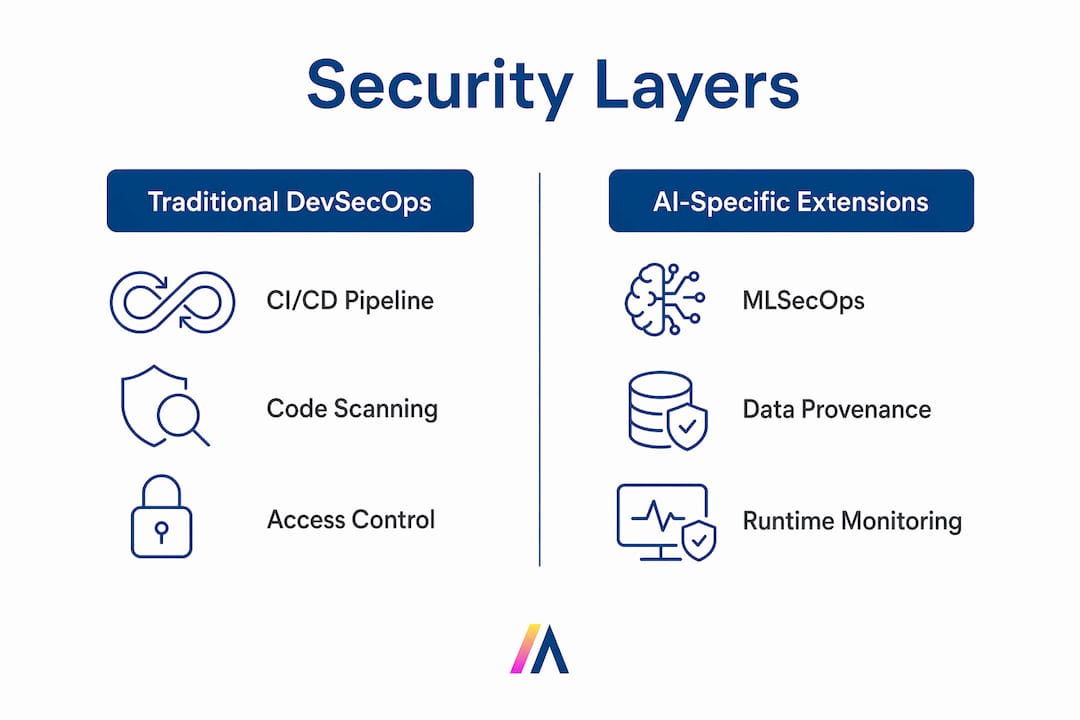
The CI/CD layer is where model artifacts, training datasets, and fine-tuning scripts move through your organization. Every artifact must be signed. Data provenance and artifact signing at early ML lifecycle stages deliver the highest risk reduction by making training data and model integrity verifiable and tamper-resistant. Without signing, a compromised dependency can silently alter model behavior before deployment.
Policy-as-code tools enforce security gates at each pipeline stage. Dependency scanning must extend beyond Python packages to include model registries and dataset sources. Any unsigned artifact should fail the pipeline automatically, with no manual override permitted without a documented exception.
The IDE layer is where token theft most commonly occurs. Static API keys embedded in developer environments are a persistent vulnerability. Ephemeral OAuth tokens injected through a central secret manager prevent token theft far more effectively than long-lived credentials. Rotating tokens automatically removes the window of opportunity for credential-based attacks.
Role-based access controls at the IDE layer also limit what any AI coding assistant can read, write, or execute. An assistant with read access to your entire codebase and write access to production branches is an unacceptable risk surface. Scope permissions to the minimum required for each task.
The inference endpoint is where prompt injection and model poisoning attacks execute. Runtime monitoring must flag anomalous input patterns, unexpected output distributions, and latency spikes that signal adversarial probing. The MLSecOps framework requires model lineage tracking and inference runtime monitoring as mandatory controls, not optional add-ons.
| Control area | Traditional DevSecOps | AI-specific extension |
|---|---|---|
| Code scanning | SAST/DAST on source code | AI agent behavior validation |
| Dependency management | Package vulnerability scanning | Model registry and dataset signing |
| Secrets management | Static API key rotation | Ephemeral OAuth token injection |
| Runtime monitoring | Application performance monitoring | Inference anomaly detection |
| Audit trail | Code commit history | Model lineage and data provenance |
Pro Tip: Treat your model registry like a production database. Apply the same access controls, audit logging, and integrity checks you would use for a critical data store. A tampered model artifact is harder to detect than a tampered database record.
The hardest challenge in integrating DevSecOps with AI is that AI models are non-deterministic. The same input can produce different outputs across runs. Traditional security tools test for known bad states. AI systems require behavioral security checks that detect statistical drift and anomalous output patterns rather than fixed signatures. That distinction demands a fundamentally different testing philosophy.
Securing AI also means protecting training datasets, model weights, and fine-tuning pipelines, not just application code. Behavior encodes in data and model weights. A poisoned training dataset produces a model that behaves maliciously in production, and no amount of code review will catch it. Security teams must extend their scope to cover the entire ML artifact chain.
Cloud and AIOps platforms introduce shared responsibility gaps that many enterprises underestimate. Cloud providers do not secure AI-generated code or metadata by default. Organizations must implement their own immutable backup strategies for model artifacts, inference logs, and training data snapshots. Assuming the platform handles it is a documented failure mode.
Additional challenges security teams encounter in practice include:
The shared responsibility model also creates governance gaps in multi-cloud AI deployments. When your AI workload spans AWS SageMaker, Azure OpenAI, and an on-premise GPU cluster, no single team owns the full security perimeter. Establishing clear ownership for each layer, and documenting it in your security policy, is the only way to close those gaps before an incident forces the conversation.
Building a mature DevSecOps program for AI starts with data provenance. Before you write a single pipeline policy, you need to know where every training dataset came from, who modified it, and when. AI-assisted development must be treated as a full Software Development Lifecycle integration, with automated controls embedded in developer environments from day one.
A practical implementation sequence for IT managers and security professionals:
Establish data provenance and artifact signing. Sign every dataset, model checkpoint, and fine-tuned artifact at creation. Use a cryptographic hash stored in an immutable registry. This single control eliminates the largest class of supply chain attacks on AI systems.
Embed security policies directly into AI IDEs and CI/CD pipelines. Policy-as-code tools like Open Policy Agent enforce security gates without requiring developer action. Automated checks run on every commit, every model push, and every deployment event. For teams transitioning to automated AI agent governance, this is the foundation layer.
Establish human-in-the-loop checkpoints for critical decisions. Automated controls handle volume. Humans handle judgment. Require explicit human approval for any merge that touches model training configuration, inference endpoint routing, or access control policy. Document the approval in your audit trail.
Deploy runtime security monitoring for inference endpoints. Instrument every inference endpoint with anomaly detection that flags unusual input patterns, output drift, and latency anomalies. Connect those alerts to your SIEM. AI deployment security at the inference layer is where most production incidents originate.
Train security teams on AI governance, not just AI tools. The shift from human code review to machine validation requires a different mental model. Security engineers need to understand model lineage, data provenance, and prompt injection mechanics. Invest in that training before you deploy AI agents at scale.
Audit your AI data security controls quarterly. AI threat surfaces evolve faster than traditional software surfaces. A quarterly review of your control coverage against the MLSecOps framework keeps your program current.
Pro Tip: Start with artifact signing and data provenance before you build any other MLSecOps control. These two measures address the highest-impact risks at the lowest implementation cost. Everything else builds on the integrity guarantees they provide.
DevSecOps in AI deployment requires continuous, automated security governance across the CI/CD pipeline, AI coding environment, and runtime inference endpoint, with MLSecOps controls covering data provenance, model lineage, and behavioral anomaly detection.
| Point | Details |
|---|---|
| Shift to machine validation | Replace manual code review with automated policy guardrails governing AI agent behavior at scale. |
| Artifact signing is foundational | Sign every dataset and model checkpoint at creation to eliminate AI supply chain attacks. |
| Ephemeral tokens over static keys | Use OAuth tokens injected by a secret manager to prevent credential theft in AI developer environments. |
| Runtime monitoring is mandatory | Instrument inference endpoints with anomaly detection to catch prompt injection and model drift in production. |
| Cloud providers don’t cover everything | Implement your own immutable backups for AI-generated code, model artifacts, and inference metadata. |
Most enterprises I’ve observed approach AI security the same way they approached cloud security in 2015. They bolt on controls after the architecture is set, then spend two years retrofitting governance into systems that were never designed for it. The pattern is predictable, and the cost is avoidable.
The insight that changes the conversation is this: AI security is not a code problem. It is a data and behavior problem. You can pass every SAST scan and still deploy a model that exfiltrates sensitive data through its outputs, because the vulnerability lives in the training data, not the application code. Security teams that have not internalized this distinction are protecting the wrong surface.
The second mistake I see consistently is treating AI agent governance as a future problem. Enterprises deploy AI coding assistants, give them broad permissions to accelerate delivery, and plan to “add governance later.” Later never comes. The enterprise AI governance frameworks that work are built before the agents are deployed, not after the first incident.
The teams that get this right share one characteristic: they treat security as a shared, continuous responsibility across development, operations, and data science. No single team owns AI security. The DevSecOps program is the coordination layer that makes shared ownership operational. Build that coordination layer first, and the controls follow naturally.
— Matthieu
Enterprise AI deployment demands security controls that keep pace with the speed of AI itself. Hymalaia is built for exactly that environment. The platform provides advanced governance and security features including role-based access controls, GDPR-compliant data handling, and audit-ready monitoring across all AI agent activity.
Hymalaia connects with over 50 enterprise tools, including Salesforce, SharePoint, and Google Workspace, giving security teams full visibility into how AI agents access and process data across your organization. Its enterprise AI platform supports cloud, on-premise, and hybrid deployments, so your DevSecOps controls apply consistently regardless of where your AI workloads run. Contact Hymalaia to see how the platform fits your security architecture.
DevSecOps in AI deployment embeds continuous, automated security controls across the CI/CD pipeline, AI coding environment, and runtime inference endpoints. It extends traditional DevSecOps with MLSecOps controls covering data provenance, model lineage, and behavioral anomaly detection.
AI systems require behavioral security checks and MLSecOps controls because vulnerabilities encode in training data and model weights, not just application code. Traditional SAST and DAST tools cannot detect prompt injection, model poisoning, or training data exfiltration.
MLSecOps is the extension of DevSecOps that adds data provenance, model lineage tracking, and inference runtime monitoring to the standard security control set. These controls address AI-specific risks that prior DevSecOps tooling failed to cover before 2026.
Replace static API keys with ephemeral OAuth tokens injected through a central secret manager. Rotating tokens automatically removes the credential exposure window that attackers exploit in AI-assisted development environments.
Most production incidents originate at the runtime inference endpoint, where prompt injection and model drift attacks execute against live systems. Instrumenting inference endpoints with anomaly detection connected to your SIEM is the primary mitigation.
