TL;DR:
- Network segmentation isolates AI components into separate subnetworks to reduce attack surfaces. Proper microsegmentation enforces policies at the workload level, preventing lateral movement and data breaches. Segmentation alone is insufficient; combined with identity controls and runtime defenses, it provides a layered AI security approach.
Network segmentation is defined as the practice of dividing a computer network into isolated subnetworks to control traffic flow and limit the attack surface available to adversaries. The role of network segmentation in AI security goes well beyond traditional IT defense. AI infrastructure introduces unique risks: GPU clusters, model registries, vector databases, and inference endpoints all handle sensitive data and require strict isolation from general production traffic. Tools like Kubernetes NetworkPolicy, Cilium, and NVIDIA Confidential Computing now form the technical backbone of segmentation in enterprise AI environments. Without deliberate segmentation, a single compromised pod can expose training datasets, model weights, and real-time inference outputs simultaneously.
Network segmentation enhances AI security by creating hard boundaries between the components that train, serve, and store AI models. Each layer operates in its own trust zone, so a breach in one segment cannot automatically reach another. This is the core principle behind zero trust for AI workloads: never assume a packet is safe because it originates inside the perimeter.

The practical evidence for segmentation’s effectiveness is concrete. Proper microsegmentation of GPU clusters contained a ransomware attack to just 3% of AI infrastructure, preventing $120 million in losses. That result is only possible when ingress and egress rules are explicit and enforced at the workload level, not at the network edge.
Microsegmentation goes further than traditional VLANs by applying policy at the individual workload or container level. Technologies like Cilium use eBPF to enforce identity-aware network policies directly in the Linux kernel, which means policies follow the workload even as containers reschedule across nodes. Service meshes like Istio add mutual TLS between services, so every connection is authenticated before a packet is accepted.
Pro Tip: Enforce explicit deny-all rules as your baseline policy and add allow rules only for verified, named traffic flows. Implicit allow is the single most common source of unintended lateral movement in AI clusters.
The most damaging segmentation errors in AI environments share a common cause: treating AI workloads like standard application workloads. They are not. AI systems move large volumes of sensitive data between components continuously, and a misconfigured boundary can expose everything at once.
Sharing network segments between AI workloads and production networks is the top configuration error causing uncontrolled data exposure. Dedicated VPCs for GPU inference clusters and vector databases are now considered a baseline maturity benchmark, not an advanced practice. Running inference pods on the same segment as web application servers is the equivalent of storing your model weights in a public S3 bucket.
Failing to segment storage networks exposes training datasets to compromise via shared volumes accessed by inference pods. Dedicated, encrypted, and segmented storage access is mandatory for enterprise AI security. A flat storage network means one compromised inference pod can read, modify, or exfiltrate every training dataset in the cluster.
| Common configuration | Recommended configuration |
|---|---|
| AI and production traffic on one VLAN | Dedicated VPC per AI function (training, inference, storage) |
| Shared model registry with no auth | Cryptographically verified model promotion with signed artifacts |
| Inference pods with storage write access | Read-only, scoped storage mounts per workload identity |
| Static firewall rules at the network edge | Identity-aware microsegmentation enforced at the pod level |
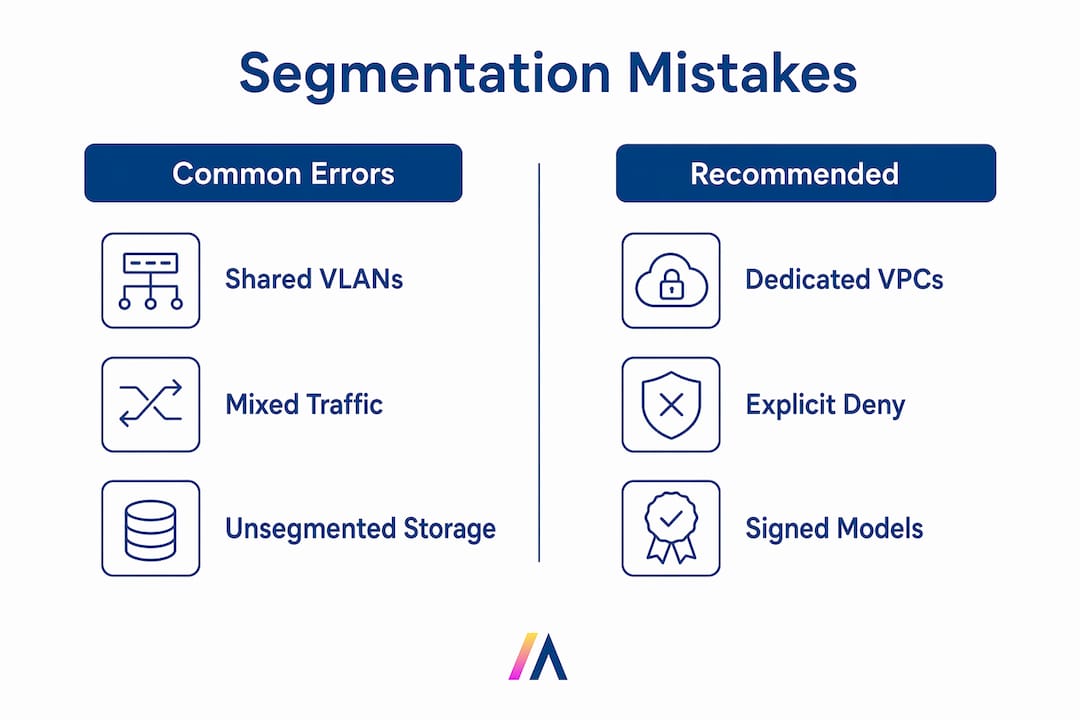
Pro Tip: Use dedicated VPCs for each AI function and require cryptographically signed model artifacts before any model promotion. This eliminates an entire class of supply chain attacks targeting model registries.
Network segmentation is a foundational control, but it does not stop attacks that travel through legitimate application channels. Prompt injection, for example, exploits the AI model’s own input processing. No VLAN boundary stops a malicious prompt from reaching an LLM if the inference endpoint is intentionally exposed to user input.
Network segmentation alone cannot stop prompt injection attacks. Runtime LLM firewalls and agentic defense layers are required to protect application-layer AI attack surfaces. This is the gap that catches security teams off guard: they build excellent network controls and then assume the AI layer is safe.
The Cloud Security Alliance’s ORCHIDEAS framework defines network segmentation as a fundamental trust boundary in agentic AI systems. Security properties must emerge from the composition and segregation of components, not from perimeter controls alone. That means segmentation is the floor, not the ceiling.
MCP servers present a specific risk in agentic AI setups. Compromised MCP tool definitions can allow lateral pivoting across agent networks. Each MCP server requires its own isolated network zone with strict output sanitization before results are passed back to the orchestrating agent.
A complete layered AI security stack for 2026 includes:
Effective implementation starts with classification. You cannot segment what you have not mapped. Every AI workload needs a trust level and a functional label before a single firewall rule is written.
Classify all AI workloads by trust and function. Separate training jobs, inference services, vector databases, model registries, and orchestration tools into distinct categories. Each category becomes a candidate for its own network segment.
Assign dedicated VLANs or VPCs per function. Microsegmentation uses VLANs for separate training, inference, storage, management, and emergency access networks. A practical VLAN numbering scheme: training (100), inference (200), storage (300), management (400). This makes firewall rules readable and auditable.
Apply deny-by-default network policies. Workload classification followed by deny-by-default policies and identity hardening improves enforcement gradually without systemic disruption. Start with the highest-risk segments and expand coverage over time.
Harden workload identities. Replace IP-based trust with cryptographic workload identity. Cilium and Istio both support SPIFFE/SPIRE for issuing short-lived certificates to each pod. This means a stolen IP address grants no access without the corresponding certificate.
Enforce scoped storage access. AI best practices mandate total separation of training and inference environments with zero direct connectivity and cryptographically verified model promotion. Storage mounts should be read-only for inference pods and write-only for designated training jobs.
Enable continuous audit logging on all segment boundaries. Log every allowed and denied flow. Feed logs into a SIEM like Splunk or Microsoft Sentinel for real-time anomaly detection. A spike in denied traffic from an inference pod toward a storage segment is an early indicator of lateral movement.
Test isolation with regular red team exercises. Simulate a compromised inference pod and verify it cannot reach training data, model registries, or management systems. Document the blast radius of each segment and update policies when AI workloads change.
Pair segmentation with AI data security controls like data masking and encryption at rest. Segmentation controls the network path. Encryption protects the data even if a segment boundary is breached.
Network segmentation is the structural foundation of AI security, but it requires layered defenses, identity controls, and continuous verification to protect modern AI workloads from both network-layer and application-layer attacks.
| Point | Details |
|---|---|
| Segmentation contains breaches | Microsegmentation limited one ransomware attack to 3% of AI infrastructure, preventing $120 million in losses. |
| Dedicated segments per AI function | Assign separate VLANs or VPCs for training, inference, storage, and management to prevent lateral movement. |
| Segmentation is not sufficient alone | Runtime LLM firewalls and agentic defense layers are required to stop prompt injection and application-layer attacks. |
| Deny-by-default is the baseline | Start with deny-all policies and add explicit allow rules only for verified, named traffic flows. |
| Identity replaces IP-based trust | Use cryptographic workload identity via tools like Cilium or Istio to authenticate every connection inside the cluster. |
The most persistent misconception I see is that network segmentation is a project with a finish line. Teams design their VLANs, write their Kubernetes NetworkPolicies, and mark the task complete. Then they deploy a new agentic workflow six months later and forget to segment the MCP servers it depends on.
AI infrastructure is not static. Containers reschedule. New models get deployed. Inference endpoints get added to serve new use cases. Static segmentation designs break under that pressure. The teams that maintain strong security posture treat segmentation as a continuous practice, not a one-time architecture decision.
The second mistake is conflating network security with AI security. I have reviewed environments with excellent microsegmentation that were still vulnerable to prompt injection because the LLM firewall was missing. Segmentation secures the pipes. You still need to secure what flows through them.
The teams I trust most on this topic combine agentic AI security practices with network controls from day one. They also run tabletop exercises specifically for AI breach scenarios, not just generic network intrusion scenarios. The threat model for an AI system is different enough that generic exercises miss the most likely attack paths.
Balancing security with performance is real but manageable. Identity-aware segmentation with Cilium adds minimal latency compared to the overhead of a full service mesh proxy. The performance cost of doing this right is far smaller than most teams expect.
— Matthieu
Enterprise AI security requires more than policy documents. It requires a platform built with segmentation, identity controls, and governance woven into its architecture from the start.
Hymalaia’s enterprise AI agent platform deploys autonomous agents across secure, governed environments with role-based access controls, GDPR compliance, and support for cloud, on-premise, and hybrid deployments. The platform connects with over 50 enterprise tools including Salesforce, Slack, Google Workspace, and SharePoint, while maintaining strict data isolation between workloads. Security teams get the network boundaries and identity controls they need. Business teams get the AI performance they expect. If you are evaluating how to deploy AI agents without compromising your security posture, Hymalaia is built for that exact requirement. Contact the Hymalaia team to see how the platform fits your infrastructure.
Network segmentation in AI security is the practice of dividing AI infrastructure into isolated subnetworks, separating training, inference, storage, and management components to limit attack surfaces and prevent lateral threat movement.
Traditional VLANs apply boundaries at the network level, while microsegmentation enforces policies at the individual workload or container level using tools like Cilium or Kubernetes NetworkPolicy, which follow the workload as it moves across nodes.
Network segmentation cannot stop prompt injection attacks because they exploit the model’s input processing, not the network path. Runtime LLM firewalls and agentic defense layers are required to address application-layer AI threats.
The five critical segments are training, inference, storage, management, and emergency access. Each should have explicit deny-by-default policies with allow rules only for verified, named traffic flows between segments.
Compromised MCP tool definitions can allow lateral pivoting across agentic AI networks. Isolating each MCP server in its own network zone with strict output sanitization prevents a single compromised tool from reaching other agents or data stores.
