TL;DR:
- AI automates compliance reporting by using machine learning and natural language processing to monitor regulations and update reports continuously. It enhances efficiency and reduces false positives by grounding outputs in internal documentation and implementing strict governance protocols. Proper oversight ensures AI supports compliance without compromising regulatory accountability or auditability.
AI in compliance reporting automation is defined as the use of machine learning, natural language processing, and workflow automation to replace manual data gathering, regulatory monitoring, and report generation with continuous, auditable processes. For compliance officers managing multi-framework obligations across GDPR, SOX, and emerging laws like California’s TFAIA and New York’s RAISE Act, this shift is no longer optional. AI compliance automation has moved from a cost-saving measure to a regulatory necessity. The combination of retrieval-augmented generation (RAG), anomaly detection models, and automated workflow routing gives compliance teams the ability to maintain living, adaptive programs rather than static annual reviews.
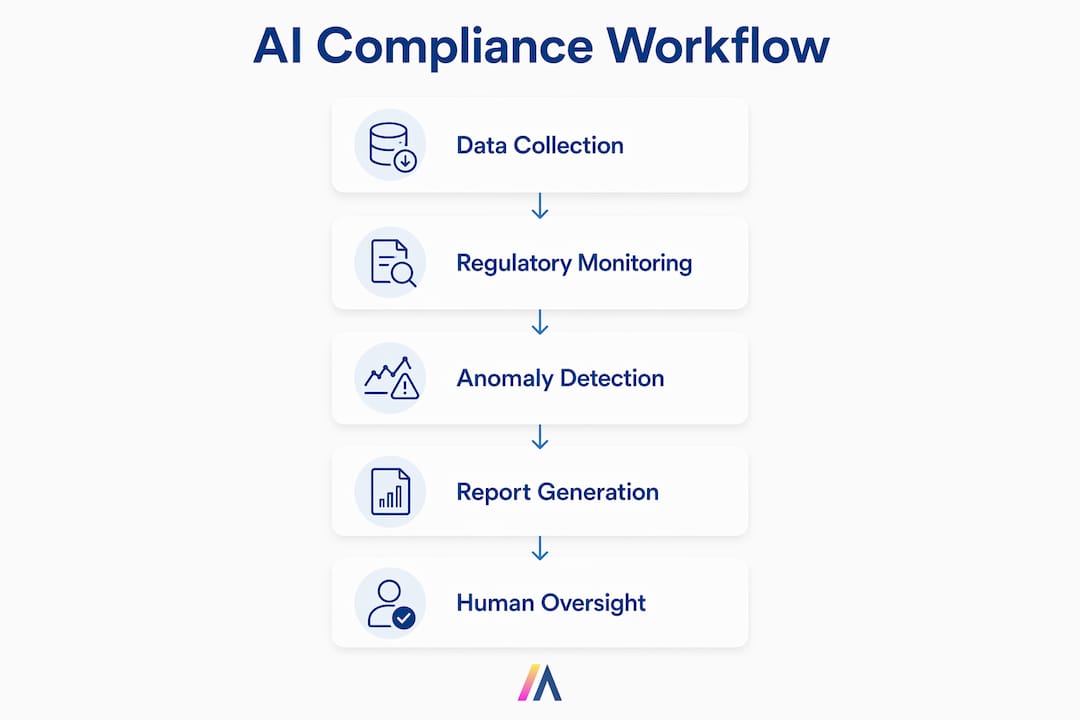
AI systems monitor regulatory feeds, government publications, and news sources to detect compliance updates in real time. That capability means your reporting parameters can adjust within hours of a rule change, not weeks. Real-time regulatory monitoring enables companies to quickly adjust internal controls and stay aligned with current standards.

Natural language processing (NLP) is the engine behind this. NLP models parse dense regulatory texts, extract the specific obligations that apply to your organization, and flag gaps between the current version of a rule and the prior version. This is particularly valuable when regulators issue amendments that change only a few clauses. A manual review process might miss a subtle shift in reporting timelines. An NLP model trained on regulatory language catches it immediately.
The practical workflow looks like this:
Pro Tip: Map your control library to specific regulatory clauses, not just framework names. When an AI system detects a clause-level change, it can pinpoint exactly which controls need updating rather than triggering a broad review.
Four technologies do the heavy lifting in automated reporting solutions. Each addresses a different failure point in traditional compliance workflows.
| Technology | Function | Compliance Use Case |
|---|---|---|
| Machine learning (anomaly detection) | Identifies patterns that deviate from expected baselines | Transaction monitoring, fraud detection |
| Natural language processing | Parses and interprets regulatory and policy text | Regulatory change detection, policy retrieval |
| Retrieval-augmented generation (RAG) | Grounds AI outputs in approved internal documents | Audit-ready compliance Q&A, report generation |
| Workflow automation | Routes alerts, escalates cases, documents decisions | Case management, audit trail creation |
Machine learning models for anomaly detection address one of the most painful problems in compliance operations. False positive rates in traditional transaction monitoring systems can exceed 90%. That number represents an enormous drain on analyst time. ML models analyze transaction data at scale and prioritize alerts by risk score, which cuts the volume of low-value alerts that compliance teams must manually review.
RAG deserves special attention. Retrieval-augmented generation powers AI compliance pipelines to produce accurate, source-cited, and verifiable answers from internal compliance documents. That means an AI agent answering a compliance question does not rely on generic training data. It pulls from your approved policy library, your current control documentation, and your regulatory mapping files. The output is auditable because the source is traceable.
Hymalaia’s platform uses RAG as a core capability, connecting AI agents to over 50 enterprise data sources including SharePoint, Salesforce, and Google Workspace. This architecture ensures that compliance outputs are grounded in your organization’s actual documentation, not approximations.
The biggest risk in AI-driven compliance is not a technical failure. It is the illusion of control. Compliance leaders who treat AI as an autonomous solution, rather than a tool requiring active governance, expose their organizations to regulatory and reputational risk. Active governance over AI tools is non-negotiable. Regulators do not accept “the AI told us to do it” as a defense.
COSO’s 2026 guidance makes this explicit. Internal controls over AI-generated outputs in financial reporting remain the organization’s responsibility, even when generative AI produces the report. The framework requires evaluation checkpoints, documented human review, and clear ownership of the final output.
Effective governance for AI in compliance reporting requires:
Regulators expect audit trails for AI-supported decisions that are comparable to those for manual processes. That means timestamped logs of every AI recommendation, every human review, and every override. Building this into your workflow from day one is far easier than retrofitting it after a regulatory inquiry.
Pro Tip: Treat your AI governance documentation the same way you treat your compliance policies. Version-control it, assign an owner, and review it on a defined schedule. Regulators will ask for it.
For compliance officers building these frameworks from scratch, a structured AI governance guide provides a practical starting point for defining roles, policies, and oversight checkpoints.
AI-driven reporting systems reduce the manual effort that consumes compliance teams in three specific areas: data validation, anomaly detection, and report assembly. AI anomaly detection models compare current data to expected patterns and flag errors earlier in the reporting cycle. Earlier detection means fewer last-minute corrections and lower audit risk.
The operational gains compound across the reporting cycle:
The impact on alert fatigue is significant. When ML models reduce false positive rates in transaction monitoring, analysts spend their time on genuine risk cases rather than clearing noise. This is not just an efficiency gain. It is a risk management improvement. High-volume false positives create the conditions where real alerts get missed.
Intelligent assistants and chatbots also support compliance teams in day-to-day operations. A compliance officer can ask a conversational AI agent to retrieve the current policy on a specific transaction type, check the status of an open audit finding, or summarize recent regulatory changes affecting a particular business line. These interactions, when built on RAG architecture, produce answers grounded in current internal documentation. Understanding AI automation in workflows helps compliance leaders see where these tools fit within broader enterprise operations.
Implementation starts with knowing what you have. Before deploying any AI tool, compliance officers need a clear inventory of existing reporting workflows, data sources, and manual touchpoints. That inventory becomes the foundation for identifying where automation adds the most value and where human judgment remains irreplaceable.
Practical implementation steps include:
For compliance officers building the technical foundation, a detailed data governance framework for AI systems provides the structural guidance needed to govern data inputs and outputs across automated reporting pipelines.
AI in compliance reporting automation delivers the most value when governance, explainability, and human oversight are built into every automated workflow from the start.
| Point | Details |
|---|---|
| Real-time regulatory monitoring | AI scans regulatory feeds continuously and flags rule changes before they affect your next filing. |
| RAG for audit-ready outputs | Retrieval-augmented generation grounds AI answers in approved internal documents, making outputs traceable and verifiable. |
| False positive reduction | ML models in transaction monitoring cut alert noise, freeing analysts to focus on genuine risk cases. |
| Governance is non-negotiable | COSO 2026 and regulators require documented human review and audit trails for every AI-supported compliance decision. |
| Cross-mapping multiplies efficiency | Mapping one control to multiple frameworks reduces duplication and accelerates audit preparation. |
I have spent years watching compliance teams get seduced by the speed of automation and then scramble when a regulator asks them to explain a filing decision. The technology is genuinely impressive. AI can monitor hundreds of regulatory sources simultaneously, flag anomalies in transaction data faster than any analyst team, and assemble reports in minutes. But speed without accountability is a liability, not an asset.
The compliance officers I respect most treat AI as a force multiplier for their judgment, not a replacement for it. They build workflows where the AI does the heavy lifting on data gathering and pattern detection, and humans make the calls that matter. They document every override. They review model performance on a schedule, not just when something goes wrong.
The uncomfortable truth is that most organizations are not yet ready for the governance demands that come with AI in compliance. They deploy the tool before they design the oversight. That sequence creates exactly the “illusion of control” that regulators are starting to call out explicitly. Get the governance architecture right first. The efficiency gains follow naturally.
— Matthieu
Compliance teams that need AI-powered reporting without sacrificing governance have a clear path forward with Hymalaia.
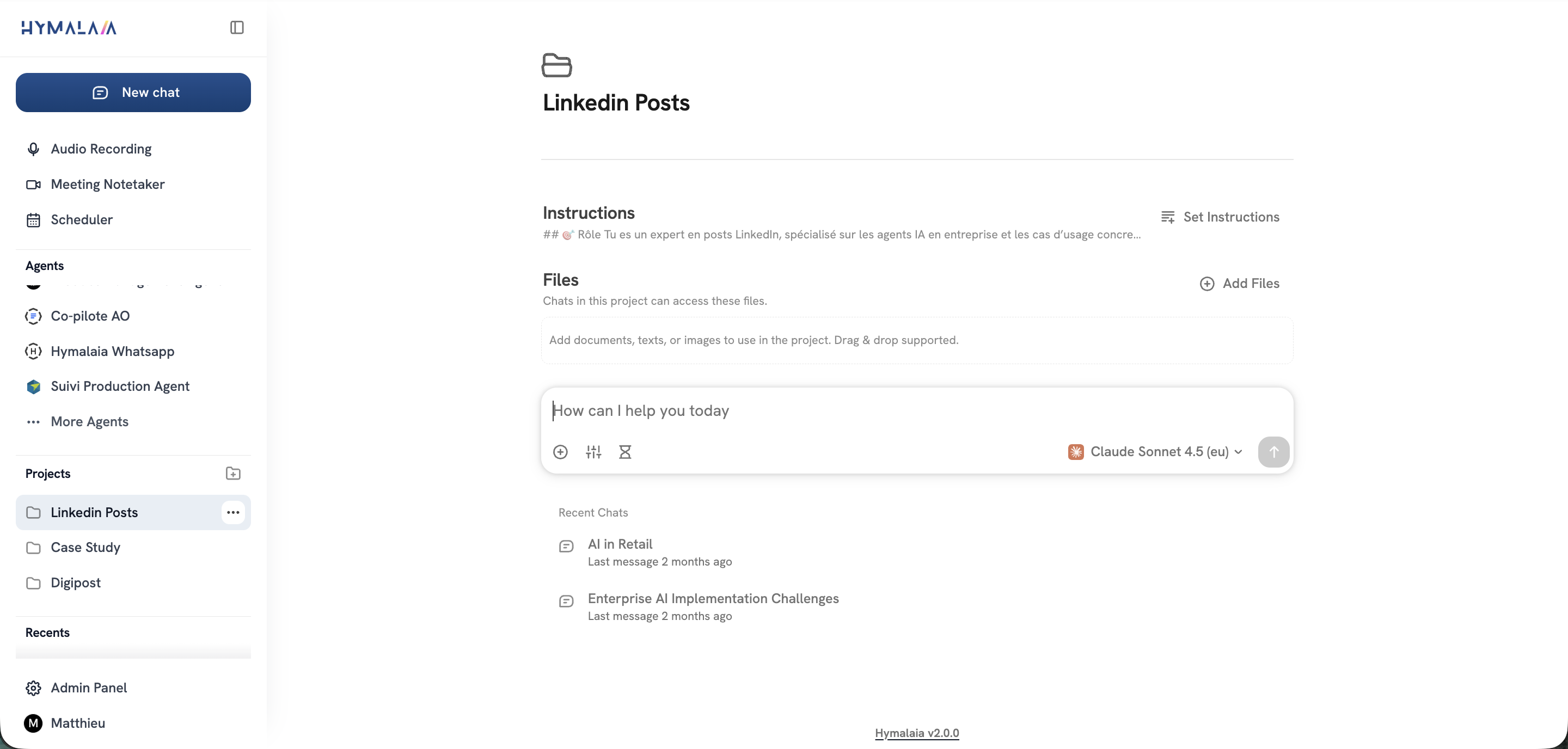
Hymalaia’s enterprise AI platform deploys autonomous AI agents that connect to over 50 enterprise data sources, including Salesforce, SharePoint, and Slack, to unify compliance data in real time. Its RAG architecture ensures every AI output is grounded in your approved internal documentation, making responses traceable and audit-ready. Role-based access controls and GDPR-compliant data handling give compliance officers the governance layer that regulators expect. Explore Hymalaia’s platform features to see how AI agents, workflow automation, and enterprise-grade security work together to support your compliance reporting program.
AI automates data gathering, regulatory monitoring, anomaly detection, and report assembly in compliance workflows. It transforms static manual programs into adaptive processes that stay aligned with current regulatory requirements.
Machine learning models analyze transaction data at scale and assign risk scores to alerts. False positive rates in traditional systems can exceed 90%; AI-driven models materially reduce that ratio by prioritizing genuine risk cases.
Regulators require documented audit trails, explainability of AI decision pathways, named ownership of AI models, and human review checkpoints for every compliance-relevant output. COSO’s 2026 guidance places ultimate responsibility for AI-generated reports with the organization.
Yes. Cross-mapping controls to multiple regulatory frameworks, such as SOX, GDPR, and ISO 27001, allows a single AI-driven control to satisfy several requirements simultaneously, reducing duplication and accelerating audit preparation.
Retrieval-augmented generation (RAG) is a technique where AI pulls answers from approved internal documents rather than generic training data. In compliance, RAG ensures outputs are source-cited, verifiable, and audit-ready.
