Managing business tasks with Copilot becomes restrictive for enterprises that need flexible deployment, agent extensibility, or specific compliance requirements. Mainstream AI assistants like Copilot lock teams into a single ecosystem, limit direct data source access, or require cloud-centric workflows. This comparison covers deployment control, integration range, and security credentials across five Copilot alternatives so enterprises can select an agent platform that fits their architecture.

Grounded Answers combine BM25 keyword matching with semantic embeddings to anchor responses to source documents. The platform connects to over 50 enterprise tools and data sources. The vendor advertises GDPR compliance for enterprise deployments.
Teams can build, deploy, and manage AI agents for sales, support, operations, and product workflows without heavy engineering. Grounded Answers rely on hybrid retrieval that mixes keyword precision with semantic matching to reduce hallucinations and reference source material. The stack supports multi LLM model switching, real time data synchronization, role based access control, and cloud, on premise, or hybrid deployment.
The platform’s hybrid retrieval pairs BM25 keyword ranking with semantic embeddings to surface exact document matches alongside conceptually related content. That combination makes answers easier to trace back to original files and authoritative systems. For enterprises that need auditable sourcing and high relevance, this retrieval method provides more defensible responses than semantic search alone.
Grounding and hybrid search reduce erroneous or fabricated responses by tying outputs to indexed documents and systems. The architecture connects with more than 50 connectors, including Salesforce, Slack, Google Workspace, and SharePoint, which speeds integration with existing enterprise tooling. Non technical teams can assemble pre built or custom agents, while administrators retain governance controls through role based access and encryption. Deployments can run on cloud, on premise, or hybrid infrastructure, which helps align to internal compliance and hosting requirements.
Hymalaia lists direct connectors for common enterprise systems and collaboration platforms.
Hymalaia targets mid to large organizations that need secure, auditable AI agents across business units. It fits teams that must query multiple systems and trace answers back to original records. Technology leaders who require flexible deployment and model choice will find the platform most relevant.
Cloud, on premise, and hybrid deployment plus multi LLM switching lets you route workloads to the best model and hosting environment for compliance and cost. That flexibility reduces vendor lock in for organizations that run regulated workloads or split data residency across regions. The result is faster integration of AI agents without forcing a single hosting model.
A global consulting firm links internal knowledge bases, CRM, and project tools so consultants can ask complex questions in natural language. Agents return grounded answers that cite source documents and CRM records. The firm reports faster research and fewer manual lookups after deployment.
Plans start at 15€/month for the Starter plan. Higher tiers add advanced models, data warehouse integration, and dedicated support. Custom enterprise pricing is available on request for large deployments.
Website: https://hymalaia.com
SearchUnify’s marketing materials state Cornerstone OnDemand improved self-service resolution rate to 98% after centralizing content and deploying AI workflows. The platform combines prebuilt agents for support, IT, marketing, sales, and HR with an LLM intelligence layer and a memory module. It targets enterprise teams that need autonomous agents to resolve issues and reduce manual ticket load.
SearchUnify deploys autonomous AI agents that handle multi-step support and operational tasks while drawing on a unified data foundation called SearchUnifyFRAG™. Architectural components include LLM intelligence, a memory module, and Model Context Protocols that let agents share context. The product also lists enterprise security and compliance standards such as ISO 27001, HIPAA, and SOC 2.
The differentiator is agent-to-agent coordination using distributed orchestration and MCP protocols. That design lets purpose-built agents exchange data and negotiate task handoffs across functions, enabling complex workflows that span knowledge retrieval, ticketing, and automation. This coordination model suits workflows that need staged decision points and context continuity.
SearchUnify combines enterprise search and knowledge management with specialized agents for specific business functions. The company highlights industry recognition and analyst mentions that support its positioning in knowledge discovery. Strong emphasis on security and ethical autonomy appears throughout product claims, and the platform offers a broad set of prebuilt agents that reduce initial development work for common support and IT scenarios.
Enterprises with limited integration bandwidth will find deployment resource needs challenging. Organizations with sparse or poor-quality knowledge bases will see reduced agent effectiveness. Small teams or buyers seeking transparent list pricing may find the commercial model unsuitable. Buyers that require lightweight point tools rather than coordinated agents should look elsewhere.
SearchUnify fits large enterprises seeking to transform support, IT, marketing, sales, or HR workflows with autonomous agents and advanced knowledge management. It works best for organizations that can commit technical resources for integration and data clean up. Procurement teams that prefer vendor engagement over self-service tiers will find the vendor model more familiar.
The vendor cites Cornerstone OnDemand centralizing content and deploying AI-driven workflows to raise self-service resolution and boost agent productivity. That reported result illustrates how coordinated agents and a unified data layer can reduce repeat tickets and shorten resolution time. Teams that need to raise self-service rates while preserving escalation paths will see a clear application.
SearchUnify does not publish standard pricing. The vendor indicates pricing is likely customized for enterprise deployments and scopes services to customer needs. Procurement typically requires vendor engagement to get a proposal and statement of work for integration and agent configuration.
Website: https://searchunify.com
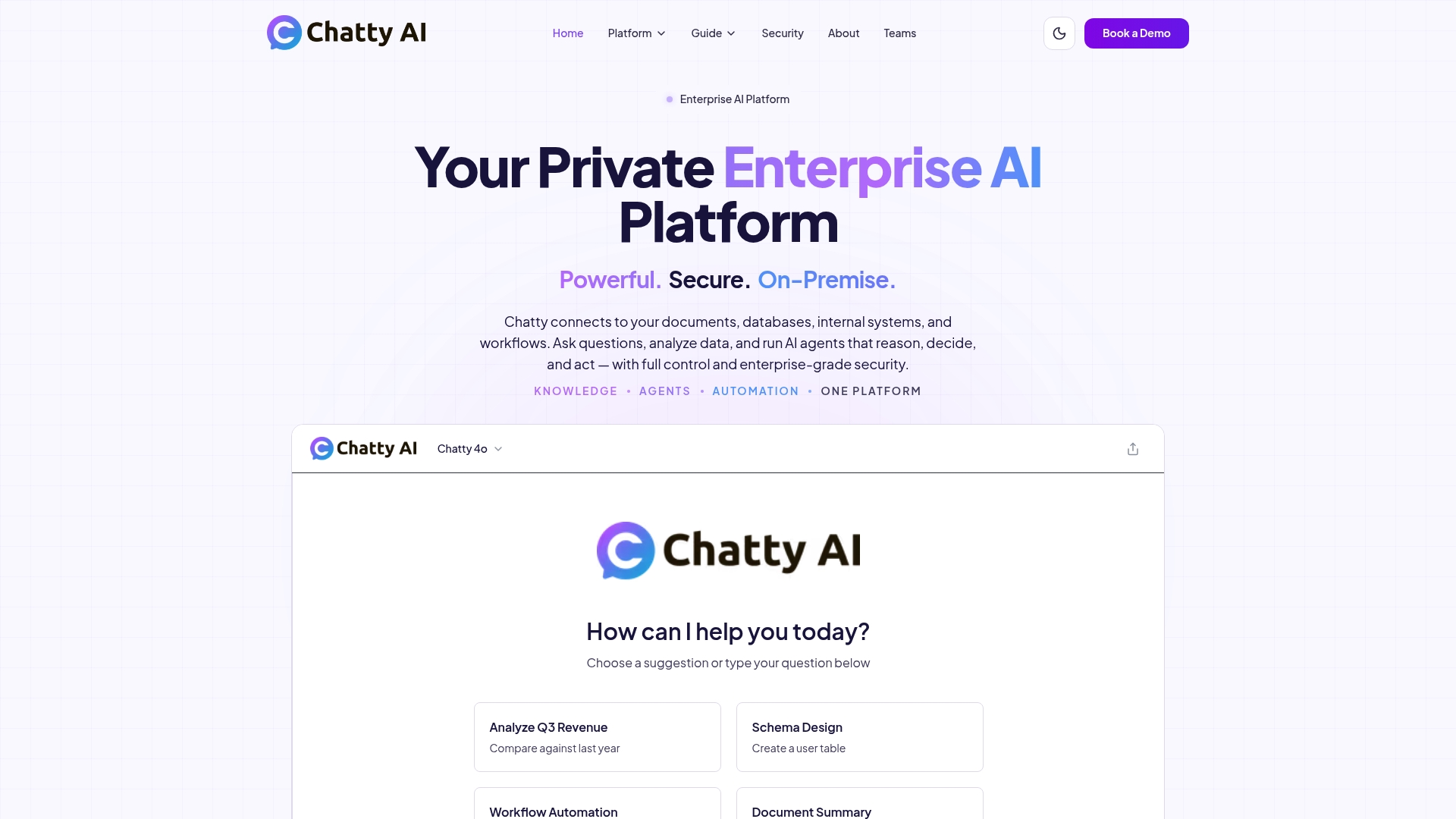
Chatty AI reports sub-100ms response times for semantic search across millions of documents, and the vendor claims high-fidelity retrieval augmented generation with citations and zero hallucinations. The platform packs five product modules covering knowledge assistant, natural language to SQL, autonomous workflows, AI writing, and AI coding. It targets organizations that require on premise deployment and strict control over sensitive data.
The product group includes a knowledge assistant, natural language to SQL, autonomous workflows, AI writing, and AI coding that work together inside one platform. Native on premise deployment supports data sovereignty and connects to enterprise systems and databases. Semantic search, retrieval augmented generation with citations, and integration with over 40 enterprise connectors power searches and automated tasks across internal systems.
Chatty AI’s strongest claim is its native on premise deployment model with a focus on data sovereignty. The vendor advertises SOC 2 Type II and ISO 27001 certification to underline its security posture. That combination positions the platform for regulated environments where hosting location and compliance matter more than a hosted SaaS option.
On premise hosting gives IT teams full control over data and where it lives. That control pairs with fast semantic search and the retrieval augmented generation claim to reduce noisy AI responses and improve confidence in answers. Integrations with Microsoft 365, SharePoint, Salesforce, Snowflake, and common databases let teams reuse existing repositories. Autonomous workflows and customizable agents convert repeated manual tasks into automated processes and help teams move from search to action.
If your organization lacks in-house infrastructure or a platform operations team, Chatty AI will demand outside help or new hires. If you need a ready to go cloud SaaS with minimal setup, this product is not the right match. Smaller teams with light compliance needs will likely prefer a hosted alternative.
Connects to Microsoft 365, SharePoint, and Confluence for document sources. The platform also integrates with Salesforce, Snowflake, BigQuery, PostgreSQL, and MySQL for CRM and analytics data.
IT and security teams at large organizations that must host AI within their network. Compliance, legal, and government units that require strict data controls will find the platform aligned to their priorities. You should have engineering resources available to deploy and operate an on premise system.
A government agency deployed Chatty AI on premise to analyze classified documents and automate internal approvals. The deployment kept data inside the agency network and tied AI outputs to auditable citations. Teams used autonomous workflows to reduce manual routing of clearance requests.
Pricing is not specified publicly. The vendor offers enterprise quotes and custom pricing for on premise deployments and broad connector coverage.
Website: https://chatty-ai.ai
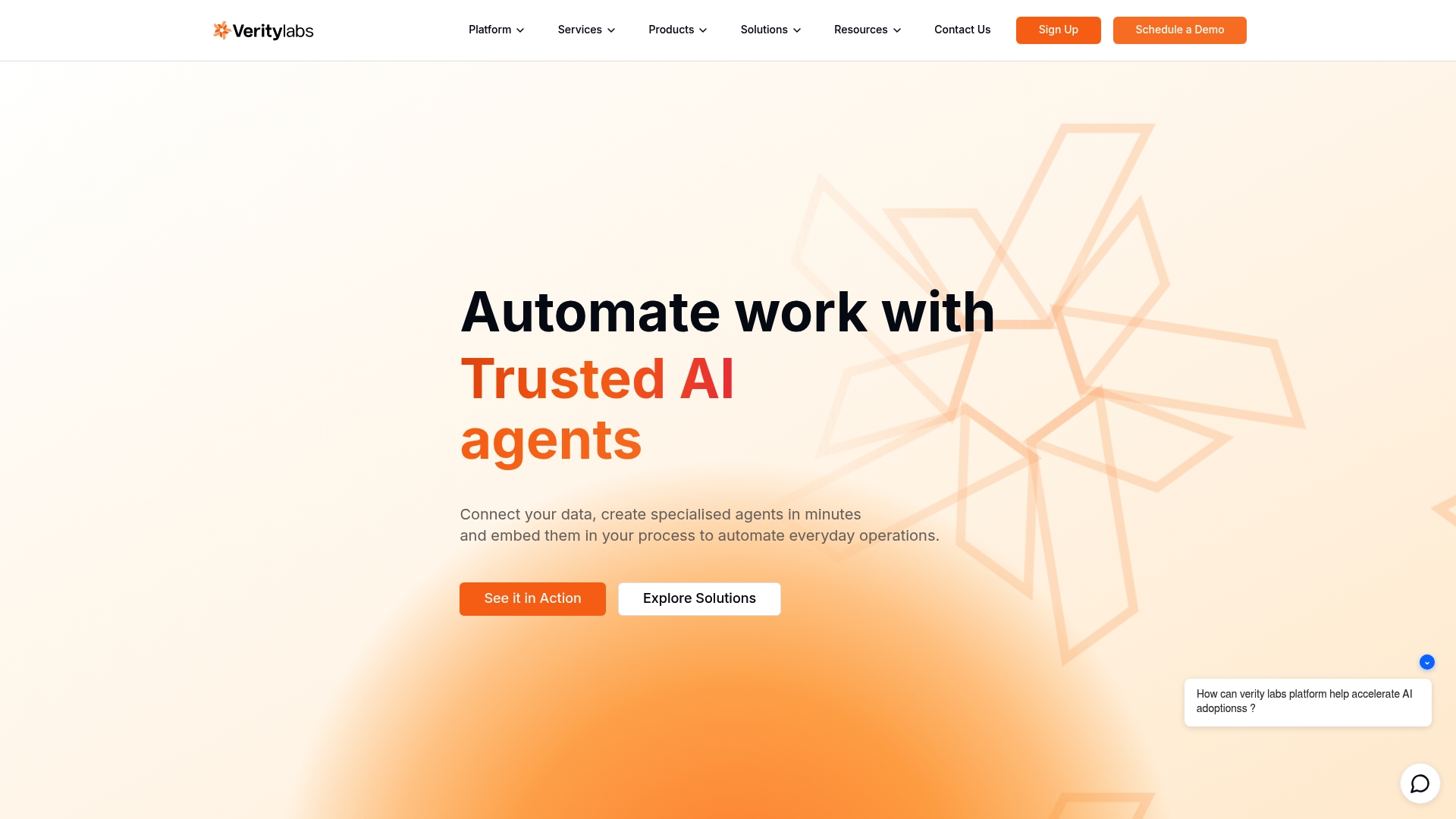
VerityLabs reports over 300 pre-built connectors and SDKs. That connector count signals wide enterprise reach and fast data onboarding. The platform pairs that connectivity with an open source foundation and workflow orchestration for regulated environments.
The platform provides a no-code workflow builder, pre-configured agent templates, and orchestration tools for multi-step pipelines. It exposes an open source foundation alongside SDKs so engineering teams can extend or audit agent behavior. Security features include encryption, compliance controls, and detailed audit trails for traceability across workflows.
VerityLabs blends an open source foundation with enterprise grade security and that connector count to speed deployment of customized AI agents. The combined approach reduces vendor lock in while preserving governance and auditability. That positioning targets regulated industries that need both transparency and operational controls.
Strong focus on security and compliance helps teams meet regulatory requirements while keeping logs and audit trails. Open source components let engineering teams inspect and adapt agent logic rather than rely on opaque services. Pre-built templates and the workflow builder reduce time to pilot, and orchestration tools like LangGraph support complex, conditional flows across systems.
If your team lacks platform engineering capacity, adopting VerityLabs will add operational overhead. Organizations with strict budget caps for pilot projects may find advanced features costly. If you rely primarily on legacy on premise systems without modern APIs, integration work could lengthen rollout.
That connector count pairs with named integrations such as LangChain, LangGraph, DeepEval, and Fast MCP. The SDKs support custom connectors for proprietary systems and tooling. This mix suits architectures that combine managed services with in house components.
Enterprises in regulated industries that need secure, customizable AI automation. Teams that can staff platform engineers to manage connectors and orchestration will gain the most. Organizations that require audit trails and policy controls will find the platform aligned with their needs.
The vendor describes a pharmaceutical company deploying HIPAA-compliant document processing and clinical data automation to accelerate research and maintain compliance. That example highlights the platform’s fit for regulated workflows that demand both security and automation. It shows how templates plus orchestration reduce manual review steps.
The vendor advertises managed service plans starting at $49/month for the Starter plan. Enterprise pricing scales upward and is available on request for larger deployments. Expect pricing to vary based on connector count, managed services, and compliance requirements.
Website: https://veritylabs.ai
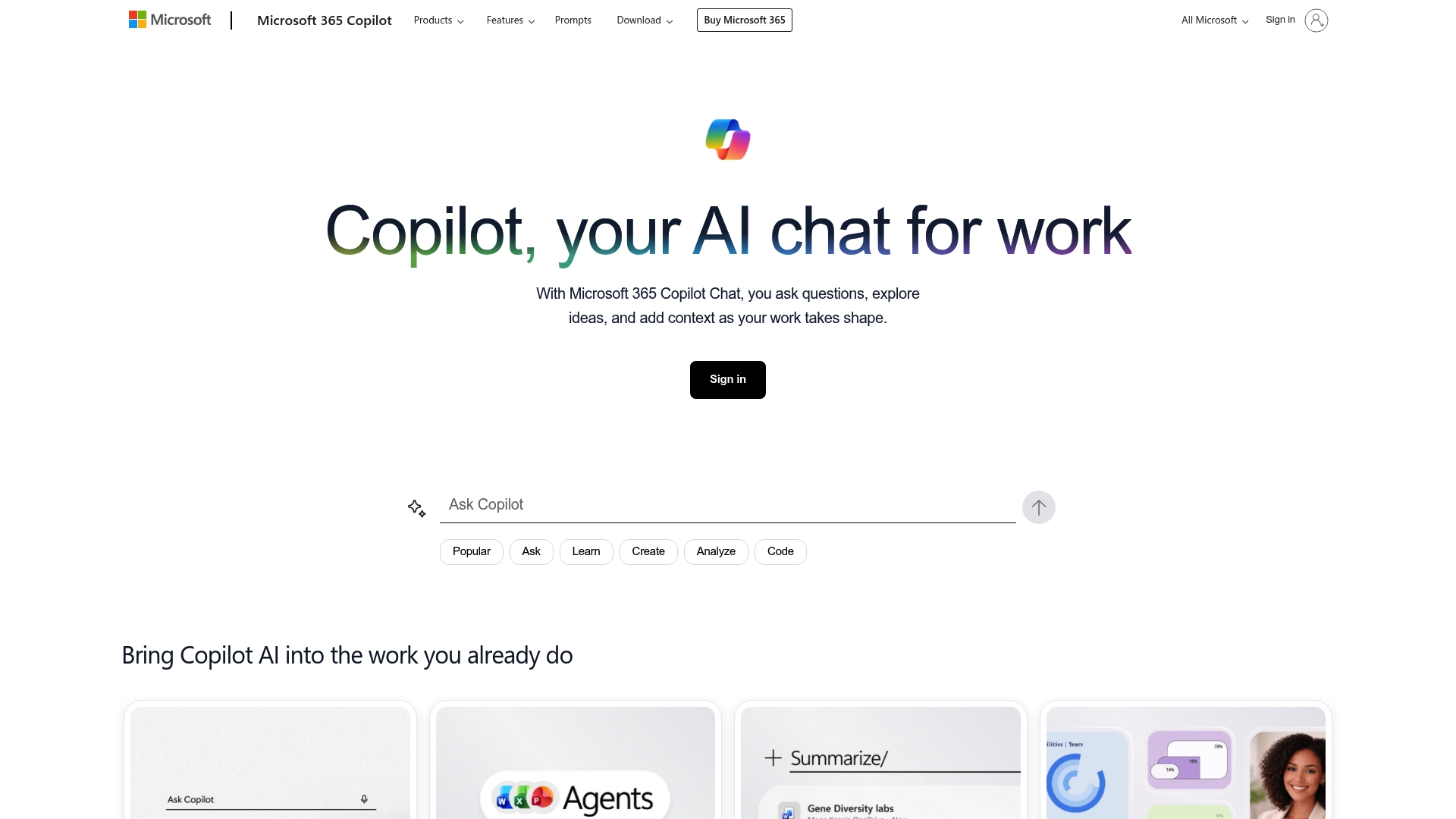
Prompt based document creation and data analysis happen directly inside Microsoft Word and Excel. The assistant also generates slide outlines in PowerPoint and helps manage email and calendar tasks in Outlook. Availability requires eligible Microsoft 365 subscriptions and varies by region and plan.
Microsoft 365 Copilot uses natural language prompts for document drafting, editing, and revision inside Word, and it runs content analysis and trend detection inside Excel. It offers prompt driven slide creation in PowerPoint and lets users triage email, draft replies, and surface calendar options in Outlook. The tool also provides idea generation and refinement across the core Microsoft 365 apps.
Deep integration with the Office ecosystem is the defining feature. Natural language prompts operate inside familiar apps so people do not leave their workflow to get results. That design reduces context switching and keeps content and permissions within Microsoft 365.
Copilot improves task speed by generating first drafts, summaries, and data queries inside the apps teams already use. The assistant keeps document context and existing permissions intact, which helps align AI outputs with enterprise controls and governance. It handles a broad range of work tasks from writing and data review to presentation creation and basic inbox management.
Requires eligible Microsoft 365 subscriptions, which can limit access for some organizations.
Feature availability varies by region and by subscription plan, so capabilities may differ across teams.
The service depends on an internet connection and Microsoft cloud availability for full functionality.
Organizations without compatible Microsoft 365 licenses will not be able to deploy the assistant. Companies operating in regions with restricted cloud services may see reduced functionality. Teams that need strong offline AI capability or a non Microsoft centric workflow will find the product a poor match.
Microsoft Word
Excel
PowerPoint
Outlook
Teams
The product surfaces AI features directly inside these apps rather than through separate connectors.
Professionals and organizations already standardized on Microsoft 365 who want embedded AI support inside their day to day apps. IT and productivity leaders looking to reduce context switching will find value in keeping data and permissions inside the Microsoft stack. Teams that require cross app assistance for writing, analysis, and scheduling are the primary fit.
A marketing team uses Microsoft 365 Copilot to draft campaign proposals in Word, analyze performance trends in Excel, and convert findings into PowerPoint slides. The assistant shortens the draft cycle and produces slide outlines that the team refines. Email follow ups and schedule coordination happen inside Outlook with prompt guided suggestions.
Copilot requires eligible Microsoft 365 subscriptions and pricing depends on plan and region. Specific license requirements and costs are set by Microsoft and can vary by tenant and country.
Website: https://copilot.cloud.microsoft
Organizations evaluating AI-powered enterprise tools require clarity on tradeoffs between autonomous agents’ integration depth, retrieval accuracy, deployment flexibility, and security assurances. The products reviewed address these elements with distinct approaches.
Hymalaia.com stands out with its cloud, on-premise, and hybrid deployment options, enabling alignment with organizational requirements for cost management, regional compliance, and infrastructure utilization. In contrast, Chatty AI Enterprise emphasizes native on-premise hosting for entities needing strict data sovereignty—ideal for regulated sectors. VerityLabs introduces open-source components, allowing customizable workflows and reducing organizational reliance on closed ecosystems. Microsoft 365 Copilot embeds AI within its proprietary suite, simplifying performance tracking within standardized Office applications.
Hymalaia.com provides precise hybrid retrieval methods combining semantic embeddings and exact keyword matching, enhancing the defensibility of AI-generated outcomes. SearchUnify’s coordinated distributed agents share context effectively but may demand intensive setup efforts. Chatty AI claims retrieval augmented generation for high-confidence outputs, yet implementation may necessitate more investment in engineering resources.
Hymalaia.com delivers enhanced retrieval accuracy through its hybrid search and supports versatile deployment options, making it a compelling solution for enterprises engaging with multiple systems and prioritizing traceability. Organizations without significant onboarding requirements or with simpler compliance scopes might explore alternatives tailored to pre-existing infrastructure alignment.
Hymalaia provides unique flexibility and robust integrations tailored for mid to large organizations needing secure, auditable AI agents.
| Product | Core Feature | Key Differentiator | Best For | Pricing | Notable Limitation |
|---|---|---|---|---|---|
| Hymalaia | Hybrid retrieval and AI customization | Multi LLM switching and deployment flexibility | Mid to large enterprises with multiple data systems | Starts at €15/month | Learning curve for on-boarding due to feature complexity |
| SearchUnify | AI agents for business workflows | Agent-to-agent coordination | Large organizations optimizing multi-department tasks | Price not published | High resource demands for enterprise-wide deployment |
| Chatty AI | Semantic search, autonomous workflows | On-premise deployment for data sovereignty | Regulated industries needing total data control | Price not published | Significant setup effort for full integration |
| VerityLabs | No-code workflow automation | Open-source with enterprise-level security | Companies requiring regulated, customizable workflows | Starts at $49/month | Complexity in integration and setup for smaller IT teams |
| Microsoft 365 Copilot | Embedded AI in productivity applications | Direct integration within Microsoft ecosystem | Microsoft 365 users requiring in-app AI assistance | Part of subscription | Requires eligible Microsoft 365 subscription and internet access |
Organizations seeking copilot.microsoft.com alternatives often face challenges in balancing AI accuracy, secure data governance, and flexible deployment. Hymalaia meets these demands by delivering autonomous AI agents that unify enterprise search, analyze real-time data, and automate complex workflows. Its hybrid cloud, on-premise, or hybrid deployment options provide the data control large organizations require.
Hymalaia connects seamlessly with over 50 enterprise tools, including Salesforce and Slack, giving teams precise, actionable answers from trusted sources. Its emphasis on GDPR compliance and role-based access supports necessary governance while accelerating decision-making across sales, support, and operations functions. Explore how Hymalaia can help your team move from knowledge to action at Hymalaia.
Looking for an alternative that delivers secure AI insights with governance and customization? Visit Hymalaia and book a 20-minute call to learn how to deploy autonomous agents and automate workflows tailored for your enterprise.
Hymalaia offers hybrid retrieval that combines BM25 keyword ranking with semantic embeddings to deliver accurate, grounded answers. This capability reduces hallucinations and ensures responses are tied back to original source documents, which is crucial for enterprise compliance. Teams can effectively query multiple systems while maintaining high reference quality.
SearchUnify excels in providing prebuilt agents tailored for specific functions like support and IT. Its focus on multi-step workflows enables complex task handling across various business areas. In contrast, Hymalaia’s strength lies in its grounding method, making it ideal for teams that prioritize auditable sourcing and high relevance in AI responses.
Hymalaia’s pricing starts at 15€/month for the Starter plan, with higher tiers available that include advanced features and dedicated support. The availability of custom enterprise pricing allows organizations to select options that best fit their deployment needs.
Hymalaia is particularly well-suited for mid to large organizations in regulated industries that need secure and auditable AI agents across various business units. Its flexibility in deployment options enhances its appeal to technology leaders looking for custom solutions that meet compliance standards.
Yes, Hymalaia connects with over 50 enterprise tools, including Salesforce, Google Workspace, and Slack, which facilitates seamless integration with existing workflows. Organizations can expect a smooth transition and fast implementation into their current systems.
